
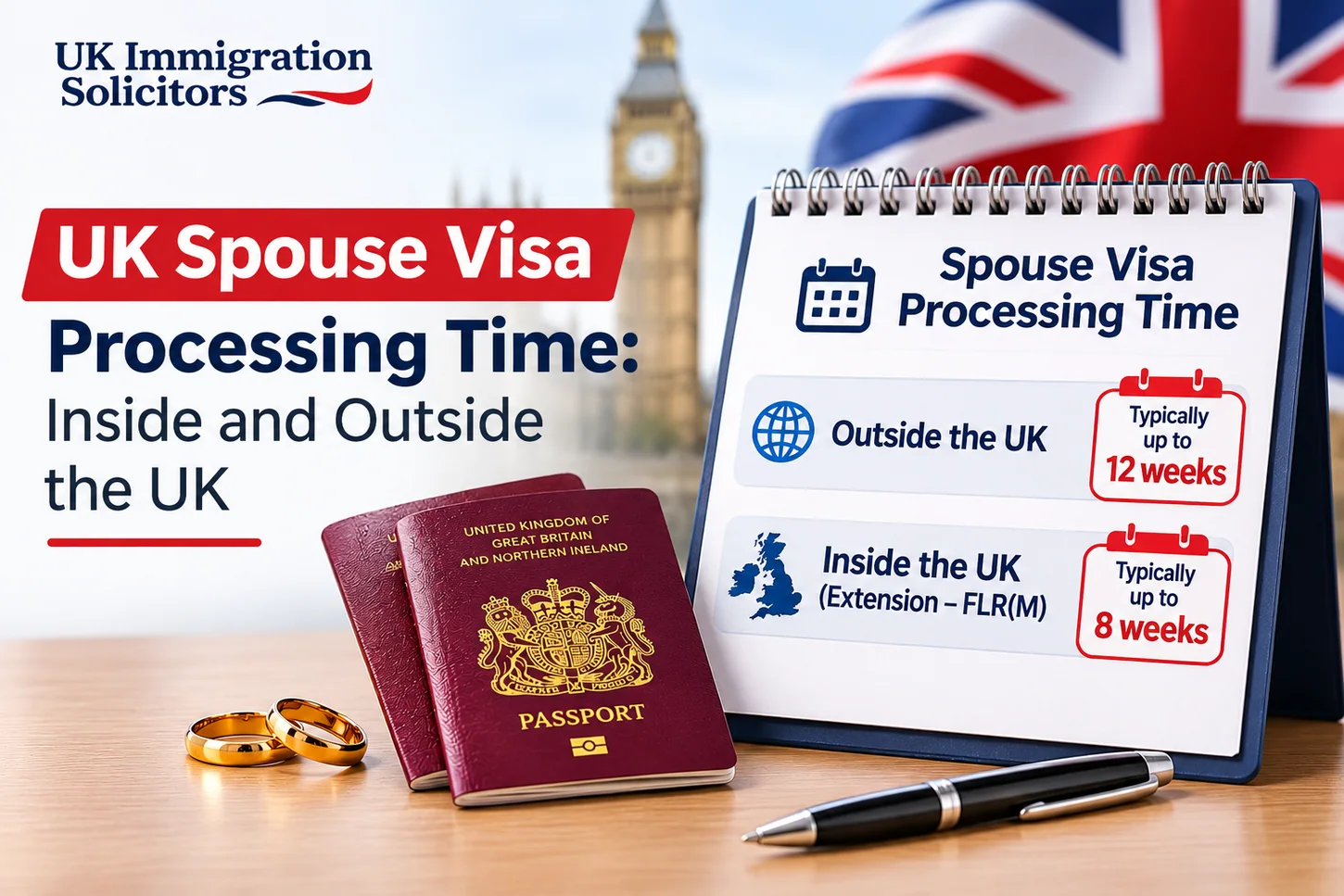
The UK spouse visa processing time depends on where you apply, which family route applies and whether you use a faster-decision service.
As at November 2026, UKVI says a standard spouse or partner application made outside the UK usually takes 12 weeks. A standard in-country spouse or partner application that meets the financial and English-language requirements usually takes 8 weeks. Certain in-country partner or private-life applications currently take around 12 months, although there is no formal service standard for that category.
Those figures are not guaranteed individual decision dates. Your application can take longer if UKVI needs additional evidence, checks your documents or immigration history, or encounters operational delays.
This guide explains the current processing times, when UKVI starts counting, priority and super-priority options, where delays arise and what to do if your application goes beyond the expected timeframe.
UK spouse visa processing times at a glance
The first question is whether you applied from outside or inside the UK.
| Application type | Current published processing time | Service standard |
|---|---|---|
| Spouse or partner application from outside the UK | Usually 12 weeks | 12-week family service standard |
| In-country spouse or partner application meeting the minimum income and English-language requirements | Usually 8 weeks | 8-week service standard |
| In-country partner/private-life application where the minimum income and English-language requirements are not required | Around 12 months | No formal service standard |
UKVI’s current family customer-service standards confirm the 12-week outside-UK standard and 8-week in-country standard for qualifying partner applications. It also confirms that there is no equivalent service standard for the longer partner/private-life category.
Processing time does not mean a guaranteed deadline
Published processing times tell you what UKVI currently expects for the relevant category.
They do not guarantee that:
- your application will be decided by a particular date
- the application will be approved
- UKVI will refund you merely because the target is missed
- a complex case will necessarily take longer than a straightforward one.
The correct approach is to identify your route and processing-start date before deciding whether the application is genuinely delayed.
UK spouse visa processing time from outside the UK
A spouse or partner application made from outside the UK currently usually takes 12 weeks.
That is the main standard to use for a typical overseas spouse visa application unless you paid for an eligible faster service.
When does the 12-week period start?
UKVI says processing starts once you either:
- verify your identity and submit the required documents and application using the UK Immigration: ID Check app, if you are told to use it
- attend the visa application centre and provide your biometric information.
For many overseas spouse applicants, the biometric appointment is therefore the most useful date for checking whether the current 12-week period has passed.
What does not necessarily start the processing clock?
Do not automatically count from:
- the day you created an online account
- the first day you started filling in the form
- the day you first uploaded one document
- a provisional appointment-booking date.
The relevant processing point depends on how UKVI required you to prove your identity and complete the application process.
Should you book travel while waiting?
UKVI advises applicants not to book travel before receiving a decision. It also states that it will not reimburse travel costs or other expenses simply because processing takes longer than expected.
If an important family event or other urgent circumstance depends on the decision, explain that when seeking advice rather than relying on the 12-week figure as a guaranteed travel date.
UK spouse visa processing time from inside the UK
In-country family applications need to be divided into different categories.
Standard spouse or partner applications
If you apply inside the UK as a spouse or partner and meet the financial and English-language requirements, UKVI currently says you will usually receive a decision within 8 weeks.
This is the relevant standard for many ordinary spouse visa extensions and eligible in-country partner applications.
Partner or private-life applications with a longer timeframe
Where an in-country partner application proceeds on the basis that the minimum income and English-language requirements are not required, the current published processing time is around 12 months.
UKVI specifically states that there is no formal service standard for this partner/private-life category. The 12-month figure reflects the current volume of cases rather than an 8-week-style service commitment.
Why this distinction matters
An applicant waiting 10 weeks may be beyond the ordinary 8-week spouse standard.
Another applicant waiting 10 weeks on the partner/private-life route may still be well within the current 12-month indication.
Before escalating a delay, identify the actual route used in the application.
If you are unsure whether your application is in the ordinary partner category or the longer family/private-life category, have the form and basis of application checked before assuming UKVI is late.
What is a UKVI service standard?
A service standard is the period UKVI uses as a customer-service target for a particular application category.
It is different from a guaranteed decision date.
For example:
- ordinary partner applications outside the UK currently have a 12-week family service standard
- qualifying ordinary partner applications inside the UK have an 8-week standard
- the longer partner/private-life category has a current processing estimate but no formal service standard.
This distinction matters when assessing a delay.
Service standard versus current processing estimate
A service standard is a formal target attached to the category.
A current processing estimate may simply tell applicants how long the category is presently taking.
Neither automatically means that every case will be completed within that period.
What happens if UKVI misses the service standard?
Missing the standard does not automatically mean:
- the application must be granted
- the fee must be refunded
- UKVI has made a legal error
- a complaint or legal challenge will immediately produce a decision.
It does mean that you should check the case history, any delay notice and whether UKVI has requested further information.
When does UK spouse visa processing time start?
The correct starting point depends on the application method.
| Application method | Starting point to check |
|---|---|
| Outside UK through a visa application centre | Biometric appointment / identity appointment |
| Outside UK using the ID Check app | Completion of the required identity and document-submission process |
| Inside UK | Relevant application and identity-completion stage for the service used |
For overseas applications, UKVI expressly says processing starts once identity has been verified through the app or the applicant attends the VAC for biometrics.
Submission date and processing-start date are not always the same
Starting the application online is not the same as UKVI beginning to process it.
Similarly, paying the application fee does not necessarily mean the processing period should be counted from that date.
Keep records of:
- online submission
- payment
- biometric appointment
- ID Check completion
- document submission
- any UKVI confirmation.
That allows you to identify the relevant date accurately if the application later appears delayed.
How long after biometrics does a spouse visa decision take?
There is no separate guaranteed rule saying that a spouse visa must be decided a fixed number of days after biometrics.
Instead, biometrics often help establish when UKVI begins processing.
For a standard overseas spouse application, use the current 12-week family processing period as the main guide.
For a qualifying in-country spouse or partner application, use the current 8-week period.
Where the application is in the longer partner/private-life category, the current indication is around 12 months.
Do not confuse a biometrics appointment with approval or with the end of the evidential assessment.
Is priority service available for UK spouse visas?
Faster-decision services can be available, but availability differs between applications inside and outside the UK.
Priority spouse visa service outside the UK
For family visa applications made outside the UK, the current priority service usually aims for a decision within 30 working days.
The additional priority-service fee is currently £500.
Whether the service is offered depends on the visa, application centre and identity process.
Super priority outside the UK
Where available for the relevant visa, super priority usually aims for a decision by the end of the next working day.
The availability of super priority can depend on the visa application centre or the online identity process.
Do not assume every overseas spouse visa centre offers it.
Faster decisions for in-country family visas
The faster-service options available inside the UK are different from those outside the UK.
If a faster service is offered for your family application, check the exact option shown during the application and appointment process.
Do not assume that the five-working-day priority option available for some routes also applies to every in-country spouse application.
Faster processing does not improve approval prospects
Priority changes the intended decision timetable.
It does not:
- lower the financial requirement
- reduce the relationship evidence required
- waive suitability checks
- guarantee approval
- prevent UKVI from taking longer if further enquiries are necessary.
Should you pay for priority or super priority?
The answer depends on urgency and application readiness.
Priority may be useful where a faster decision has genuine value and the application is ready to submit.
However, paying for speed does not solve an evidential problem.
Before purchasing a faster service, check:
- whether the correct service is available
- whether all required documents are ready
- whether the financial evidence period is complete
- whether relationship dates and addresses are consistent
- whether there is complex immigration or criminal history
- whether UKVI is likely to require further verification.
If waiting a little longer would produce a stronger application, for example, completing a required financial evidence period, speed should not automatically take priority over eligibility.
What can delay a UK spouse visa application?
UKVI states that applications can take longer where further information or additional checks are required. Increased demand and technical outages can also affect processing.
Common areas that can lead to additional work include:
| Possible delay | What may need checking |
|---|---|
| Financial evidence | Employment, savings, self-employment or company records may need verification. |
| Relationship evidence | UKVI may need to assess periods apart, limited records or inconsistent dates. |
| Further-document request | More evidence or clarification may be needed. |
| Immigration history | Previous refusals, overstaying or complex records may require further checks. |
| Suitability issues | Criminal or other background matters can require additional consideration. |
| Document verification | Banks, employers or civil-status records may need checking. |
| Identity issues | UKVI may need further identity or biometric information. |
| Complex family circumstances | Children, parental responsibility or unusual living arrangements can add questions. |
| Technical or operational problems | Systems issues or increased application volumes can affect the timetable. |
Does complex evidence always cause a delay?
No.
A complicated application can still be decided within the normal timeframe.
A straightforward application can sometimes take longer.
The important point is that complexity increases the possibility of additional enquiries; it does not determine the outcome or timetable automatically.
Does a well-prepared application guarantee a faster decision?
No.
Good preparation can reduce avoidable problems, but applicants cannot control UKVI workload, verification checks or operational issues.
The benefit of preparation is a clearer and better-supported application, not a guaranteed decision date.
Can financial evidence delay a spouse visa?
It can where UKVI needs additional verification or clarification.
Potential issues include:
- inconsistent salary figures;
- missing payslips;
- bank credits that do not reconcile with the evidence;
- recent employment changes;
- incorrect Category A or B calculations;
- self-employment accounts;
- company ownership questions; or
- the source and holding period of cash savings.
A financial query does not necessarily mean refusal.
However, financial evidence is often technical, so check the category and calculation before submitting.
For detailed help, read our UK spouse visa financial requirement guide.
Can relationship evidence delay an application?
Relationship evidence can require further consideration where the couple’s circumstances are not immediately clear.
Examples include:
- living in different countries;
- relatively short relationship history;
- inconsistent first-meeting or marriage dates;
- long periods between visits;
- missing communication records; or
- unclear address history.
Delay does not itself mean that UKVI believes the relationship is not genuine.
It may simply mean the evidence requires closer assessment.
Our spouse visa relationship evidence guide explains how to present periods living apart, relationship timelines and evidence gaps clearly.
What happens if UKVI asks for more documents?
Read the request carefully before responding.
Identify:
- exactly what UKVI is asking for;
- the deadline;
- which period or issue the request concerns;
- how you must submit the response; and
- what proof of submission you can retain.
Do not respond with a large unrelated document bundle simply because the application is delayed.
Does a further-document request restart the processing clock?
There is no simple universal rule that every further-document request restarts the entire published processing period.
It can, however, make the practical decision process longer.
The effect depends on what UKVI needs and how quickly the requested information is supplied.
Will UKVI always ask before refusing?
No.
Do not submit an incomplete application on the assumption that UKVI will necessarily give you another opportunity to provide missing evidence.
Where a required document or eligibility issue is unresolved before submission, address it then.
When is a spouse visa application actually delayed?
Before treating the case as overdue, check five things:
- Which route did you use?
- Did you apply inside or outside the UK?
- What is the correct processing-start date?
- Did you use a priority service?
- Has UKVI already told you that the application will take longer?
For an overseas spouse application, compare the case with the current 12-week family timing.
For an ordinary in-country spouse application meeting the standard financial and English requirements, compare it with the current 8-week standard.
For a partner/private-life application, remember that the current indication is around 12 months and there is no formal service standard.
What should you do if your spouse visa is taking too long?
Check all correspondence
Review:
- the email account used in the application;
- spam and junk folders;
- messages from the visa application centre;
- UKVI requests;
- delay notifications; and
- any correspondence sent to a representative.
A missed document request can create a much more serious problem than the delay itself.
Confirm the processing category and start date
Do not contact UKVI saying the application is 15 weeks old if the 15 weeks are being counted from an incorrect date.
Create a short chronology:
| Event | Date |
|---|---|
| Online application submitted | |
| Application fee paid | |
| Biometrics / identity check | |
| Priority service purchased | |
| Further documents requested | |
| Response submitted | |
| UKVI delay notice | |
| Most recent contact |
Contact UKVI when appropriate
Current outside-UK processing guidance says that if the application has taken longer than the published processing time and UKVI has not contacted the applicant to explain that it will take longer, the applicant should contact UKVI.
Keep the enquiry factual. Include the application reference and relevant dates.
When legal advice may be useful
Consider advice where:
- the case is substantially beyond the published timeframe;
- UKVI correspondence is unclear;
- there is an urgent care or family issue;
- an in-country applicant is unsure about their immigration status;
- UKVI has repeatedly requested complex evidence;
- previous enquiries have not clarified the position; or
- a prolonged delay is causing a significant practical or legal problem.
Legal assistance cannot guarantee that UKVI will make an immediate decision.
The value is in identifying whether the delay is genuinely abnormal and what next step is proportionate.
Can a delayed spouse visa application be escalated?
Sometimes, but escalation should match the problem.
Possible steps can include:
- a UKVI enquiry;
- a complaint about service where appropriate;
- asking an MP for assistance in suitable circumstances; or
- obtaining legal advice in unusually prolonged or urgent cases.
A complaint does not decide the immigration application
A service complaint and the immigration decision are separate.
Complaining about delay does not mean the application will be approved or automatically moved to the front of the queue.
Judicial review is not a routine delay procedure
Judicial review is a specialist public-law remedy and should not be treated as the normal next step simply because the published service standard has been exceeded.
Where a delay becomes exceptionally prolonged or legally significant, tailored advice is required.
Can you track a UK spouse visa application?
Tracking is limited.
Applicants may receive updates through UKVI, the application centre or the relevant online service, but there is usually no detailed live dashboard showing exactly which caseworker has the application or how many days remain.
An “under consideration” message generally confirms that the application remains pending. It does not provide a reliable prediction of the decision date.
Repeatedly contacting UKVI does not generally make an application move faster.
What UKVI messages should you watch for?
Monitor correspondence for:
- biometric or identity-check instructions;
- requests for additional documents;
- requests for clarification;
- notices that the application will take longer;
- decision emails;
- passport return or collection instructions where relevant.
Keep the email account active until the process is complete.
If a representative supplied their contact details, confirm who is monitoring correspondence and how messages will be shared with you.
What happens if your current visa expires while you are waiting?
For some in-country applicants, section 3C leave can extend existing permission while an application remains undecided.
It applies where, among other things:
- the person had limited leave;
- they made an application to vary that leave before it expired;
- their permission expired before the application was decided; and
- the application remains undecided and has not been withdrawn.
Do your existing work rights continue?
Where section 3C applies, the existing conditions of leave generally continue.
That can include existing work conditions.
Submitting a spouse application does not automatically give someone new or unrestricted work permission.
Do not assume every pending application creates section 3C leave
Late, invalid or otherwise different applications may have different consequences.
If your current immigration permission has expired or is approaching expiry, check the status position rather than relying on a generic processing-time article.
Can you travel while an in-country spouse application is pending?
Travel can have serious consequences for an in-country application.
Section 3C leave ends if the person leaves the UK.
The effect of leaving the UK can also depend on the particular pending application and destination.
Do not book travel during an in-country spouse or partner application without checking the procedural consequences first.
For detailed in-country guidance, read our FLR(M) form and evidence guide.
Do weekends and bank holidays count?
For standard outside-UK processing times, UKVI says processing is based on the UK working week from Monday to Friday and includes UK public holidays in the published calculations. It does not include public holidays in other countries.
Faster-decision services use working-day targets.
Do not manually add or subtract days from a published timeframe unless the particular service explains how its working-day calculation operates.
First spouse visa versus spouse visa extension processing time
These applications should not be treated as the same timing category.
| Application | Main timeframe to check |
|---|---|
| First spouse visa from outside the UK | Current outside-UK family visa processing time |
| In-country spouse extension meeting standard requirements | Current in-country partner processing time |
| In-country partner/private-life application | Current longer family/private-life indication |
| Settlement / ILR | Separate settlement processing rules |
The immigration route matters more than the informal label used by the applicant.
For example, calling every in-country family application a “spouse visa extension” can lead to an incorrect expectation of an 8-week decision.
Does a previous refusal make a new spouse visa application slower?
Not automatically.
A fresh application starts a new decision process.
However, the previous refusal may create additional issues that need to be addressed, such as:
- an earlier financial finding;
- relationship concerns;
- immigration-history issues; or
- inconsistencies between applications.
A previous refusal should therefore be reviewed before submitting again, but it does not create a universal longer processing standard.
Read our guide on what happens after a UK spouse visa refusal for the next-step issues.
Do self-employed spouse visa applications take longer?
There is no separate published processing standard solely because the sponsor or applicant is self-employed.
However, self-employment can involve more complex financial evidence, including tax records, business accounts, bank statements and evidence of ongoing trading.
If UKVI needs additional verification, the practical decision time can increase.
That does not mean every self-employed application will be delayed.
For detailed financial preparation, read our self-employed spouse visa guide.
Do applications with children take longer?
There is no general published rule saying that a spouse visa application automatically takes longer because dependent children are included.
More complicated parental circumstances can, however, require additional assessment.
Examples include:
- children living with another parent;
- questions about parental responsibility;
- dependency concerns; or
- inconsistent family information.
Make sure each child’s circumstances are accurately explained and evidenced.
Worked example: overseas standard spouse visa
This is a fictional timing example, not a guaranteed decision date.
Amir submits his spouse visa application online and attends his biometric appointment on 7 September 2026.
He uses the standard service. UKVI does not request further documents or tell him that additional time is required.
For timing purposes, Amir should focus on the biometric appointment as the relevant processing-start point and assess the application against the current 12-week outside-UK family processing time.
He should not count from the earlier date on which he first created the online application.
If the current processing period passes without a decision or delay communication, he can then consider the appropriate UKVI enquiry.
The 12-week indication still does not guarantee that Amir will receive a decision on one particular calendar day.
Worked example: in-country spouse extension
Sara submits a valid spouse extension before her existing leave expires.
Her application meets the standard financial and English-language requirements and falls within the ordinary in-country partner category.
The current published processing time is 8 weeks.
Her existing permission expires while the application remains undecided.
Sara checks whether section 3C applies rather than assuming her right to stay and work from the simple fact that the application is pending.
If she reaches 10 weeks without a decision, she checks for:
- a document request;
- a UKVI delay notice;
- the correct processing-start date; and
- any communication sent to her representative.
Only then does she assess whether further contact is appropriate.
Worked example: further evidence causes a longer wait
Daniel applies from outside the UK using the standard spouse route.
Several weeks later, UKVI asks for further evidence explaining an employment payment.
Daniel responds within the deadline and retains proof of submission.
His case later takes longer than he originally expected.
It would be misleading to assess the delay solely by counting weeks from biometrics and ignoring the additional evidence request.
Instead, he keeps a chronology showing:
- biometrics
- UKVI request
- response date
- any later correspondence
- the current published processing standard.
That gives a much clearer basis for deciding whether the case needs further action.
How can you reduce avoidable spouse visa delays?
You cannot control UKVI workload, caseworker allocation or external verification.
You can reduce avoidable problems before submission.
Check:
- you are using the correct application
- identity and biometric steps are completed
- names and dates agree across the form and evidence
- the correct financial category is used
- the required financial period is fully evidenced
- translations meet the applicable requirements
- relationship evidence explains relevant periods apart
- document scans are readable
- any previous refusal or immigration history is disclosed accurately
- the email account used in the application is monitored.
A clear application cannot guarantee a faster decision, but it can reduce the risk of preventable evidence queries.
UK spouse visa processing time FAQs
How long does a UK spouse visa take from outside the UK?
The current published processing time for a spouse or partner family visa from outside the UK is usually 12 weeks.
How long does a spouse visa extension take inside the UK?
An in-country spouse or partner application meeting the minimum income and English-language requirements currently usually takes 8 weeks.
Why can some in-country partner applications take around 12 months?
Partner/private-life applications where the minimum income and English-language requirements are not required currently have an approximate 12-month processing time. UKVI states that there is no formal service standard for that category.
When does UKVI start counting the processing time?
For overseas applications, UKVI generally begins processing once the applicant verifies identity through the app and submits the required application information, or attends the visa application centre for biometrics.
How long after biometrics will I receive a decision?
There is no separate guaranteed number of days after biometrics. Use the processing timeframe for your application category.
Does paying the visa fee start the processing clock?
Not necessarily. Paying is one part of the process. The relevant processing-start point depends on the identity and application process used.
Is priority available for spouse visas outside the UK?
It can be. UKVI currently says family visa applications using priority outside the UK usually receive a decision within 30 working days, where the service is offered.
Can priority take longer than 30 working days?
Yes. Priority is a target rather than a guaranteed decision deadline. Additional checks can still extend the process.
Is super priority available for spouse visas?
It may be available for eligible applications. Availability depends on the route, location and identity process. Where offered outside the UK, super priority generally aims for a decision by the end of the next working day.
What causes spouse visa delays?
Possible causes include additional evidence requests, financial or relationship verification, immigration-history checks, document authentication, technical problems and increased application demand.
Does a request for more documents mean the visa will be refused?
No. It means UKVI wants additional information before completing the assessment. Respond accurately and within the stated deadline.
Does a document request restart the processing clock?
There is no universal rule that every request restarts the full processing period. It can, however, make the practical wait longer.
Can I track my spouse visa?
You can monitor UKVI and visa-application-centre updates, but there is generally no detailed live tracker showing exactly how far a caseworker has progressed.
What should I do if UKVI has exceeded the published processing time?
First check your route, processing-start date and correspondence. If the current timeframe has passed and UKVI has not already explained the delay, current guidance says you should contact UKVI.
Can I stay in the UK if my visa expires while my spouse extension is pending?
Potentially, where section 3C applies because a valid, in-time application was made before existing permission expired and remains pending. The individual circumstances must be checked.
Can I work while my spouse extension is pending?
Where section 3C applies, existing conditions generally continue. A pending application does not automatically create new work rights.
Can I travel while an in-country application is pending?
Travel can affect the application and ends section 3C leave. Check the consequences before leaving the UK.
Do self-employed spouse visa applications take longer?
There is no separate official self-employed processing standard. More complicated financial evidence can sometimes require additional checks.
Does including children make processing slower?
Not automatically. Complex parental or dependency circumstances may require more assessment, but there is no universal separate spouse-processing standard merely because children are included.
Does a previous refusal make the next application slower?
Not automatically. However, the previous refusal may create issues that need additional explanation and evidence.
Can a solicitor make UKVI decide faster?
No solicitor can guarantee a faster UKVI decision. Legal assistance can help establish whether the case is genuinely delayed, identify outstanding issues and advise on proportionate next steps.
Get help with a delayed or time-sensitive spouse visa application
Before escalating a delay, establish which processing timeframe actually applies to your case.
UK Immigration Solicitors can help review the application category, processing history, UKVI correspondence and any immigration-status or urgent family issue that needs attention.
When contacting us, provide:
- whether you applied inside or outside the UK
- the application type
- application and biometrics dates
- whether priority was purchased
- the latest UKVI communication
- any request for further evidence
- any urgent immigration or family circumstances.
Call 020 3384 4389 or request a free initial assessment to discuss the support you need.
The initial assessment is with the assessments team. A solicitor consultation and substantive legal advice are separate, chargeable services. Confirm the proposed scope and fees before instructing us.
This article provides general information, not legal advice. UKVI processing times and priority-service availability can change, and individual applications may take longer than the published timeframe.