

Not Just Advice – Legal Strategy That Works
Switch UK Visa - Change Your Visa Route From Inside the UK
Want to change your UK visa without leaving the country? We can assess whether your current immigration status allows an in-country switch, identify the right new route and help you prepare a compliant application before your existing permission expires.
Get clear, regulated immigration advice on changing visa routes, switching employers, moving to a work or family visa and understanding how the change could affect your future in the UK.
Speak to a Switch UK Visa expert at 20 3384 4389 for immediate, personalised assistance.
- Excellent Reviews





- 5.0 rating


“Me and my wife used Sabz Solicitors throughout my wife’s visa process. Alanta from sabz was our case worker who was very professional and re-assuring throughout. I Honestly couldn’t recommend her expertise enough to anyone looking to take the stress away from the visa process. Thank you again Sabz and thank you again Alanta.”
Martin S.
- Excellent Reviews

4.7 (832 Reviews)







Ready to Join Your Partner in the UK? Get Help Today!
No more confusion or wasted time. Tell us about your case, and we’ll provide an expert-backed, realistic plan to secure your UK visa.
Free Spouse Visa Assessment Form
Tell me the basics of your case, and I’ll match you with the right legal strategy for success.
"*" indicates required fields

What Is UK Visa Switching?
UK visa switching means applying from inside the UK to move from one immigration route to another. Whether you can switch depends on the visa you currently hold and the requirements of the route you want to enter.
Some applicants can change routes without leaving the UK, while others must make a new application from overseas.

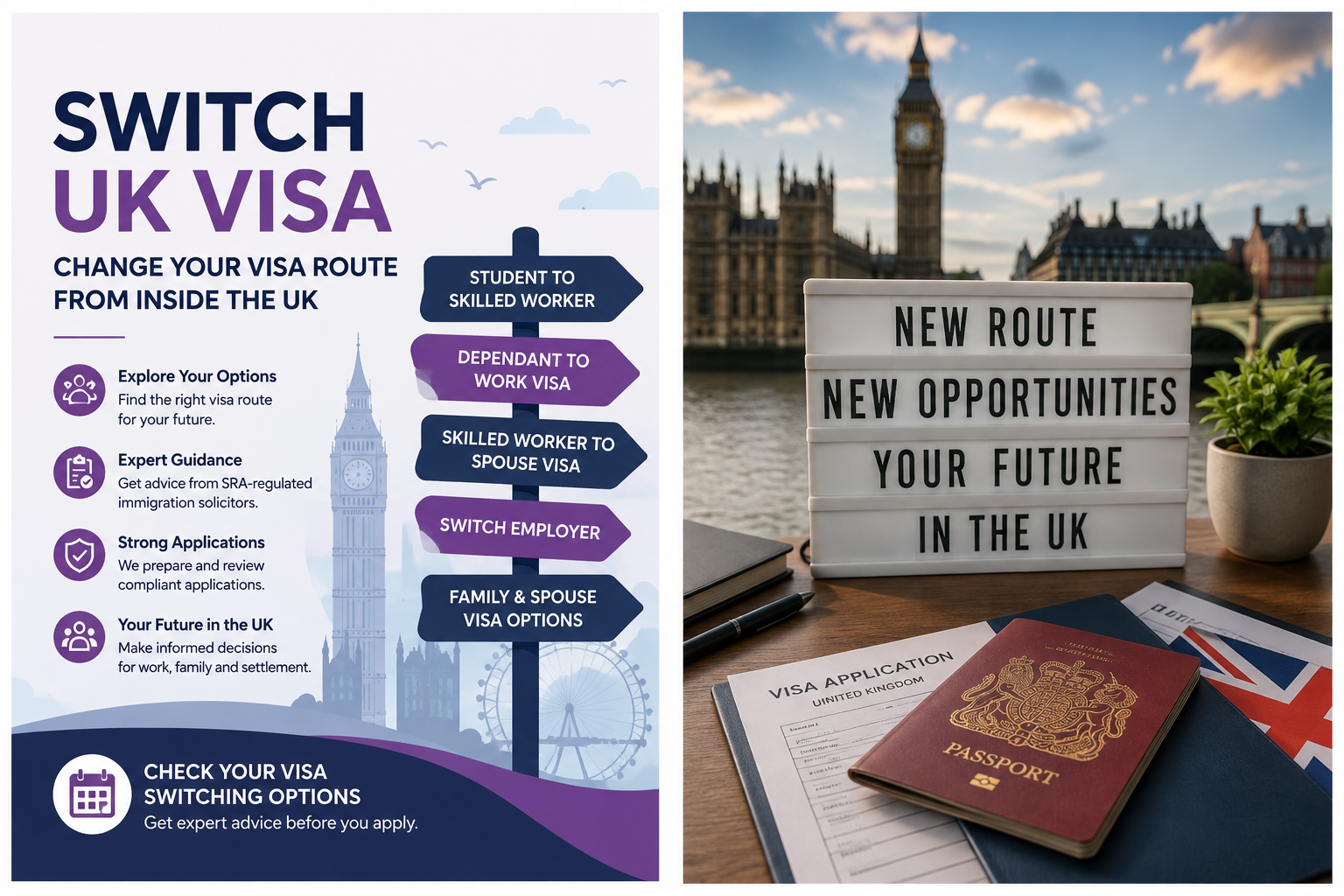
Switch UK Visa – Quick Facts
Switch Visas Within the UK
Many visa holders can apply for a different immigration route from inside the UK if their current status permits switching and they meet the new route's requirements.
Skilled Worker Visa Switching
Students, Graduates, dependants and some other visa holders may be able to switch to Skilled Worker if they have an eligible sponsored job and meet the route requirements.
Spouse and Partner Visa Switching
Some people already in the UK can switch to a qualifying Spouse or Partner Visa without leaving the country. Your current status and family-route eligibility must both be checked.
Visas With Switching Restrictions
Visitors and certain short-term or temporary visa holders cannot normally switch directly into some work or family routes from inside the UK.
Application Timing
Where an in-country switch is permitted, applying before your current permission expires can be critical to maintaining lawful immigration status while UKVI considers the application.
Settlement and ILR
Changing visa routes can affect which periods of residence count towards settlement. Check the ILR consequences before moving from one immigration category to another.
Does Switching UK Visas Affect Settlement?
Yes. Switching routes can change which time counts towards ILR and may restart a route-specific qualifying period.
Why Can a UK Visa Switch Be Refused?
Refusal can happen if switching is not permitted, eligibility is not met, evidence is missing, or suitability issues apply.
Expert Guidance
A visa switch can affect your work rights, sponsorship, family members and route to settlement. We can review the legal and practical consequences before you commit to a new application.

Benefits
Why Choose Our UK Visa Switching Solicitors?
Route Eligibility Assessment
We check whether your current immigration status allows the proposed switch and whether you meet the requirements of the new route.
Switching Strategy
We compare your available immigration options and consider how each route may affect your longer-term UK plans.
Application Review
We check the form and supporting evidence for accuracy, consistency and compliance before submission.
Settlement Planning
We consider whether changing routes could alter your qualifying period for Indefinite Leave to Remain.
UKVI Support
Where instructed, we can support your application through submission and advise on additional UKVI requests or decision issues.
Switching Visas Within the UK: Rules, Routes and Application Guidance
To switch a UK visa means applying from inside the UK to move from your current immigration route into a different route.
For example, you may want to move from a Student or Graduate Visa to a Skilled Worker Visa, change from dependant status to your own work visa, or move from a work route to a qualifying Spouse or Partner Visa.
A visa switch is a new immigration application. You must satisfy the requirements of the route you want to enter, and your current immigration status must allow you to make that application from inside the UK.
Visa Switching vs Extending Your Visa
A visa extension normally means remaining on the same immigration route for a further period.
For example, continuing on the Skilled Worker route with eligible sponsorship may be an extension or update.
Switching means moving into a different category, such as:
- Student → Skilled Worker
- Graduate → Skilled Worker
- Dependant → Skilled Worker
- Skilled Worker → Spouse or Partner
- Skilled Worker → Dependant
Visa Switching vs Updating Your Existing Visa
Not every immigration change is technically a visa switch.
A Skilled Worker who changes employer normally needs to update their Skilled Worker permission, because they remain on the same immigration route. GOV.UK requires a new application in specified circumstances, including changing employer.
Switching From Inside the UK vs Applying Overseas
If the Immigration Rules allow an in-country application from your present status, you may be able to change routes without leaving the UK.
If your current category is excluded from switching into the intended route, you will normally need to leave the UK and make the appropriate entry-clearance application from overseas.
Key point: whether you can switch depends on both your current immigration status and the visa you want next.
Can You Switch Visas Within the UK?
Many people can switch visas within the UK, but there is no general right to move from any visa into any other category.
You normally need to establish that:
- your current status permits an in-country application
- the destination route allows switching from your circumstances
- you satisfy all eligibility requirements for the new visa
- you meet any sponsorship, financial, English-language or relationship requirements
- there is no suitability issue preventing the application
- you submit the correct application before your existing permission expires where required
Your Current Visa Matters
Two applicants seeking the same new visa can have very different options.
For example, an eligible Graduate Visa holder may potentially switch to Skilled Worker from inside the UK, while a Visitor cannot normally make the same Skilled Worker switch in-country.
You Must Qualify for the New Route
Holding valid UK immigration permission does not exempt you from the requirements of the destination visa.
If you want to switch to Skilled Worker, you still need to satisfy the Skilled Worker requirements.
If you want to move to a Family Visa, you must meet the applicable family-route requirements.
Apply Before Your Existing Permission Expires
Where an in-country switch is available, applying before your present permission expires can be critical.
A valid in-time application can, in qualifying circumstances, allow your existing permission to continue under section 3C of the Immigration Act 1971 while UKVI considers the application.
Direct answer: you may be able to switch visa UK routes without leaving the country, but the answer must be checked against your current status and intended new route.
Which UK Visas Restrict Switching From Inside the UK?
Switching restrictions vary between destination routes. You should therefore check the rules of the visa you want to enter rather than relying on a universal list.
For Skilled Worker applications, the current rules prevent an in-country switch where the applicant has, or was last granted, permission as:
- a Visitor
- a Short-term Student
- a Parent of a Child Student
- a Seasonal Worker
- a Domestic Worker in a Private Household
- a person granted permission outside the Immigration Rules
Health and Care Worker rules also identify immigration bail as a status from which an in-country switch is not permitted.
Visitor Visa
A Visitor cannot normally switch directly to Skilled Worker from inside the UK.
Visitors also usually need to leave the UK before applying for a Family Visa, although limited family-route exceptions can apply.
Short-Term Student Visa
Short-term Student permission is excluded from switching into several mainstream routes, including Skilled Worker and Student.
Seasonal Worker Visa
Seasonal Workers cannot normally switch directly to Skilled Worker from inside the UK.
Parent of a Child Student Visa
This category is also excluded from in-country switching into routes including Skilled Worker and Student.
Domestic Worker in a Private Household
A person in this category cannot normally switch directly into Skilled Worker from inside the UK.
Immigration Bail
Immigration bail is not ordinary visa permission. It can prevent an in-country application under routes that expressly exclude applicants on bail.
Key point: never assume that being physically present in the UK means you are permitted to switch immigration category.
Common UK Visa Switching Routes
The following are among the most common visa switch UK scenarios. Each requires its own eligibility assessment.
Switch to a Skilled Worker Visa
You may be able to switch to a Skilled Worker Visa from inside the UK if your current immigration category permits switching and you independently satisfy the Skilled Worker requirements.
You will normally need:
- an eligible job
- an approved sponsor
- a valid Certificate of Sponsorship
- the applicable salary
- the required English-language ability
- compliance with the other Skilled Worker rules
This section gives an overview only. Detailed salary, occupation-code and sponsor requirements should sit on the site’s dedicated Skilled Worker Visa page to avoid competing with that service page.
Student to Skilled Worker Visa
A Student may be able to switch to Skilled Worker, subject to additional rules applying to people moving from the Student route. The sponsorship and job requirements must also be satisfied.
A job offer alone is not enough.
Graduate to Skilled Worker Visa
A Graduate Visa holder may potentially switch to Skilled Worker if they obtain qualifying sponsored employment.
This can be strategically important because the Graduate route is temporary, whereas Skilled Worker can provide a route towards settlement under the rules applicable to that route.
Dependant to Skilled Worker Visa
A dependant can potentially move onto their own Skilled Worker permission if they independently qualify.
This means obtaining your own sponsored immigration status, rather than continuing to rely on the main visa holder.
How to Convert a Dependant Visa to a Work Visa in the UK
If you currently hold dependant permission, you may be able to switch to your own eligible work route from inside the UK.
For a Skilled Worker application, your partner’s sponsorship does not transfer to you. You need to qualify independently.
You Need Your Own Sponsor
You will normally need your own:
- eligible job
- licensed sponsor
- Certificate of Sponsorship
- qualifying salary
- English-language evidence
- route-specific supporting documents
What Happens to Your Dependant Status?
If the work application is granted, your new immigration permission is based on your employment rather than your relationship to the previous main visa holder.
What Happens to Your Family?
If your new work route permits dependants, eligible family members may be able to make separate dependant applications.
They do not automatically switch when you change your own immigration status. GOV.UK confirms this expressly for Skilled Worker switching.
Consider Settlement Before Switching
Moving from dependant status to a work route can alter the settlement route on which you expect to qualify.
The question is not simply whether you can obtain the new visa, but whether changing route supports your longer-term immigration plans.
Can I Switch From a Skilled Worker Visa to a Dependant Visa?
You may potentially switch from Skilled Worker to dependant status if your spouse or partner holds a route that permits qualifying dependants and you meet that route’s dependant requirements.
This is a new application based on your relationship with the main visa holder.
What Happens to Your Skilled Worker Status?
Once dependant permission is granted, your immigration position is no longer based on your Skilled Worker sponsorship.
Your right to remain will instead depend on the conditions of the new dependant permission.
Can You Work as a Dependant?
Many dependant routes permit employment, but the exact conditions depend on the immigration category of the main applicant.
Check the conditions of the specific dependant route rather than assuming they are identical across the immigration system.
What Happens to Your ILR Route?
This is often the most important strategic consideration.
Time accumulated under Skilled Worker does not automatically count towards every other five-year settlement route. The relevant continuous-residence and settlement provisions must be checked before changing categories.
Switch Employer on a Skilled Worker Visa
If you already hold Skilled Worker permission and change sponsor, this is usually an update to your Skilled Worker Visa, rather than a move into a different immigration category.
A new application is normally required when changing employer.
New Sponsorship
Your new employer must meet the relevant sponsorship requirements and assign the appropriate Certificate of Sponsorship.
Changing Job With the Same Employer
A change in role can also require action where the new employment falls under circumstances requiring an updated Skilled Worker application.
The precise requirement depends on the change being made.
When Can You Start the New Job?
Do not assume that submitting the new application permits you to begin working for the new sponsor immediately.
Your existing work conditions continue while a qualifying application is pending under section 3C; they do not automatically become the conditions of the visa you are requesting.
Switch to a Spouse Visa UK
If you are already in the UK on another qualifying immigration route, you may be able to switch to a Spouse Visa or another qualifying Family Visa without leaving the country.
GOV.UK confirms that someone who came to the UK on another visa may be able to switch to a Family Visa to remain with their spouse, partner, child or parent.
Skilled Worker to Spouse Visa
A Skilled Worker with an eligible spouse or partner may potentially move to the Family Visa route.
Before switching, consider:
- Family Visa eligibility
- financial requirements
- relationship evidence
- current Skilled Worker settlement progress
- how the change affects future ILR timing
Student or Graduate to Spouse Visa
Students and Graduate Visa holders may potentially move into the Family Visa partner route where they meet the family requirements and their current immigration position permits an in-country application.
Dependant to Spouse Visa
A dependant may need to consider a Family Visa application where their partner now has a status that brings them within the family-route sponsorship rules.
Visitor to Spouse Visa
Visitors usually need to leave the UK before applying for a Family Visa, subject to limited exceptions.
For full relationship, income and partner-route requirements, link to the site’s dedicated Spouse Visa page rather than reproducing that page here.
Can an Asylum Seeker Switch to a Work Visa in the UK?
An asylum claim is not an ordinary visa category, so “switching from asylum to a work visa” is not the same as moving between two standard immigration routes.
A person with a pending asylum claim needs their underlying immigration position assessed before considering a Skilled Worker or other work application.
Can an Asylum Seeker Switch to a Skilled Worker Visa?
There is no general rule allowing every person with a pending asylum claim to simply convert that claim into Skilled Worker permission.
Relevant factors can include:
- whether the person has existing or section 3C permission
- how and when the asylum claim was made
- whether another application can validly be made
- whether the Skilled Worker validity requirements can be satisfied
- the effect of withdrawing or maintaining the protection claim
Home Office validity guidance confirms that some applications can be void rather than treated as ordinary variations, and a void application cannot extend permission under section 3C.
Permission to Work Is Not a Skilled Worker Visa
Some asylum seekers may receive limited permission to work while their asylum claim is outstanding.
That permission does not give the person Skilled Worker immigration status.
Current Home Office guidance treats permission to work for asylum seekers as a separate regime.
What About a Recognised Refugee?
A recognised refugee has immigration permission and generally has access to employment without needing Skilled Worker sponsorship merely to take a job.
Moving voluntarily from protection status into another immigration route can have significant consequences and should be considered carefully.
Key point: asylum-to-work cases require individual legal analysis. They should not be presented as routine visa switches.
What Do You Need to Switch a UK Visa?
There is no universal “visa switching checklist”. The documents and requirements are determined primarily by the route you are moving into.
Current Immigration Status
You should identify:
- your present immigration category
- expiry date
- any switching restriction
- any pending application
- whether section 3C leave applies
- previous UKVI decisions relevant to the new application
Eligibility for the New Visa
You must meet the destination route’s substantive requirements.
Sponsorship
Where the new visa is sponsored, you may need an eligible sponsor and sponsorship documentation.
Financial or Salary Requirements
Work, family and study routes use different financial tests.
Do not apply the requirements of your current visa to the new category.
English-Language Requirement
The required standard varies by route and application history.
Relationship Evidence
If you are moving to a family-based route, you may need evidence demonstrating the qualifying relationship and sponsor status.
Supporting Documents
Depending on the application, documents can include:
- passport or travel document
- current immigration-status evidence
- Certificate of Sponsorship
- employment and salary information
- financial evidence
- English-language evidence
- relationship documents
- dependant documents
- previous Home Office decisions
- certified translations
Key point: your evidence should prove the requirements of the new visa, not simply demonstrate that you currently live lawfully in the UK.
How to Switch Your Visa From Inside the UK
Step 1: Confirm That Your Current Status Permits Switching
Check the destination route’s in-country switching restrictions.
Step 2: Confirm the Correct New Visa
Compare your available routes rather than choosing solely on the basis of immediate eligibility.
Consider work rights, dependants and settlement.
Step 3: Check the New Visa Requirements
Review the current Immigration Rules and official route guidance.
Step 4: Prepare the Supporting Evidence
Create a route-specific evidence list.
Step 5: Complete the Correct Online Application
Use the in-country application process for the route you are moving into.
Step 6: Pay the Required Charges
A visa switch is normally a new application, so a new application fee will generally be payable.
The Immigration Health Surcharge may also apply unless the destination route or applicant is exempt. Most immigration applications currently attract an IHS rate of £1,035 per year, while the reduced rate is £776 per year for students, their dependants, Youth Mobility Scheme applicants and applicants under 18.
Step 7: Prove Your Identity
Follow the identity-verification instructions given during the application.
Step 8: Provide Supporting Evidence
Documents should be complete, readable and consistent with the form and previous immigration history.
Step 9: Wait for the UKVI Decision
Your existing immigration conditions do not automatically change simply because a new application has been submitted.
Step 10: Check Your New Immigration Status
If successful, check your new digital immigration status, expiry date and conditions before relying on the new permission.
What Happens While Your Visa Switch Application Is Pending?
If you apply while your existing visa remains valid, your immigration position while waiting can be very different from that of someone who applies after their permission has expired.
What Is Section 3C Leave?
Section 3C can extend a person’s existing permission where they make a qualifying application to vary their leave before that leave expires and the Home Office has not decided the application before expiry.
Section 3C is not a new visa.
It temporarily extends existing permission in qualifying circumstances.
Can You Stay in the UK While Waiting?
Where section 3C applies, you can remain lawfully in the UK while the qualifying application remains pending.
Can You Continue Working?
Existing conditions normally continue during section 3C leave.
If your previous visa allowed you to work subject to restrictions, those restrictions generally continue.
A pending switch application does not automatically give you the work rights of the route you want to enter.
What if Your Current Visa Expires Before the Decision?
Where a valid in-time application engages section 3C, your permission can continue despite the expiry date of your previous visa passing.
What if the Application Is Invalid or Void?
Do not assume that every attempted application protects your immigration status.
Home Office guidance states that a void application cannot extend permission under section 3C.
Can You Change Your Pending Application?
In some circumstances, a pending permission-to-stay application can be varied before a decision is made. GOV.UK states that where variation is permitted, the original application date can remain relevant.
This can be legally important where your existing permission has already expired.
Can You Travel While the Application Is Pending?
Leaving the UK or Common Travel Area while an in-country application is pending can cause serious problems, including withdrawal of the application in circumstances governed by the withdrawal rules.
Where section 3C applies, withdrawal can also bring that leave to an end.
Obtain advice before travelling while a switch application is pending.
UK Visa Switching Fees and Processing Times
There is no single UK visa switching fee.
The amount you pay depends on the visa route you are moving into.
Application Fee
You normally pay the Home Office application fee for the destination route.
Because fees change and vary significantly between visa categories, check the current Home Office fee table immediately before applying.
Immigration Health Surcharge
Where the IHS applies, the current annual rates are:
- £1,035 per year for most immigration applications
- £776 per year for students, student dependants, Youth Mobility Scheme applicants and applicants under 18
Health and Care Worker applications use different healthcare charging arrangements and eligible applicants do not pay the standard IHS for that route.
Skilled Worker Application Costs
Skilled Worker fees depend on factors including the length of permission and whether a reduced fee applies to the job.
Use the dedicated Skilled Worker page and current GOV.UK fee information for the exact amount rather than treating one figure as the cost of all visa switches.
How Long Does a UK Visa Switch Take?
Processing time is determined by the visa you are moving into.
Current published in-country standards include:
Destination route | Published processing time |
Skilled Worker | 8 weeks |
Health and Care Worker | 3 weeks |
Standard qualifying partner/spouse Family Visa | 8 weeks |
These are service standards rather than guaranteed decision dates.
What Can Delay the Application?
A switch may take longer where UKVI needs:
- sponsor verification
- additional financial evidence
- further immigration-history checks
- additional documents
- clarification of personal circumstances
- an interview or other verification
Key point: costs and decision times belong to the destination route, not to a separate universal “switch visa” category.
What Happens to Your Dependants When You Switch Visas?
Your partner or children do not automatically receive your new immigration status when you switch.
For Skilled Worker applications, GOV.UK expressly states that a partner or child’s visa does not automatically change when the main applicant switches. Their existing permission remains valid until its original expiry unless they make their own application.
Can Dependants Apply at the Same Time?
Where the new route permits dependants and they qualify, they may be able to submit their applications alongside yours.
Can They Apply Later?
They may in many cases apply before their existing immigration permission expires.
Does Your New Route Allow Dependants?
Always check this independently.
Dependant eligibility can differ according to the main applicant’s route, occupation and circumstances.
What if Your Family Members Are Currently Visitors?
Certain dependant routes restrict switching where the family member currently holds Visitor or another excluded status.
For example, Skilled Worker dependant rules exclude several categories from making an in-country dependant switch.
What if a Child Turns 18?
Route-specific rules can allow some existing dependant children to continue after reaching 18 where they were previously granted dependant permission and remain eligible.
The child’s own immigration history should therefore be checked rather than treating them as automatically included in the main applicant’s switch.
Does Switching UK Visas Affect Indefinite Leave to Remain?
It can.
This is one of the most important questions to answer before changing visa routes.
Five-Year Settlement Routes Are Route-Specific
Different immigration routes have different rules about which periods of previous residence can count towards their qualifying settlement period.
Switching from one five-year route to another does not automatically mean that your entire previous residence transfers to the new route.
Previous Lawful Residence May Still Be Relevant
Even where previous residence does not count towards the new route’s five-year settlement requirement, it may still be relevant to Long Residence.
The Long Residence route currently allows a person to potentially apply for settlement after 10 years of continuous lawful residence, and time with permission on most immigration routes can count towards that period.
Should You Switch or Stay on Your Current Visa?
Before switching, ask:
- How much qualifying residence have I already completed?
- Does my current route lead to settlement?
- Does the proposed new route lead to settlement?
- Will my previous time count under the new route?
- Will my partner or children’s settlement timing change?
- Would extending or updating my existing visa be more efficient?
- Could Long Residence become relevant later?
Future Settlement Changes
Settlement policy can change. The government has announced future reforms affecting settlement requirements, including changes scheduled beyond the current 2026 rules. Applications should therefore be assessed against the rules in force when the relevant settlement application is eventually made.
Key point: a visa switch should be assessed as a long-term immigration decision, not merely a way to obtain another period of leave.
Common UK Visa Switching Problems
Your Current Visa Does Not Permit the Switch
Check the destination route before paying a fee.
Being lawfully present in the UK does not mean every in-country application is available.
You Apply Too Late
Waiting until after your immigration permission expires can materially change your legal position.
An in-time application can be important for section 3C protection.
You Choose the Wrong New Route
A route may be technically available but strategically unsuitable.
Consider employment, family circumstances, dependants and settlement before applying.
Sponsorship Requirements Are Not Met
Work-route switching may fail if the sponsor, job or Certificate of Sponsorship does not satisfy the destination route.
Financial or Salary Requirements Are Not Met
The financial test belongs to the new route.
Do not rely on the requirements of the visa you currently hold.
Documents Are Inconsistent
UKVI can compare the new application with previous immigration records.
Check:
- employment dates
- sponsor details
- addresses
- relationship information
- salary
- previous refusals
- travel and immigration history
You Assume Your Work Rights Have Already Changed
Submitting a switch application does not normally give you the employment rights of the new route before approval.
You Travel While the Application Is Pending
Travel can result in withdrawal of an in-country application in relevant circumstances and can affect section 3C leave.
You Ignore the Settlement Consequences
A successful switch can still be a poor long-term decision if it unnecessarily restarts or changes your route towards settlement.
What Happens if Your UK Visa Switch Is Refused?
Read the refusal decision carefully before submitting another application.
The correct response depends on the destination route, the reason for refusal and the legal rights attached to the decision.
Fresh Application
A new application may be appropriate where the problem can be corrected—for example, where evidence was missing or circumstances have changed.
Administrative Review
Administrative review is available for specified eligible immigration decisions where the applicant argues that a caseworking error occurred.
It is not available for every refusal.
Appeal
Appeal rights apply to particular categories of immigration decision, including specified human-rights and protection decisions.
Do not assume that an ordinary work-visa refusal automatically carries an appeal.
Judicial Review
Judicial review may be relevant where a decision is arguably unlawful and there is no adequate alternative remedy.
It is not simply a second merits application.
Practical point: understand the refusal and deadline before deciding whether to reapply or challenge the decision.
UK Visa Switching Options at a Glance
Current status | Potential new route | In-country switch position | Main issue to check |
Student | Skilled Worker | Potentially available | Student switching rules and Skilled Worker eligibility |
Graduate | Skilled Worker | Potentially available | Sponsor, job, salary and English |
Dependant | Skilled Worker | Potentially available | Independent sponsorship and settlement impact |
Skilled Worker | Dependant | Potentially available | Relationship eligibility and ILR implications |
Skilled Worker | Spouse/Partner | Potentially available | Family Visa requirements and settlement timing |
Student/Graduate | Spouse/Partner | Potentially available | Family Visa eligibility |
Visitor | Skilled Worker | Not permitted as a direct in-country switch | Overseas application normally required |
Visitor | Family Visa | Usually restricted | Check limited Family Visa exceptions |
Pending asylum claimant | Skilled Worker | Not a routine visa switch | Individual status and validity assessment required |
The table provides a general orientation only. Each application must be checked against the current rules for the specific destination route.
UK Visa Switching FAQs
Can I Switch My Visa if It Expires Soon?
Potentially, provided the intended route permits an in-country application and you meet its requirements.
Because your immigration status can depend on submitting a valid application before expiry, do not leave route selection and document preparation until the final day.
Can I Change My Pending Visa Application to Another Route?
In some circumstances, you can vary a pending application before UKVI makes a decision.
GOV.UK states that where an application can validly be varied, the original application date may be preserved.
What Happens to My Old Visa When the New Visa Is Granted?
Once the new permission takes effect, your immigration position is governed by the new grant and its conditions.
Check your updated digital status carefully.
Can I Withdraw a Visa Switch Application?
Applications can be withdrawn, but withdrawal can affect immigration status, section 3C leave and fees.
Where your original visa has already expired, obtain advice before withdrawing.
Can I Start a New Job While My Skilled Worker Application Is Pending?
Do not assume that applying for Skilled Worker gives you immediate permission to start the proposed sponsored employment.
Your existing conditions generally continue where section 3C applies.
Do I Need to Provide Biometrics Again?
The application system will tell you how to prove your identity. The process can vary according to your immigration status and the application route.
Can I Switch UK Visas More Than Once?
Potentially.
Each future switch must be permitted from the visa you hold at that time, and you must meet the requirements of the next route.
Repeated switching can also affect settlement strategy, so consider the long-term consequences before changing category.
Does My Family Switch Automatically With Me?
No.
Each dependant’s immigration position needs to be checked separately. GOV.UK expressly confirms this for Skilled Worker switching.
Get Advice Before Switching Your UK Visa
Switching visas within the UK can be straightforward where the rules clearly permit the change and the new visa requirements are met. It can become considerably more complex where your current route restricts switching, your visa is close to expiry, you have dependants, you are changing sponsor or your decision could affect future settlement.
Our UK immigration solicitors can help you assess:
- whether you can switch without leaving the UK
- which immigration route best fits your circumstances
- whether your current status restricts switching
- Skilled Worker switching and employer changes
- dependant-to-work and work-to-dependant applications
- switching to a Spouse or Partner Visa
- complex asylum and work-route questions
- section 3C and pending application issues
- dependant applications
- the potential impact on Indefinite Leave to Remain
General Immigration Information
This content provides general information about switching UK visa routes and does not constitute legal advice for an individual case. Immigration Rules, switching restrictions, fees, processing times and settlement requirements can change. Eligibility depends on your current status, destination route, immigration history and personal circumstances.
Legally reviewed by BILAL BABAR
10 + years of immigration law experience
Last legally reviewed – 20 August 2026

UK Visa Switching FAQs
Possibly. Many visa holders can switch routes from inside the UK, but eligibility depends on both your current immigration status and the visa you want to move to. Some categories, including Visitors and certain temporary routes, have switching restrictions.
Potentially, yes. You must meet the Skilled Worker requirements, including eligible sponsorship, and Student Visa holders must also satisfy specific switching conditions.
You may be able to switch to a Family Visa from inside the UK if your current status permits it and you meet the relevant spouse or partner requirements. Consider how changing routes could affect your future settlement timeline.
Potentially. A dependant may qualify for their own Skilled Worker or another eligible work route if they independently meet its requirements. Family members do not automatically switch when the main applicant changes visa.
Usually not for routes such as Skilled Worker. Visitors are specifically excluded from switching into the Skilled Worker route from inside the UK, and Family Visa switching is also normally restricted for visitors, subject to limited exceptions.
If you made a valid application before your existing permission expired and section 3C applies, your previous visa conditions normally continue while UKVI considers the application. This does not automatically give you the work rights of the new visa.
It can. Moving to a different immigration route may change which residence counts towards a route-specific ILR qualifying period. Previous lawful residence may still be relevant under Long Residence, subject to its separate rules.
Blog
Read Our Latest Blogs
Services
Services You Might be Interested In
Request a Free Case Review Appointment
Start your free case review by booking a quick assessment so our team can understand your situation and guide you to the right next steps.

Speak directly with an immigration specialist at a time that works for you.

Call Us Now
020 3384 4389 Our lines are open 24/7, 365 days a year.
97.37%
Success Rate
37,573
Applications Approved
93.7%
Immigration Appeal Win Rate
4.9/5
Average Rating
From Consultation to Visa Approval
Our immigration specialists streamline your application process by clearly identifying which evidence and strategies will strengthen your case.
By aligning your unique circumstances with Home Office requirements, we help you focus on high-impact preparations while addressing any potential weaknesses in your application.
Maximising Your Approval Chances
Our goal is to maximise the chances of your visa being approved the first time. By carefully reviewing your circumstances, identifying potential weaknesses, and preparing strong supporting evidence, we significantly reduce the risk of refusals. Every application is checked by senior immigration solicitors who apply their expertise to make your case as clear, accurate, and persuasive as possible. This attention to detail is what improves success rates and helps our clients move forward with confidence.
Success Rate Optimisation
We carefully analyse every detail of your application to maximise the chances of approval. By addressing weaknesses, strengthening supporting evidence, and ensuring full compliance with Home Office rules, we optimise your case for success. This thorough approach significantly improves approval rates and gives you confidence throughout the process.
Risk Mitigation Strategies
We identify potential risks in your application early and put safeguards in place to address them. By preparing strong evidence, clarifying complex points, and anticipating Home Office concerns, we minimise the chance of delays or refusals.
-
Evidence-based case preparation

-
Home Office compliance checks
-
Success rate optimisation

-
Risk mitigation strategies


From Consultation to Visa Approval
Our immigration specialists streamline your application process by clearly identifying which evidence and strategies will strengthen your case.
By aligning your unique circumstances with Home Office requirements, we help you focus on high-impact preparations while addressing any potential weaknesses in your application.
Maximising Your Approval Chances
Our goal is to maximise the chances of your visa being approved the first time. By carefully reviewing your circumstances, identifying potential weaknesses, and preparing strong supporting evidence, we significantly reduce the risk of refusals. Every application is checked by senior immigration solicitors who apply their expertise to make your case as clear, accurate, and persuasive as possible. This attention to detail is what improves success rates and helps our clients move forward with confidence.
Success Rate Optimisation
We carefully analyse every detail of your application to maximise the chances of approval. By addressing weaknesses, strengthening supporting evidence, and ensuring full compliance with Home Office rules, we optimise your case for success. This thorough approach significantly improves approval rates and gives you confidence throughout the process.
Risk Mitigation Strategies
We identify potential risks in your application early and put safeguards in place to address them. By preparing strong evidence, clarifying complex points, and anticipating Home Office concerns, we minimise the chance of delays or refusals.
Work With Trusted, SRA-Regulated UK Immigration Experts
Your immigration journey is too important to risk on unqualified or unregulated help. Every case we handle is prepared by SRA-regulated solicitors who apply structured legal reasoning, precise documentation checks and full compliance with Home Office and UKVI rules.
Our accreditations are your assurance that you are working with a reputable, experienced and highly trained legal team. We combine decades of immigration expertise with strict professional standards to give you clarity, confidence and complete peace of mind — no matter which visa or application route you are pursuing.
