
Not Just Advice – Legal Strategy That Works
Medical Treatment or Organ Donation Visa UK
Foreign nationals can visit the UK on a Medical Visa for specialised private healthcare, treatment under reciprocal NHS arrangements, or to donate or be assessed as an organ donor. Our SRA-regulated solicitors prepare evidence-driven, Home Office-compliant applications that ensure clarity of purpose, funding, and duration – reducing the risk of delay or refusal.
Call us now at 020 3384 4389
- Featured In
- Excellent Reviews






- 5.0 rating


“I had my decision in four weeks! There was a brief hiccup early on with my questionnaire, but the UKIS team stepped in quickly, corrected everything, and kept the process on track.”
Sarah Amawi

- Excellent Reviews

4.7 (832 Reviews)





Medical Treatment or Organ Donation Visa UK Stressing You Out? Get Help Now
No more confusion or wasted time. Tell us about your case, and we’ll provide an expert-backed, realistic plan to secure your UK visa.
Free UK Visitor Visa Assessment
Complete a quick form so we can review your case and advise you clearly.
"*" indicates required fields

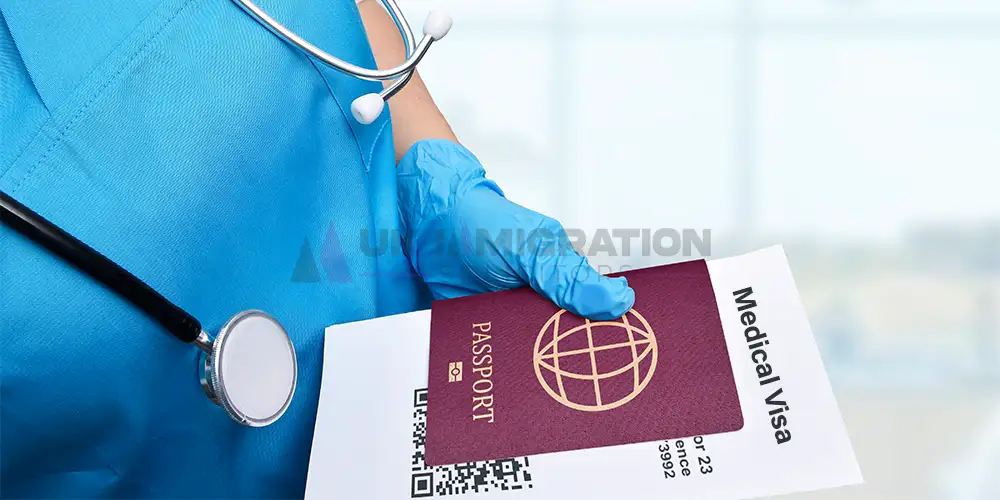
A UK Medical Visa allows foreign nationals to access private healthcare in the UK, as well as donate organs or be assessed as a potential organ donor for a designated recipient.
On this page, we address many frequently asked questions, including when a foreign national can have private medical treatment in the UK, and examine the criteria for a Private Medical Visa. For how long can one obtain a private medical treatment visa? And can someone with a Private Medical Treatment Visa accompany them to the UK?
Meanwhile, you can also call our expert solicitors at 020 3384 4389 to discuss your private medical treatment visa UK application.

Quick Facts You Shouldn’t Miss
Visa type
There’s no separate “medical visa”. Apply under the Standard Visitor – Medical Treatment category for private care, reciprocal NHS treatment, or organ donation.
Who needs a visa
Non-visa nationals may seek entry visa-free for up to six months, provided they satisfy the Border Force officer that their purpose, funding, and onward travel meet the Visitor rules.
Length of stay
Normally up to six months; can be extended to 11 months if the medical letter confirms treatment beyond six months.
Permitted reasons
Private consultation or treatment, government-funded reciprocal care, organ donation or compatibility tests, and aftercare reviews.
Letter from UK consultant confirming diagnosis, treatment plan, estimated cost and duration; proof of funds and accommodation; return travel plans.
Applicants with contagious conditions must show they pose no public health risk and may need TB screening from an approved clinic.
Possible only if treatment continues and all fees are paid. Apply before visa expiry and show fresh medical proof.
Close family or carers may apply separately as Standard Visitors – Medical Accompanying Person. Each must file their own application.

When Health Matters, Accuracy Matters More
Medical treatment cases are often time-sensitive and emotionally draining. Small errors – missing consultant letters or ambiguous funding proof – can delay urgent care. Our immigration solicitors draft and submit fully documented applications aligned with Home Office requirements, so your focus stays on recovery – not paperwork.

Benefits
Why We’re the Right Choice for Your UK Organ Donation or Medical Visa
Medical treatment and organ donation applications require clear evidence, accurate documentation, and careful alignment with Home Office visitor rules. Our SRA-regulated immigration solicitors provide structured, compliant guidance at every stage, helping you submit a complete and well-prepared application without unnecessary risk or uncertainty.
97.37%
Success Rate
37,573
Applications Approved
93.7%
Immigration Appeal Win Rate
4.9/5
Average Rating

From Consultation to Visa Approval
Our immigration specialists streamline your application process by clearly identifying which evidence and strategies will strengthen your case.
By aligning your unique circumstances with Home Office requirements, we help you focus on high-impact preparations while addressing any potential weaknesses in your application.
Maximising Your Approval Chances
Our goal is to maximise the chances of your visa being approved the first time. By carefully reviewing your circumstances, identifying potential weaknesses, and preparing strong supporting evidence, we significantly reduce the risk of refusals. Every application is checked by senior immigration solicitors who apply their expertise to make your case as clear, accurate, and persuasive as possible. This attention to detail is what improves success rates and helps our clients move forward with confidence.
Success Rate Optimisation
We carefully analyse every detail of your application to maximise the chances of approval. By addressing weaknesses, strengthening supporting evidence, and ensuring full compliance with Home Office rules, we optimise your case for success. This thorough approach significantly improves approval rates and gives you confidence throughout the process.
Risk Mitigation Strategies
We identify potential risks in your application early and put safeguards in place to address them. By preparing strong evidence, clarifying complex points, and anticipating Home Office concerns, we minimise the chance of delays or refusals.
-
Evidence-based case preparation

-
Home Office compliance checks
-
Success rate optimisation

-
Risk mitigation strategies


From Consultation to Visa Approval
Our immigration specialists streamline your application process by clearly identifying which evidence and strategies will strengthen your case.
By aligning your unique circumstances with Home Office requirements, we help you focus on high-impact preparations while addressing any potential weaknesses in your application.
Maximising Your Approval Chances
Our goal is to maximise the chances of your visa being approved the first time. By carefully reviewing your circumstances, identifying potential weaknesses, and preparing strong supporting evidence, we significantly reduce the risk of refusals. Every application is checked by senior immigration solicitors who apply their expertise to make your case as clear, accurate, and persuasive as possible. This attention to detail is what improves success rates and helps our clients move forward with confidence.
Success Rate Optimisation
We carefully analyse every detail of your application to maximise the chances of approval. By addressing weaknesses, strengthening supporting evidence, and ensuring full compliance with Home Office rules, we optimise your case for success. This thorough approach significantly improves approval rates and gives you confidence throughout the process.
Risk Mitigation Strategies
We identify potential risks in your application early and put safeguards in place to address them. By preparing strong evidence, clarifying complex points, and anticipating Home Office concerns, we minimise the chance of delays or refusals.
Work With Trusted, SRA-Regulated UK Immigration Experts
Your immigration journey is too important to risk on unqualified or unregulated help. Every case we handle is prepared by SRA-regulated solicitors who apply structured legal reasoning, precise documentation checks and full compliance with Home Office and UKVI rules.
Our accreditations are your assurance that you are working with a reputable, experienced and highly trained legal team. We combine decades of immigration expertise with strict professional standards to give you clarity, confidence and complete peace of mind — no matter which visa or application route you are pursuing.

Who Requires a UK Medical Visa?
People from countries on the UK’s visa nationals list (see “Appendix Visitor: Visa national list” in the Immigration Rules) must apply for a visa before they can come to the UK for medical reasons.
You don’t need a special medical visa to enter the UK. You would instead apply for a UK Standard Visitor Visa, which lets people with visas come to the UK for medical care. In this case, they might come to the UK to get private medical care at a hospital or another medical facility. It could also mean going to the UK to receive NHS treatment, only where it is paid for in full or covered under a reciprocal healthcare agreement authorised by the relevant government. As long as your own government pays for the care as part of a mutual healthcare deal. If you have accepted to be an organ donor for a family member or close friend, or if you want to be checked out to see if you could be a donor, you can also come to the UK with this visa.
Non-visa nationals, whose country of origin is not on the list of visa nationals, may seek entry to the UK without applying for a visa in advance, provided they satisfy a Border Force officer that they meet the Visitor rules, as long as their stay is less than six months. They do not plan to do anything illegal under the UK’s Immigration Rules, such as work. People who don’t need a visa should check to see if they need to apply for an ETA to come to the UK.
Non-UK visa nationals visiting the UK for more than six months must apply for entry clearance as a Standard Visitor for medical treatment before travelling.
What are UK Medical Visa Requirements?
You must meet the following eligibility conditions for travellers seeking private medical care in the UK:
- If you have a disease that can be spread, you must show the medical inspector that you are not a threat to public health.
- You must have planned your specialised medical care in the UK ahead of time
- You must show a letter from a doctor or expert in the UK explaining the medical problem that needs treatment or consultation, along with an estimate of how much it will cost, the estimated duration of treatment, as confirmed by the UK medical practitioner, and where the treatment or consultation will happen.
- If you want to get NHS treatment through a healthcare exchange between the UK and another country, you need to show a form signed by the government of that other country.
If you want to come to the UK for up to 11 months, you must also show proof from a doctor or consultant in the UK that the planned treatment will last longer than six months but not more than 11 months;
or if you want to get NHS treatment through a reciprocal healthcare arrangement, you must show an authorisation form that says the planned treatment will last longer than six months but not more than 11 months;
finally, you must show a valid medical certificate confirming that you have been screened for TB if needed.
In order to be eligible to come to the UK to give an organ or be evaluated as a possible donor match, you must also meet the following requirements:
- You must want to donate an organ to someone in the UK with whom you have a genetic or close personal link, or you must be evaluated as a possible donor for that person.
- You must give written proof of tests that show you are a donor match for the particular person who has been identified, or that you are currently having more tests to see if you could be their donor.
- Also, you need to show a letter from a UK registered medical practitioner or the lead nurse or supervisor of the Living Donor Kidney Transplant team at the UK NHS Trust, no more than three months before you plan to arrive in the UK.
- Who is a doctor for the NHS or is on the Specialist Register of the General Medical Council—this proves that you meet the requirements and lets us know when and where the medical tests or organ transplants will happen in the UK.
- If asked, you must be able to prove that the person you’ve chosen as the recipient is legally in the UK or will be there at the time of the planned transplant.
How Can I Apply for a UK Medical Visa?
To apply for a private medical treatment visa UK, the first thing you need to do is
- Fill out the online form, which you can find on the UK Government’s official website. There will be questions about your personal information, your medical situation, and the care you will be getting in the UK. Before sending in the form, make sure that all of the information is correct.
- After sending in your application, you will need to go to a visa application centre to give your biometric information, which includes a picture and your fingerprints. This step is necessary and helps to verify your identity.
- A visa fee is part of the application process and must be paid online at the same time the application is sent in. The length of your stay determines the cost of a UK medical visit visa. The visa costs £115 and lets you stay for up to six months. The visa fee is £200 for stays of more than six months but less than 11 months.
- A visa application office may sometimes ask you to come in for an interview. You might be asked about your health problem, the care you will get, and your goals in the UK during the interview.
- Read your application carefully and be ready to give any extra information that may be asked for.
If you want to get a visa, you will have to wait for a decision and finish all the steps. Processing times can be different, but you can check online to see where your application stands. If your application is accepted, you will get a vignette, which is a sticker that you can put on your visa that lets you enter the UK.
Documents Required for UK Medical Visa
Along with a passport or other valid travel document, several supporting documents are required when applying for a medical visa to the UK.
| Needed Documents | Description of Documents |
| Valid Passport | Must have a passport that is both current and valid for the whole time you will be staying in the UK. The visa vignette requires a minimum of one blank page. |
| Visa Application Form | A filled-out online application form that can be found on the website for visas and immigration for the UK Government. |
| Biometric Information | At a visa application centre, fingerprints and a picture are taken. |
| Confirmation of Acceptance for Treatment | A letter from a hospital or clinic in the UK confirming the specifics of your medical care, such as the plan, length, and cost of the care. |
| Medical Evidence | Written permission from your doctor or consultant in your home country, outlining your health problem and the reason you need care in the UK. |
| Financial Proof | Proof that you can pay for your medical care and stay in the UK. This could be a letter from a sponsor, bank records, or a savings account. |
| Accommodation Information | A hotel reservation or a letter from a friend or family member telling you where you will be staying during your treatment. |
| Travel Itinerary | Information about your trip plans, such as the flights you’ve booked and any other arrangements you’ve made. |
Certificate Of Tuberculosis (TB) Test | If you come from a place where TB testing is required, you will need a medical certificate saying you do not have TB. The test must be carried out at an accredited clinic. |
| Invitation Letter from Sponsor | If someone is paying for your trip, a letter from them explaining how they know you and their commitment to help you financially. |
| Evidence of Return Travel | A return flight ticket or other proof that you plan to go back to your home country after your treatment. |
To begin, you will need to show UKVI that you meet all of the normal requirements for the visitor route. Therefore, you will have to show proof that you are a real guest and that you plan to go back home after getting medical care, donating an organ, or being checked out as a possible match. For instance, you may need to provide evidence that you own or rent a house abroad or that you have obligations to return to your family while abroad.
Additionally, you need to show that you can pay for your own journey and stay in the UK. To do this, you will need to show proof of your finances, like pay stubs or bank statements, along with information about where you plan to stay. If someone else is paying for your trip to the UK, they should sign and return a letter saying they will pay for all of your hotel and transport costs.
You will also have to show the required documents that are needed by the extra rules for people who want to come to the UK for private medical care, to give an organ, or to be evaluated as a possible donor. This has to include proof from the doctors and nurses who worked on you during your process or treatment.
It’s important to note that the proof needed to support a medical visa UK application can be tricky, so it’s usually best to get help from an immigration law expert. Because time may be of the essence when you are getting medical care or agreeing to be an organ donor, your application must be approved the first time. Having a lawyer help you with the application process and gather the necessary paperwork can greatly improve your chances of a successful outcome.
What are the Cost and Processing Fees for a UK Medical Visa?
This type of visa costs £115 and lets you stay for up to six months. Visas cost £200 for stays of more than six months but less than 11 months.
You can apply for a medical visa UK up to three months before your trip. Standard processing times are usually around three weeks, although this may vary by location and case complexity.
If you are applying from a certain country, you might be able to pay extra for a priority or super priority service that will help your application get processed faster. Please check with the visa application centre in the country where you live at the moment.
How to Extend a Medical Visa UK?
If you inform UKVI ahead of time that your medical care will take longer than six months and the documents you send with your application make this clear, they should let you stay for up to 11 months at first. Instead, you can apply for a visa that lets you stay for up to six months and then, once you’re in the UK, pay an extra £1,000 to extend your stay for another six months.
You are allowed to extend your stay in the UK subject to continued eligibility, medical evidence, and Home Office discretion.
- You have no outstanding debt from medical care received in the UK.
- You can and will pay for the extra medical care that you need.
- You still meet the conditions for a medical visa UK.
Regardless of your country, it will cost you £1,000 each time you try to extend your stay for medical reasons. Additionally, you must ask for an extension while you are still in the UK and before your current visa expires. If you want to apply for an extension on your medical visa for the UK, you will need to show:
- Written proof from a UK-licensed doctor or NHS consultant that your situation needs more treatment.
- If you are getting ongoing treatment at an NHS hospital as part of a reciprocal healthcare arrangement, you will need to show an extra form from your country’s government saying that they will pay for your ongoing treatment.
If you want to extend your visa, you will need to make an appointment at a UK Visa and Citizenship Application Services (UKVCAS) service point to give your supporting documents and biometric details. To keep your visa application from being thrown out, you must not leave the UK before you hear back.
How Can UK Immigration Solicitors Help?
Travelling to the UK for medical treatment is just one example of how our committed team of legal advisors can assist with all aspects of the visitor visa application process, including eligibility requirements. Contact us at 020 3384 4389 for specialist guidance on Home Office applications.

Frequently Asked Questions FAQs
Yes. You can apply for a Standard Visitor Visa for medical treatment to receive private care or reciprocal NHS treatment for up to six months (extendable to 11 months if needed).
Yes. A spouse, relative, or carer may apply separately as a Standard Visitor accompanying a medical visitor
You may apply to extend your stay so that your total time in the UK does not exceed 11 months, provided ongoing treatment is required, you have no outstanding medical debt, and you submit fresh medical evidence.
Non-visa nationals may seek entry for visits under six months without applying in advance, provided they satisfy a Border Force officer that their purpose, funding, and intention to leave meet the Visitor rules.
You must show documented compatibility tests and a recent letter from a UK medical practitioner confirming the planned assessment or transplant arrangements.
Missing consultant letters, unclear funding, weak evidence of treatment duration, or doubts about intention to leave after recovery.
You must submit updated medical evidence confirming ongoing treatment, show no outstanding NHS debt, and apply from within the UK before your current permission expires.
Yes, unless your treatment is covered by an approved reciprocal healthcare arrangement between the UK and your home country. Medical visitors are not entitled to free NHS treatment. Any NHS care must either be paid for in full or authorised under a reciprocal agreement confirmed by the relevant government authority.
No. Visitors, including those travelling to the UK for private medical treatment or organ donation, do not pay the Immigration Health Surcharge. The IHS applies only to certain long-term visa routes and does not apply to the Standard Visitor category.
Having a medical condition does not, by itself, lead to a visa refusal. However, applicants must meet public health requirements, provide appropriate medical evidence, and comply with any tuberculosis screening rules that apply based on their country of residence. Clear documentation and treatment planning are essential.
Blog
Read Our Latest Blogs
Services
Services You Might be Interested In
Request My Free Immigration Assessment?
Your immigration situation deserves attention. Start with a free, no-obligation initial assessment. Our team will explain how UKIS may help and the next steps. No solicitor can guarantee an individual immigration outcome.

Speak directly with an immigration specialist at a time that works for you.

Call Us Now
020 3384 4389 Our lines are open 24/7, 365 days a year.
What We Commonly Advise On
- Spouse, fiancé and partner matters.
- Family and dependant routes.
- Skilled Worker and sponsorship matters.
- Settlement and Indefinite Leave to Remain.
- Refusals, appeals and judicial review.
- Student, visitor and private life matters.
- Complex cases involving human rights considerations.