

Not Just Advice – Legal Strategy That Works
UK Family Visas Bring Your Family Together in the UK
Get clear legal support with a UK Family Visa application for your spouse, partner, child, parent or other eligible relative. We can help you identify the correct route, check the requirements and prepare your application with the right supporting evidence.
Speak to a UK Family Visa expert at 20 3384 4389 for immediate, personalised assistance.
- Excellent Reviews





- 5.0 rating


“Me and my wife used Sabz Solicitors throughout my wife’s visa process. Alanta from sabz was our case worker who was very professional and re-assuring throughout. I Honestly couldn’t recommend her expertise enough to anyone looking to take the stress away from the visa process. Thank you again Sabz and thank you again Alanta.”
Martin S.
- Excellent Reviews

4.7 (832 Reviews)







Ready to Join Your Family in the UK? Get Help Today!
No more confusion or wasted time. Tell us about your case, and we’ll provide an expert-backed, realistic plan to secure your UK visa.

"*" indicates required fields
What Is a UK Family Visa?
A UK Family Visa can allow an eligible person to join or remain with a qualifying spouse, partner, parent, child or certain other family members in the UK.
The correct route depends on your family relationship, the UK-based person’s immigration status and whether you are applying from inside or outside the country.
Different Family Relationships Require Different Visa Routes


UK Family Visa – Quick Facts
Spouse and Partner Visas
For eligible spouses, civil partners and qualifying unmarried partners who want to live together in the UK.
Parent and Child Visas
For eligible parents and children whose family circumstances meet the relevant UK Family Visa requirements
Adult Dependant Relative
For qualifying adults who need long-term personal care from an eligible close relative living in the UK.
Family Visa Requirements
Requirements vary by route and can include family relationship, sponsor status, finances, English and accommodation.
UK Family Visa Cost
Application fees and healthcare charges depend on the family route, application location and number of applicants.
Family Visa Settlement
Some Family Visa routes can lead to Indefinite Leave to Remain, but qualifying periods and requirements differ.
Which UK Family Visa Route Is Right for You?
The right route depends on your relationship and your family member’s UK status.
Can You Apply From Inside the UK?
Sometimes. It depends on your current visa and the family route you are applying for.
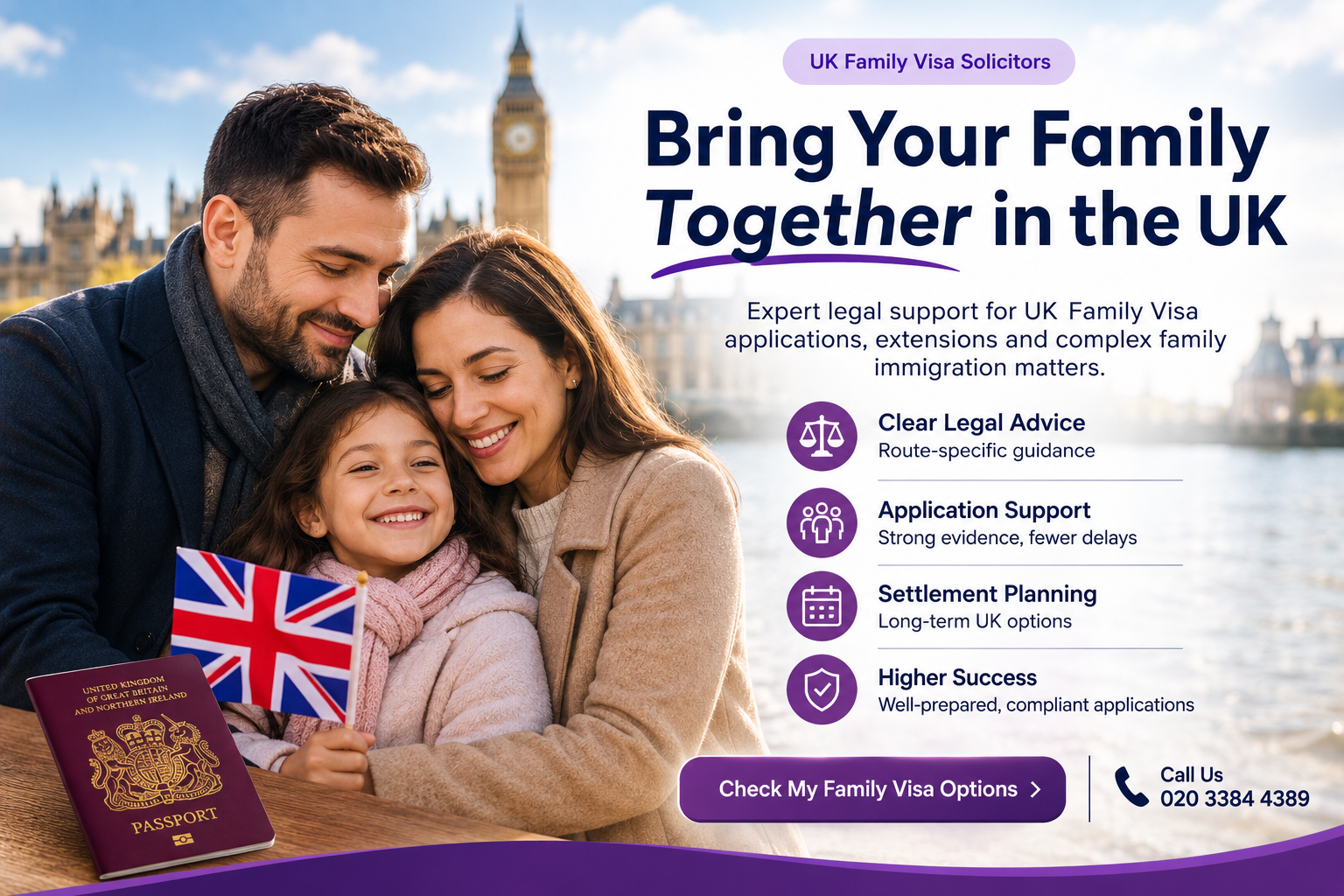
Expert Guidance
Using the wrong family route can lead to unnecessary cost, delay or refusal. We can assess your circumstances and explain which application best fits your relationship and immigration goal.

Benefits
Why Choose Our UK Family Visa Solicitors?
Our UK immigration solicitors help families identify the correct visa route and prepare applications around the specific requirements that apply to spouses, partners, parents, children and other qualifying relatives. We focus on clear legal advice, accurate evidence and early identification of issues that could delay or weaken an application.
We can assist with complex family immigration matters, including financial shortfalls, self-employment, limited relationship evidence, previous refusals, switching from another UK visa and cases involving children or unusual family circumstances. Every application is reviewed on its own facts rather than treated as a generic Family Visa case.
Our support can cover initial applications, extensions, settlement planning and refusal advice, with clear communication throughout the process. The aim is to help you understand your options, avoid avoidable mistakes and submit a well-prepared UK Family Visa application with confidence.
UK Family Visas: Routes, Requirements, Costs and Application Guidance
A UK Family Visa allows an eligible person to join or remain with a qualifying family member in the United Kingdom. It is not one single visa with one set of rules. The Family Visa framework includes several routes for partners, parents, children and certain adult relatives.
The route you need depends on your relationship to the person in the UK, their immigration status, whether you are applying from inside or outside the country, and whether you meet the requirements for that specific category.
Who Can Use the UK Family Visa Route?
Depending on the circumstances, a Family Visa may be available to someone applying as a:
- spouse or civil partner
- unmarried partner
- fiancé, fiancée or proposed civil partner
- parent
- child
- adult dependant relative
Each route has different eligibility, financial, evidence and settlement rules.
What Does “Family Route Visa” Mean?
“Family route visa” is a broad term used to describe immigration permission based on a qualifying family relationship.
It should not be confused with a dependant visa linked to a temporary work or study route. For example, the partner of a Skilled Worker may need to apply as a dependant under the Skilled Worker route rather than under the Family Visa framework.
Is an England Family Visa Different From a UK Family Visa?
No. There is no separate England Family Visa.
Family immigration rules apply at UK level. A person may live in England, Scotland, Wales or Northern Ireland after approval, subject to the conditions of their immigration permission.
What Does “UKBA Family Visa” Mean Today?
“UKBA” refers to the former UK Border Agency, which no longer exists.
Current applications are handled through the Home Office and UK Visas and Immigration. Searches for “UKBA family visa” usually refer to the modern UK Family Visa system.
Which UK Family Visa Route Do You Need?
Choosing the correct route is the first step. Applying under the wrong family category can lead to unnecessary cost, delay or refusal.
Spouse Visa
A Spouse Visa is for an eligible person who is married to a qualifying partner in the UK.
The detailed relationship, financial and evidence requirements should be covered on the dedicated UK Spouse Visa page.
Unmarried Partner Visa
This route is for qualifying partners who are not married or in a civil partnership but meet the durable relationship requirements.
Current Home Office guidance confirms that an unmarried couple does not necessarily need to have lived together for the full two-year period if the relationship itself is durable and similar to marriage or civil partnership.
Fiancé or Proposed Civil Partner Visa
This route is for someone intending to marry or form a civil partnership in the UK within the permitted period.
Unlike a full partner visa, fiancé or proposed civil partner permission does not normally allow work or study before the subsequent partner application is approved.
Civil Partner Visa
A Civil Partner Visa is for someone whose relationship is legally recognised as a civil partnership.
Parent Visa
A Parent Visa may allow an eligible parent to live in the UK based on their relationship with a qualifying child.
The rules can involve parental responsibility, direct access, the child’s status and the applicant’s financial circumstances.
Child Visa
A Child Visa can apply where a child is joining or remaining with a qualifying parent.
The rules vary depending on the child’s age, where they live, the parent’s immigration position and whether the child is applying alone or with a parent.
Adult Dependant Relative Visa
This route is for an adult who needs long-term personal care because of age, illness or disability and wants to join a qualifying close relative in the UK.
It is one of the more restrictive Family Visa categories. A new applicant must normally apply from outside the UK.
When a Dependant Visa Applies Instead
A Family Visa is not always the correct route.
If your family member is temporarily in the UK on a work or study visa, you may need to apply as their dependant under that route rather than under the Family Visa system.
UK Family Visa Requirements
The UK Family Visa requirements differ by category. There is no universal checklist that applies equally to spouses, parents, children and adult dependant relatives.
Qualifying Family Relationship
You must show that your relationship falls within the relevant route.
For example, a partner application may require evidence of marriage, civil partnership or a qualifying durable relationship, while a parent application focuses on the applicant’s relationship with a child.
Sponsor or UK-Based Family Member Status
The person you are joining must usually hold a qualifying status.
Depending on the route, this can include:
- British or Irish citizenship
- indefinite leave to remain
- settled status
- certain qualifying pre-settled status
- refugee or humanitarian protection
- another status specifically accepted under the Family Visa rules
Age Requirements
Age rules depend on the category.
For partner applications, both parties must normally be at least 18.
Child applications have separate age and dependency rules.
Adult dependant relatives must be 18 or over and meet the long-term care criteria.
Genuine Relationship Requirements
Partner applications must show a genuine and subsisting relationship.
Parent applications require evidence of a genuine parental role or relationship.
Child cases can involve evidence concerning care, dependency and the parent’s immigration position.
Financial Requirement
The financial test depends on the route.
The £29,000 minimum income requirement applies to most new partner applications, but it is not a universal Family Visa requirement. Parent, child and Adult Dependant Relative routes use different tests.
English-Language Requirement
English-language requirements apply to some adult family routes but not in the same way to every applicant.
Partner applicants can need to meet the relevant English standard, while other routes may have different or no equivalent requirement.
Accommodation Requirement
Where relevant, applicants should show that suitable accommodation is available without prohibited overcrowding or inappropriate reliance on public funds.
Immigration Status and Suitability
Previous overstaying, criminality, false representations, deception and other immigration-history matters can affect eligibility.
These issues should be disclosed and assessed before submission.
Requirements for Children
A child may need to show that they:
- meet the age requirements
- are not living an independent life
- live with or are joining the relevant parent
- meet the specific dependency or care rules of the route
Current guidance confirms that an adult child can only continue under certain Family Visa provisions if their qualifying family permission began while they were under 18.
UK Family Visa Income Requirement
The family visa income requirement depends on which family route you are using.
The most important distinction is that the £29,000 threshold is a partner-route rule, not a blanket Family Visa requirement.
Does Every Family Visa Have the Same Financial Requirement?
No.
Different routes use different financial tests.
Partner applications usually use a minimum income requirement. Parent applications can involve an adequate maintenance-style assessment. Adult Dependant Relative cases focus on whether the UK-based relative can maintain, accommodate and care for the applicant without relying on public funds.
Financial Requirement for Partner Routes
Most new partner applicants currently need to show combined qualifying income of at least £29,000 a year.
How that requirement is met depends on the income source and the specified evidence rules.
Transitional Rules for Existing Partner Applicants
Different rules apply to some applicants who first entered the partner route before 11 April 2024 and are extending with the same partner.
GOV.UK confirms that these applicants may remain subject to the previous £18,600 threshold, with additional amounts potentially applying for certain children.
Employment and Self-Employment Income
Employment income can be used where the relevant rules are met.
Self-employed applicants and company directors are subject to more specific evidence and calculation requirements.
Cash Savings and Other Permitted Income
Cash savings can potentially be used in some partner applications, either alone or in combination with permitted income sources.
Pension income and certain non-employment income may also be relevant.
Specified Benefits and Adequate Maintenance
Where the sponsoring partner receives certain disability or carer’s benefits, the standard minimum income requirement may not apply.
Instead, the case may be assessed under an adequate maintenance test.
Financial Rules for Parent and Child Applications
Parent and child routes do not simply apply the standard partner threshold in every case.
For parent applications, GOV.UK states that the applicant must be able to financially support themselves and any relevant dependants without claiming public funds.
For a child application, the evidence can depend on the parent’s route and financial position.
Common Financial Evidence Errors
Applications can become vulnerable where:
- the wrong threshold is used
- payslips and bank credits do not match
- the wrong evidence period is submitted
- self-employment documents are incomplete
- savings have not been held correctly
- the wrong financial category is selected
- transitional rules are overlooked
Documents for a UK Family Visa Application
The documents required for a family visa application depend on the route and the applicant’s personal circumstances.
Current GOV.UK guidance confirms that applicants may need to provide identity, financial, relationship, sponsor and child-related information depending on the application.
Identity and Immigration Documents
Common documents include:
- current passport or travel document
- previous passports where relevant
- current immigration-status evidence
- previous Home Office decisions
- travel and immigration history
Relationship Evidence
For partner applications, evidence may include:
- marriage or civil partnership certificates
- tenancy or mortgage records
- Council Tax or utility bills
- joint financial records
- official correspondence
- evidence of communication or visits where the couple lives apart
GOV.UK states that applicants may be asked how they met, how often they see one another, how long they have lived together and what expenses they share.
Sponsor Status Evidence
Applicants may need to show the UK-based family member’s:
- nationality
- passport
- immigration status
- settled or protection status
Financial Documents
The exact evidence depends on the financial category being used.
Examples can include:
- payslips
- bank statements
- employer letters
- tax records
- business accounts
- savings statements
- pension records
Accommodation Evidence
Relevant evidence can include:
- tenancy agreement
- mortgage statement
- property ownership evidence
- landlord letter
- confirmation from relatives if the applicant will live with family
English-Language Evidence
Where required, evidence may include:
- an approved English test
- a qualifying UK degree
- Ecctis confirmation for an overseas qualification
- evidence that an exemption applies
Documents for Children
UKVI may ask for information about:
- the child’s nationality
- date of birth
- passport
- where they live
- parental responsibility
- care arrangements
- contact with parents
- extended family
Evidence About Previous Relationships
Where relevant, applicants may need to provide:
- divorce certificates
- dissolution documents
- evidence that previous marriages or relationships have ended
Certified Translations
Documents not in English or Welsh may need to be accompanied by an appropriate certified translation.
When a Cover Letter May Help
A cover letter can be useful where the case involves:
- complex finances
- periods of separation
- previous refusals
- immigration breaches
- unusual family circumstances
- human-rights considerations
It should explain the application clearly rather than repeat every document.
How to Apply for a UK Family Visa
A family visa application should be built around the correct family category.
Step 1 – Choose the Correct Family Route
Identify whether you are applying as a:
- partner
- parent
- child
- adult dependant relative
- dependant under another immigration category instead
Step 2 – Check Eligibility
Review the current requirements for the exact route.
Step 3 – Prepare Supporting Documents
Gather evidence linked to each requirement.
Step 4 – Complete the Online Application
Most Family Visa applications are submitted online through the relevant GOV.UK process.
Step 5 – Pay the Required Charges
Pay the Home Office application fee and, where applicable, the Immigration Health Surcharge.
Step 6 – Prove Your Identity
Follow the identity-verification or biometric instructions generated during the application.
Step 7 – Submit Supporting Evidence
Upload complete, legible documents in the required format.
Step 8 – Respond to UKVI Requests
UKVI may ask for further information or clarification.
Step 9 – Check the Decision and eVisa
If the application is approved, review your digital immigration status and conditions carefully.
Can You Apply for a Family Visa From Inside the UK?
Whether you can apply from inside the UK depends on your current immigration status and the family route you want to use.
Applying From Outside the UK
Applicants joining family from overseas generally apply online from outside the UK.
This is particularly important for routes that do not permit an in-country switch.
Applying From Inside the UK
A person already in the UK on another visa may be able to switch to a Family Visa to remain with a:
- spouse or partner
- child
- parent
GOV.UK states that a qualifying switch can be made before the applicant’s current permission expires.
Switching From Another UK Visa
Someone on an eligible work, study or other route may potentially switch into a Family Visa.
The consequences for settlement should be considered before changing route.
Visitor Visa Restrictions
Visitors generally cannot switch into the Family Visa route from inside the UK, subject to limited exceptions.
A visitor will usually need to leave the UK and apply from overseas.
When You Must Apply From Overseas
Some family categories expressly require an overseas application.
For example, a new Adult Dependant Relative applicant normally must apply from outside the UK.
What if Your Current Visa Is Close to Expiry?
Do not wait until the last day to decide which family route applies.
Where an in-country application is permitted, submitting a valid application before current permission expires can be important for maintaining lawful status.
UK Family Visa Fee and Cost
The family visa fee depends on the route and whether you apply from inside or outside the UK.
Current fees should always be checked immediately before submission.
Application Fee
For applications to join a partner, parent or child, current GOV.UK fees are:
Application location | Current fee |
Outside the UK | £2,064 |
Inside the UK | £1,407 |
The same listed fee applies to each dependant added to the relevant application.
Immigration Health Surcharge
Many Family Visa applicants also need to pay the Immigration Health Surcharge.
Current GOV.UK figures for typical Family Visa periods include:
- £2,587.50 for an adult staying 2 years and 6 months
- £3,105 for an adult staying 2 years and 9 months
- £5,175 for an adult staying 5 years
For children, the corresponding current amounts are lower.
Adult Dependant Relative Fees
Adult Dependant Relative applications use different fees.
Current GOV.UK guidance states that the fee can be:
- £3,635 for an overseas application in most standard cases
- £452 from outside the UK where the relative has temporary protection status
- £1,407 for an eligible in-country application
Fees for Children and Dependants
Each dependant generally has a separate application fee and, where applicable, a separate healthcare surcharge.
Priority and Super Priority Services
Where available, applicants may be able to pay for a faster decision.
GOV.UK currently lists a £1,000 Super Priority service for eligible in-country Family Visa applications.
English Test and Translation Costs
Additional costs may include:
- approved English-language test
- Ecctis assessment
- certified translations
- document scanning
- biometric or commercial appointment services
Are Family Visa Fees Refundable?
Refund rights depend on the type of payment and stage of the application.
Do not assume the application fee, IHS and optional service charges will all be refundable.
UK Family Visa Processing Times
Processing times vary by family route and whether the application is made inside or outside the UK.
Partner and Spouse Applications
The current published standard is:
- 12 weeks for partner or spouse applications made outside the UK
- 8 weeks for qualifying standard partner or spouse applications made inside the UK
Parent Applications
Current GOV.UK guidance states:
- 12 weeks for parent applications made outside the UK
- around 12 months for parent applications made inside the UK
Child Applications
Current service standards list:
- 12 weeks outside the UK
- 8 weeks inside the UK
Adult Dependant Relative Applications
Current guidance states:
- 12 weeks outside the UK
- 8 weeks inside the UK for eligible extension applications
Faster Decision Services
Some eligible Family Visa applications can use a faster service.
Availability depends on the route and application location.
What Can Delay a Decision?
Applications can take longer where UKVI needs:
- additional relationship evidence
- financial verification
- sponsor or family-status checks
- further documents
- clarification of immigration history
Family Visa vs Family Dependant Visa UK
A Family Visa and a family dependant visa UK application are not the same thing.
What Is a Family Visa?
A Family Visa is generally used where the applicant is joining or remaining with a qualifying family member under the UK Family Visa framework.
Examples include partner, parent and child routes.
What Is a Dependant Visa?
A dependant visa is normally linked to the immigration route of a temporary main visa holder.
For example, dependants of:
- Skilled Workers
- Health and Care Workers
- Students
- Global Talent holders
- other eligible work-route migrants
apply under the rules of the main applicant’s route.
When a Partner Should Use the Family Visa Route Instead
If the UK-based partner is British, Irish or settled, the Family Visa route may be the appropriate framework.
If the partner is temporarily in the UK on a work or study visa, a dependant route may be more appropriate.
Can Children Apply as Dependants?
Yes, where the main immigration route permits dependants and the child satisfies the relevant requirements.
UK Family Visa vs Family Visit Visa
A visa to visit family is different from a visa to live with family.
What Is a Family Visit to the UK?
Someone coming to see relatives temporarily normally uses the Standard Visitor route.
There is no separate modern immigration category called a general “Family Visit Visa”.
Standard Visitor Visa for Visiting Family
A Standard Visitor can usually visit the UK for up to 6 months for tourism or to see family and friends.
UK Family Visit Visa Requirements
A visitor must generally show that they:
- will leave the UK at the end of the visit
- can support themselves and any dependants
- can pay for their return or onward journey
- will not live in the UK through frequent or successive visits
Can a Family Visitor Work?
No, not in ordinary UK employment.
Standard Visitors cannot generally work for a UK company or work as self-employed, except for limited permitted activities.
Can a Visitor Switch to a Family Visa?
Usually not.
Visitors generally need to leave the UK before applying for a Family Visa, subject to limited exceptions.
When You Need a Family Visa Instead
If your intention is to live in the UK with a spouse, partner, parent, child or other qualifying family member rather than visit temporarily, the relevant Family Visa route should be considered.
How Long Can You Stay on a UK Family Visa?
Visa length depends on the family category.
Partner Route
A partner application made from outside the UK can normally grant up to 2 years and 9 months.
A successful extension or in-country switch can normally grant up to 2 years and 6 months.
Parent Route
A parent can normally receive:
- 2 years and 9 months on an initial overseas grant
- 2 years and 6 months on an extension or switch
Adult Dependant Relative
Where the UK relative is British, Irish or settled, a successful Adult Dependant Relative applicant can receive indefinite permission rather than a time-limited visa.
When You Need to Extend
If your visa is time-limited and you are not yet eligible for settlement, you must normally apply before your current permission expires.
What Happens if Your Family Circumstances Change?
Changes such as:
- relationship breakdown
- separation
- death of a sponsor
- change in parental responsibility
- child becoming independent
can affect immigration status and future applications.
Obtain advice where the basis of the visa has materially changed.
Can a UK Family Visa Lead to Indefinite Leave to Remain?
Some Family Visa routes can lead to settlement, but the qualifying period is not the same for every category.
Five-Year Partner Route
A person on the standard partner route can normally apply for ILR after 5 continuous years on a qualifying Family Visa as a partner. Time on another visa or as a fiancé does not normally count towards that five-year period.
Ten-Year Family Route
Some applicants who cannot meet all standard requirements but qualify on family-life or human-rights grounds may be placed on a longer route before settlement.
Parent Route
Current GOV.UK guidance states that the earliest a qualifying parent can normally apply for ILR is after 5 continuous years on a Family Visa as a parent.
Child and Dependant Settlement
A child’s settlement position depends on the parent’s status, the child’s own immigration history and the relevant route.
Adult Dependant Relative
A person joining a British, Irish or settled relative under the Adult Dependant Relative route can receive indefinite permission if the application succeeds.
English and Life in the UK Requirements
Some settlement applications require English at the relevant level and the Life in the UK Test, subject to exemptions.
When Another Extension May Be Needed
If you have not completed the qualifying period or do not yet meet the settlement requirements, a further extension may be required.
Rights and Conditions on a UK Family Visa
Rights depend on the exact Family Visa granted.
Right to Work
A person granted full partner permission can generally work in the UK.
A fiancé or proposed civil partner cannot normally work until they make and succeed with the subsequent partner application.
Right to Study
Full partner permission generally allows study.
Fiancé permission does not normally allow study before the relationship is formalised and the next partner application is granted.
Self-Employment
Some Family Visa holders can work on a self-employed basis, depending on the conditions attached to their immigration permission.
Travel Outside the UK
Travel is generally possible while valid immigration permission remains in force, but applicants should check any effect on residence requirements and ongoing applications.
Access to Public Funds
Many Family Visa grants are subject to a no recourse to public funds condition.
Some applicants granted under particular family-life or exceptional circumstances may have different conditions.
Children and Dependants
Whether children can be included depends on the family route and their individual circumstances.
Checking Your eVisa Conditions
After approval, check the eVisa carefully to confirm:
- visa category
- expiry date
- work rights
- conditions
- passport linkage
Common UK Family Visa Problems and Refusals
Family Visa refusals often arise because the wrong route is selected or the evidence does not clearly prove the legal requirements.
Applying Under the Wrong Route
A spouse, unmarried partner, dependant, parent or visitor application can have very different rules.
Choosing the wrong category can make an otherwise genuine case fail.
Relationship Evidence Is Insufficient
Partner cases can be refused where UKVI is not satisfied that the relationship is genuine or meets the relevant route requirements.
Financial Requirement Is Not Met
The applicant may:
- use the wrong threshold
- rely on an unaccepted income source
- submit insufficient financial evidence
- overlook transitional rules
Documents Are Missing or Inconsistent
Conflicting names, dates, addresses, financial figures or relationship details can create credibility concerns.
Sponsor Status Is Not Eligible
The UK-based family member must hold the status required for the specific route.
English-Language Requirement Is Not Met
Where the route requires English, the applicant must use an accepted method of proof or demonstrate an applicable exemption.
Accommodation Evidence Is Weak
Where accommodation is relevant, UKVI may need to be satisfied that appropriate housing is genuinely available.
Immigration History Creates a Suitability Issue
Previous overstaying, deception, criminality or other immigration issues may affect the decision.
Switching Restrictions Are Overlooked
A person already in the UK may not be permitted to switch into the intended family route from their current status.
What to Do After a Refusal
Read the refusal letter carefully before taking further action.
Possible options can include:
Fresh Application
A new application may be suitable where the problem can be corrected.
Appeal Where Available
Some Family Visa refusals involving human-rights claims can carry appeal rights.
Administrative Review Where Applicable
Administrative review is not available for every Family Visa refusal and should only be used where the decision provides that remedy.
Judicial Review
Judicial review may be relevant where a decision is arguably unlawful and there is no adequate alternative remedy.
Family Life and Human Rights
Some applicants who cannot meet every standard Family Visa requirement may still have arguments based on family life, a qualifying child or exceptional circumstances.
UK Family Visa Routes Compared
Route | Who it is for | Main relationship basis | Work rights | Typical settlement position |
Spouse Visa | Married partners | Recognised marriage | Usually yes | Can lead to ILR |
Unmarried Partner Visa | Durable unmarried partners | Qualifying partner relationship | Usually yes | Can lead to ILR |
Fiancé Visa | Couples planning to marry in the UK | Intention to marry/form civil partnership | No during initial fiancé period | Partner route after further application |
Civil Partner Visa | Civil partners | Recognised civil partnership | Usually yes | Can lead to ILR |
Parent Visa | Parents of qualifying children | Genuine parental relationship | Route-specific | Can lead to ILR |
Child Visa | Children joining or remaining with parent | Parent-child relationship | Age-dependent | Route-specific |
Adult Dependant Relative | Adults needing long-term care | Close qualifying relative | Not the core purpose of route | Can be indefinite in qualifying cases |
Work/Student Dependant | Dependants of temporary visa holders | Relationship to main visa holder | Depends on route | Depends on main route |
UK Family Visa FAQs
Which UK Family Visa Route Is Right for Me?
The correct route depends on who you are joining, their UK immigration status and your relationship to them. A partner, parent, child, Adult Dependant Relative and work-route dependant application all have different requirements.
Can I Apply if My Family Member Is Only Temporarily in the UK?
Possibly, but a Family Visa may not be the correct route. If your family member is in the UK temporarily on a work or study visa, you may need to apply as their dependant instead.
Can I Change From a Work or Student Visa to a Family Visa?
Potentially. GOV.UK confirms that some people already in the UK can switch to a Family Visa before their current permission expires. Your current route and the family category must both allow the application.
What if My Sponsor Does Not Meet the Standard Partner Income Requirement?
The £29,000 threshold applies to most new partner applications, but different rules can apply in transitional cases, where specified benefits are received, or where family-life or human-rights considerations arise.
Can Children Apply With Me?
Children can be included in many Family Visa applications if they meet the relevant age, dependency and care requirements.
Can I Work While Holding a Family Visa?
Many full Family Visa routes allow work, but fiancé permission is a notable exception. Always check the conditions attached to your actual grant.
Can I Visit Family Without Applying for a Family Visa?
Yes. If your intention is only to visit family temporarily, the Standard Visitor route may be appropriate instead of a Family Visa.
What Happens if My Family Circumstances Change After the Visa Is Granted?
A relationship breakdown, change in parental responsibility or other major family change can affect immigration status. The correct next step depends on the visa route and individual circumstances.
Get Help With a UK Family Visa Application
A successful UK Family Visa application begins with choosing the correct route and understanding which requirements actually apply to that category.
The rules for a spouse or partner are not the same as the rules for a parent, child, Adult Dependant Relative or dependant of a temporary visa holder.
Our UK immigration solicitors can help with:
- identifying the correct Family Visa route
- checking eligibility
- reviewing relationship and family evidence
- assessing financial requirements
- preparing supporting documents
- switching from another UK visa where permitted
- family visa extensions
- settlement planning
- refusals and appeals
Speak to a UK Family Visa Solicitor
Get your family relationship, sponsor status, application route and supporting evidence reviewed before you submit your application.
Legally reviewed by Haq Nawaz
15+ years of immigration law experience
Last legally reviewed – 24 August 2026
General Immigration Information
This content provides general information about UK Family Visas and does not constitute legal advice for an individual case. Family Visa rules, fees, processing times, financial requirements and switching provisions can change. Eligibility depends on the specific family route, the UK-based family member’s status and the applicant’s circumstances.

UK Spouse Visa FAQs
The correct route depends on your relationship to the person in the UK, their immigration status and whether you are applying as a spouse, partner, parent, child or other qualifying relative.
Possibly. Some applicants can switch to a Family Visa from inside the UK, while others must apply from overseas. Your current immigration status determines whether an in-country application is allowed.
Requirements vary by route but can include a qualifying family relationship, eligible sponsor status, financial evidence, English-language ability, suitable accommodation and compliance with the relevant suitability rules.
The cost depends on the family route and where you apply. You may need to pay the application fee, Immigration Health Surcharge and additional costs such as translations, English tests or priority processing.
In many cases, eligible children can apply with or join a parent, but the age, dependency and care requirements depend on the specific family route.
Some Family Visa routes can lead to ILR, but the qualifying period varies. Partner and parent routes can lead to settlement, while other family categories follow different rules.
Read the refusal decision carefully before taking further action. Depending on the reason, you may be able to submit a fresh application, appeal, request another legal remedy or obtain advice on family-life and human-rights options.
Services
Services You Might be Interested In
Request a Free Case Review Appointment
Start your free case review by booking a quick assessment so our team can understand your situation and guide you to the right next steps.

Speak directly with an immigration specialist at a time that works for you.

Call Us Now
020 3384 4389 Our lines are open 24/7, 365 days a year.
97.37%
Success Rate
37,573
Applications Approved
93.7%
Immigration Appeal Win Rate
4.9/5
Average Rating
From Consultation to Visa Approval
Our immigration specialists streamline your application process by clearly identifying which evidence and strategies will strengthen your case.
By aligning your unique circumstances with Home Office requirements, we help you focus on high-impact preparations while addressing any potential weaknesses in your application.
Maximising Your Approval Chances
Our goal is to maximise the chances of your visa being approved the first time. By carefully reviewing your circumstances, identifying potential weaknesses, and preparing strong supporting evidence, we significantly reduce the risk of refusals. Every application is checked by senior immigration solicitors who apply their expertise to make your case as clear, accurate, and persuasive as possible. This attention to detail is what improves success rates and helps our clients move forward with confidence.
Success Rate Optimisation
We carefully analyse every detail of your application to maximise the chances of approval. By addressing weaknesses, strengthening supporting evidence, and ensuring full compliance with Home Office rules, we optimise your case for success. This thorough approach significantly improves approval rates and gives you confidence throughout the process.
Risk Mitigation Strategies
We identify potential risks in your application early and put safeguards in place to address them. By preparing strong evidence, clarifying complex points, and anticipating Home Office concerns, we minimise the chance of delays or refusals.
-
Evidence-based case preparation

-
Home Office compliance checks
-
Success rate optimisation

-
Risk mitigation strategies


From Consultation to Visa Approval
Our immigration specialists streamline your application process by clearly identifying which evidence and strategies will strengthen your case.
By aligning your unique circumstances with Home Office requirements, we help you focus on high-impact preparations while addressing any potential weaknesses in your application.
Maximising Your Approval Chances
Our goal is to maximise the chances of your visa being approved the first time. By carefully reviewing your circumstances, identifying potential weaknesses, and preparing strong supporting evidence, we significantly reduce the risk of refusals. Every application is checked by senior immigration solicitors who apply their expertise to make your case as clear, accurate, and persuasive as possible. This attention to detail is what improves success rates and helps our clients move forward with confidence.
Success Rate Optimisation
We carefully analyse every detail of your application to maximise the chances of approval. By addressing weaknesses, strengthening supporting evidence, and ensuring full compliance with Home Office rules, we optimise your case for success. This thorough approach significantly improves approval rates and gives you confidence throughout the process.
Risk Mitigation Strategies
We identify potential risks in your application early and put safeguards in place to address them. By preparing strong evidence, clarifying complex points, and anticipating Home Office concerns, we minimise the chance of delays or refusals.
Work With Trusted, SRA-Regulated UK Immigration Experts
Your immigration journey is too important to risk on unqualified or unregulated help. Every case we handle is prepared by SRA-regulated solicitors who apply structured legal reasoning, precise documentation checks and full compliance with Home Office and UKVI rules.
Our accreditations are your assurance that you are working with a reputable, experienced and highly trained legal team. We combine decades of immigration expertise with strict professional standards to give you clarity, confidence and complete peace of mind — no matter which visa or application route you are pursuing.
