
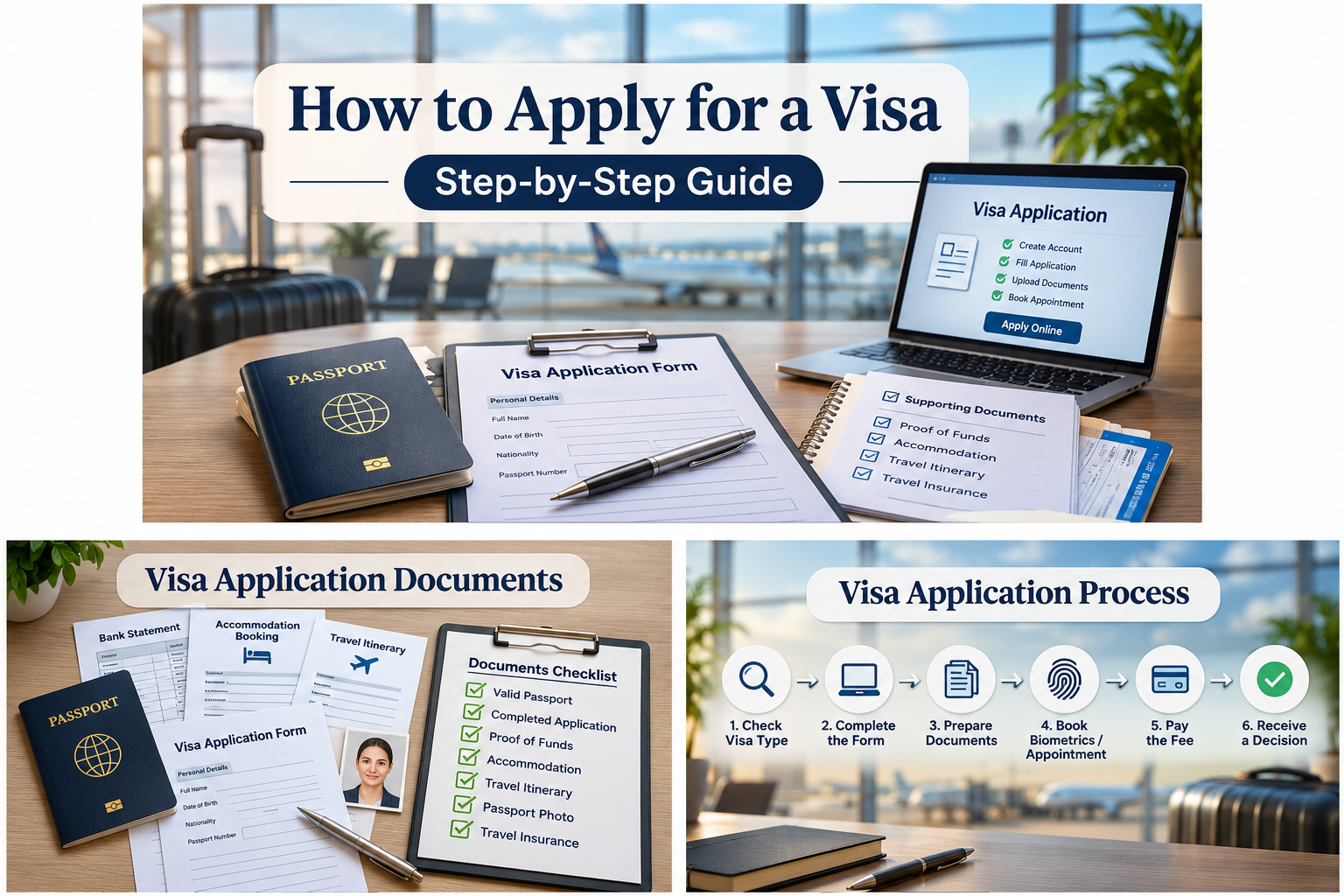
If you are planning to travel, work, study, visit family or move abroad, understanding how to apply for a visa is one of the first things you may need to do. The process can involve eligibility checks, application forms, supporting documents, fees, biometrics and, in some cases, an interview.
There is no single visa application process that applies to every country. Your nationality, destination, reason for travelling and intended length of stay can all affect whether you need a visa and which route you should use.
This guide explains how to apply for a visa step by step, what visa requirements you may need to meet, which documents can be required, how online applications work, what a visa may cost, how long a decision can take and what happens if an application is refused.
What Is a Visa?
A visa is a form of permission that allows an eligible traveller to enter, stay in or travel through another country for a specified purpose and period, subject to that country’s immigration rules.
Depending on the destination, permission may be issued electronically or recorded in another form. Some travellers may not need a conventional visa at all because they qualify for visa-free entry, an electronic travel authorisation or a visa on arrival.
Common visa categories include:
- Tourist and visitor visas
- Work visas
- Student visas
- Family visas
- Business visas
- Transit visas
- Residence visas
Choosing the correct category matters because the conditions attached to one visa may be completely different from another. A visitor visa, for example, should not automatically be treated as permission to work or live permanently in the destination country.
How to Apply for a Visa Step by Step
Although procedures vary between countries, most visa applications involve a similar sequence. Following the process in the correct order can help you avoid unnecessary delays and mistakes.
Step 1: Check Whether You Need a Visa
Before starting an application for a visa, establish whether one is actually required.
This can depend on your nationality, passport, destination, purpose of travel and intended length of stay. Existing visas or residence permits may also affect the entry rules in some countries.
You might qualify for:
- Visa-free travel
- Visa on arrival
- Electronic travel authorisation
- eVisa
- Traditional visa issued before travel
Do not assume that two people travelling from the same country have identical visa requirements. Nationality is often a major factor. Always check the official government or immigration authority for your destination before applying.
Step 2: Choose the Correct Visa Type
If you need a visa, identify the category that matches what you genuinely intend to do.
A holidaymaker may need a tourist or visitor visa. Someone moving abroad for employment may require a work visa, while an international student may need a student visa.
Before applying, check:
- What activities the visa permits
- How long you can stay
- Whether employment is permitted
- Whether study is permitted
- Whether dependants can accompany you
- Whether extensions are possible
- Whether the route can lead to residence or settlement
Choosing a visa simply because it looks easier or cheaper can create problems if it does not match your real purpose.
What Are the Requirements to Get a Visa?
One of the most common questions is: what are the requirements to get a visa? There is no universal answer. Visa requirements depend on the destination, visa category and applicant’s circumstances.
Common requirements can include:
- Valid passport or travel document
- Completed visa application form
- Passport photographs
- Evidence explaining the purpose of travel
- Proof of sufficient funds
- Accommodation information
- Travel itinerary
- Sponsorship evidence where applicable
- Employment or education documents
- Relationship evidence for some family routes
- Medical or health documentation for certain routes
- Police or criminal-record certificates where required
- Biometrics
- Payment of the application fee
A short tourist application may require relatively limited evidence, while work, study, family and residence applications can involve significantly more documentation. The official checklist for your specific visa should always take priority over generic online advice.
What Documents Are Required for a Visa Application?
The documents required for a visa depend on the route, but several types of evidence are commonly requested.
Passport or Travel Document
Your passport normally provides evidence of your identity and nationality.
Check whether the destination requires your passport to remain valid for a particular period after arrival or departure. Some countries also require blank pages or impose rules concerning damaged passports.
Visa Application Form
The visa application form may ask for your name, nationality, passport details, address, employment, education, family circumstances, travel history, proposed travel dates and reason for visiting.
Information in the form should be accurate and consistent with your supporting documents.
Financial Evidence
Some visa categories require evidence that you can pay for your trip or support yourself during your stay.
Depending on the route, this might include bank statements, payslips, savings evidence or sponsorship documentation.
Accommodation and Travel Information
You may need to explain where you intend to stay, how long you will remain and what you intend to do during the trip.
Requirements vary, so do not make expensive non-refundable bookings unless you understand what the relevant authority expects.
Evidence Supporting Your Travel Purpose
A student may need evidence of admission to an educational institution. A worker may require employment or sponsorship documentation. Family applications can require evidence of the relevant relationship.
Your visa application checklist should therefore be based on your actual visa route rather than a generic document list.
Can You Apply for a Visa Online?
Many immigration systems now allow applicants to apply for a visa online.
An online process can involve creating an account, completing the application form, uploading supporting documents, paying the fee and booking an appointment.
A typical online visa application may involve:
- Creating an application account
- Selecting the correct visa category
- Completing the online form
- Uploading supporting evidence
- Paying the visa fee
- Booking biometrics where required
- Attending an appointment if necessary
- Waiting for a decision
However, submitting a form online does not necessarily mean the entire process is digital. Some applicants still need to attend a visa application centre, provide fingerprints or submit their passport.
Use the official government portal or an authorised application provider. Avoid assuming that the first commercial website appearing in search results is the official visa service.
What Is a Visa Application Centre?
A visa application centre is a location used by some immigration authorities to handle administrative parts of the application process.
Depending on the system, applicants may attend a centre to provide fingerprints and a photograph, submit documents, verify their identity or complete other procedural requirements.
The application centre does not necessarily decide whether the visa will be granted. The immigration decision is generally made by the relevant government or immigration authority.
Do You Need a Visa Appointment?
Some applications require a visa appointment after the online form has been submitted.
At an appointment, you may need to:
- Verify your identity
- Present your passport
- Provide fingerprints
- Have a photograph taken
- Submit supporting documents
Follow the appointment instructions carefully and bring any documents specifically requested. Missing a mandatory appointment or biometric deadline can prevent an application from progressing.
What Happens at a Visa Interview?
Not every applicant has to attend a visa interview.
Where an interview is required, questions can relate to your travel purpose, finances, accommodation, employment, education, family circumstances and previous immigration history. Your answers should be truthful and consistent with your application.
Trying to guess what an interviewer wants to hear can create contradictions. Clear and accurate answers are more useful than rehearsed responses that do not match the evidence.
How Much Does a Visa Cost?
How much does a visa cost? There is no universal visa fee.
The amount can depend on:
- Destination
- Visa category
- Length of permission
- Number of permitted entries
- Applicant’s age or nationality
- Standard or priority processing
Applicants may also face additional costs for biometrics, document translation, medical examinations, application-centre services, courier services or professional advice. Always check the current fee on the official immigration or government website immediately before applying. Visa fees can change.
How Long Does It Take to Obtain a Visa?
How long does it take to obtain a visa? Processing times can range from days to several months.
Factors that can affect visa processing time include:
- Visa category
- Destination
- Application volumes
- Time of year
- Missing evidence
- Additional security or background checks
- Document verification
- Interviews
- Requests for further information
Published processing times should generally be treated as estimates unless the authority explicitly states otherwise. Avoid assuming that submitting an application guarantees a decision before your planned departure date.
When Should You Apply for a Visa?
The correct time to apply depends on the destination and visa category. Some immigration authorities accept applications several months before travel, while others impose a shorter application window.
Before deciding when to apply, check the earliest permitted application date, current processing times, appointment availability and how long it may take to receive your passport or digital status after a decision. Applying with a reasonable time buffer can reduce the risk of travel disruption.
How to Get a Visa: What Makes an Application Stronger?
If you are researching how to get a visa, it is important to understand that no legitimate adviser can guarantee approval.
The decision belongs to the relevant immigration authority. What applicants can control is the quality and accuracy of the application.
Meet the Eligibility Requirements
Check the rules before applying and make sure you can demonstrate that you meet the relevant criteria.
Submit Relevant Evidence
Provide the evidence required for your particular route instead of adding unnecessary documents simply to make the application look larger.
Keep the Application Consistent
Dates, finances, employment information, travel plans and supporting documents should make sense when considered together.
Explain Relevant Issues Clearly
If there is something unusual in your immigration or travel history that requires an explanation, address it accurately rather than hoping it will be ignored.
Review Everything Before Submission
Check names, passport numbers, dates, answers, uploaded files and supporting evidence before submitting the application.
Common Visa Application Mistakes
Understanding how do you get a visa also means understanding what can go wrong.
Common mistakes include:
- Applying for the wrong visa category
- Using an unofficial website
- Completing the wrong application form
- Providing inconsistent information
- Missing supporting documents
- Using an expired or unsuitable passport
- Failing to attend biometrics
- Missing an application deadline
- Providing unclear financial evidence
- Applying too close to the travel date
- Failing to disclose relevant immigration history
False information or fraudulent documents are particularly serious and can affect both the current application and future immigration matters.
Why Are Visa Applications Refused?
A visa application can be refused for many different reasons.
Common visa refusal reasons include:
- Failure to meet eligibility requirements
- Insufficient supporting evidence
- Financial concerns
- Inconsistent information
- Doubts about the stated purpose of travel
- Previous immigration breaches
- Incorrect visa category
- Failure to meet sponsorship requirements
- False information or documents
A refusal should be analysed before another application is submitted. Simply repeating the same application without addressing the underlying issue can produce the same result.
Can You Reapply After a Visa Refusal?
In many immigration systems, applicants can submit another application after refusal. However, whether you should reapply immediately depends on the reason for the decision.
Possible options can include making a fresh application, requesting an administrative review or pursuing an appeal where the relevant immigration system provides those rights.
If the refusal involves allegations of deception, previous immigration breaches or another complex issue, obtaining professional advice before reapplying may be sensible.
Visa Application Checklist
Before submitting an application, check that you have:
- Confirmed whether a visa is required
- Selected the correct visa category
- Checked the eligibility requirements
- Confirmed passport validity
- Completed the correct application form
- Prepared the required supporting documents
- Checked any financial requirements
- Arranged certified translations where required
- Paid the correct fee
- Booked biometrics or an appointment where required
- Reviewed all dates and personal details
- Kept copies of the application and evidence
- Checked current processing times
- Understood the conditions attached to the visa
A final review can catch simple errors before they become part of the official application.
How to Apply for a UK Visa
If your destination is the United Kingdom, the process should be checked against the specific UK immigration route rather than relying only on a generic visa procedure.
UKVI currently advises applicants to first check whether they need a visa and identify the correct route. Applicants then prepare the required evidence, apply online, pay the relevant fee and prove their identity. Depending on the application, identity may be verified through a visa application centre or the UK Immigration: ID Check app.
The visa you need depends on factors including where you come from, why you want to come to the UK, how long you intend to stay and your personal circumstances. Some travellers may require an Electronic Travel Authorisation rather than a visa.
UK visa applicants should also avoid booking travel on the assumption that an application will be approved. GOV.UK advises applicants not to book travel until a decision has been received.
What Documents Do You Need for a UK Visa?
The documents required depend on the UK immigration route.
For example, current Standard Visitor guidance requires a valid passport or travel document and asks applicants to provide information about matters such as intended travel dates, accommodation and trip costs. Depending on the circumstances, additional information about travel history, employment, sponsorship or family in the UK may also be required.
UKVI’s current visitor guidance also explains that applicants should demonstrate that they are genuine visitors, will leave at the end of their visit and can support themselves and meet the costs of their journey.
Other UK visa routes have different requirements, so a visitor document checklist should not be copied into a work, student or family application.
How Long Does a UK Visa Application Take?
UK processing times vary by route.
Current GOV.UK guidance states that applications to come to the UK generally take between 3 and 12 weeks, depending on the visa. Current published processing times for applications made outside the UK list approximately three weeks for Standard Visitor and Student applications and 12 weeks for several family routes, although individual cases can take longer.
Processing may take longer where information is inaccurate, further evidence is required, documents need verification, an interview is needed or personal circumstances require additional consideration.
Applicants should therefore check the latest official processing time for their particular route rather than relying on a single general timeframe.
How UK Immigration Solicitors Can Help
If you are trying to apply for a UK visa, UK Immigration Solicitors (UKIS) can advise on the immigration route relevant to your circumstances.
Our UK visa solicitors assist with visitor, work, student, family and other UK immigration applications. Depending on the case, this can include assessing eligibility, identifying supporting evidence, reviewing an application and advising where there has been a previous refusal or more complex immigration history.
UKIS advises on UK immigration law. If you are applying for a visa issued by another country, the application is governed by that country’s immigration rules and decided by its relevant authorities.
If you are unsure which UK immigration route applies to you, start with our free Immigration Assessment.
Frequently Asked Questions
How do I apply for a visa?
Check whether you need a visa, identify the correct category, confirm that you meet the requirements, prepare the supporting documents and complete the official application. You may then need to pay a fee, provide biometrics or attend an appointment before receiving a decision.
How do you apply for a visa?
The process usually involves checking your eligibility, choosing the correct visa, completing an application form, providing supporting evidence and paying the required fee. The exact procedure depends on the destination and visa type.
How can I get a visa?
Start with the official immigration rules for your destination. Determine which visa matches your purpose, make sure you meet the eligibility requirements and submit a complete application with the required evidence.
How to acquire a visa?
To acquire a visa legally, you need to use the official application route provided by the destination country, satisfy the relevant requirements and receive approval from the responsible immigration authority.
How to obtain a visa?
The usual process is to identify the appropriate visa category, complete the application, provide the required documents, pay the fee and complete any biometrics or interview requirements before a decision is made.
How to apply for a tourist visa?
First check whether your nationality requires a tourist visa for the destination. If it does, review the visitor requirements, complete the official application and provide the documents requested for tourism or short-term travel.
What are the requirements to get a visa?
Requirements depend on the country and visa category. They can include a valid passport, supporting evidence, financial documents, proof of travel purpose, biometrics and route-specific eligibility requirements.
What documents are required for a visa application?
Common documents can include a passport, application form, photographs, financial evidence and documents supporting the purpose of travel. The exact checklist depends on the visa.
Can I apply for a visa online?
Many countries allow online visa applications, although applicants may still need to attend an appointment for biometrics, passport checks or other requirements.
How much does a visa cost?
Visa fees vary according to the destination and visa category. Additional charges can apply for biometrics, priority processing, translations or other services. Always check the current official fee.
How long does it take to obtain a visa?
Processing can take anywhere from a few days to several months depending on the country, visa type and complexity of the application.
Can I apply again if my visa is refused?
Often yes, but you should understand and address the reason for the refusal before submitting another application. Depending on the immigration system, review or appeal rights may also exist.
Final Thoughts
Understanding how to apply for a visa is much easier when the process is approached in the correct order: check whether you need permission, select the right category, understand the eligibility rules, prepare the required evidence and complete the official application accurately.
Do not assume the same process applies everywhere. Visa applications, fees, processing times, supporting documents and eligibility requirements vary between countries and visa categories.
If you want to apply for a UK visa, the route-specific Immigration Rules matter. UKIS can help you understand your options and the evidence relevant to your circumstances through our free Immigration Assessment.