
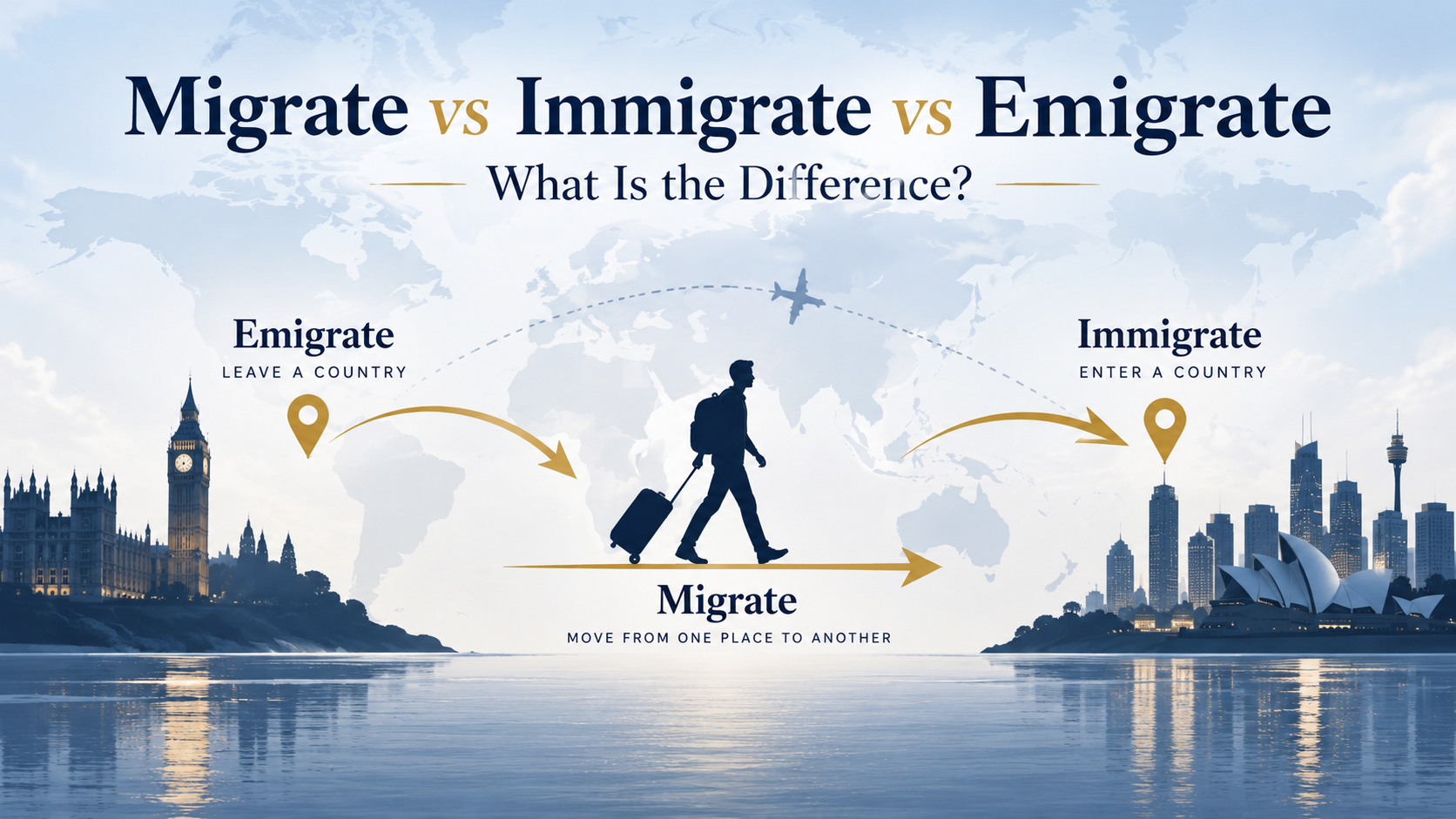
The difference between migrate, immigrate and emigrate is mainly about perspective.
Migrate is the broadest term. It means moving from one place to another, either within a country or between countries.
Immigrate means moving into another country to live there.
Emigrate means leaving one country to live in another.
For example, if someone moves from France to the UK, they emigrate from France, immigrate to the UK, and have migrated internationally.
A simple way to remember the difference is:
Migrate = Move
Immigrate = Into
Emigrate = Exit
The words describe related forms of movement, but they are not interchangeable. This guide explains when each term should be used and how they relate to UK immigration terminology.
Migrate, Immigrate and Emigrate: The Difference at a Glance
The easiest way to understand migrate vs immigrate vs emigrate is to look at what each word focuses on.
| Term | Meaning | Focus |
|---|---|---|
| Migrate | Move from one place to another | The overall movement |
| Immigrate | Move into another country to live there | The destination |
| Emigrate | Leave one country to live elsewhere | The country being left |
Imagine someone moving from Spain to the UK.
From the person’s overall perspective, they have migrated.
From Spain’s perspective, they have emigrated.
From the UK’s perspective, they have immigrated.
The movement is the same. The word changes according to the perspective from which it is being described.
Migration vs Immigration
The main difference between migration and immigration is that migration is the broader concept.
Migration can describe movement:
- within the same country;
- between different countries;
- for temporary or longer-term reasons;
- for work, study, family, safety or other purposes.
The Office for National Statistics describes migration broadly as the movement of people from one place to another. When a person changes residence from one country to another, that movement becomes international migration.
Immigration is more specific.
It refers to movement into a country from another country.
For example:
Manchester → London
This is migration within the UK, but it is not immigration.
Spain → UK
This is international migration and, from the UK’s perspective, immigration.
The distinction is therefore:
Migration describes movement generally, while immigration describes movement into another country.
Migrated vs immigrated
The same distinction applies to migrated and immigrated.
Use migrated when referring broadly to movement.
“The family migrated from one region to another.”
Use immigrated when someone specifically moved into another country to live there.
“The family immigrated to the UK.”
A person can therefore have migrated internationally and immigrated to a particular country at the same time.
Immigration vs Emigration
Immigration and emigration describe opposite sides of the same international move.
Immigration focuses on arrival.
Emigration focuses on departure.
Consider a person moving from Italy to the UK:
Italy → UK
From Italy’s perspective:
The person is emigrating from Italy.
From the UK’s perspective:
The person is immigrating to the UK.
The Office for National Statistics uses the same directional distinction when measuring UK international migration: immigration refers to people moving from another country to live in the UK, while emigration refers to people leaving the UK to live elsewhere.
Immigrating or emigrating?
Whether you should say immigrating or emigrating depends on which country you are talking about.
A useful grammar rule is:
Emigrate from a country.
Immigrate to a country.
For example:
“She emigrated from Australia.”
“She immigrated to the UK.”
Both statements can describe exactly the same person and journey.
Immigrant vs Emigrant vs Migrant
The same distinctions apply when describing the person who moves.
| Term | Meaning |
|---|---|
| Migrant | A person who moves from one place to another |
| Immigrant | A person who moves into another country |
| Emigrant | A person who leaves one country to live elsewhere |
A migrant is therefore the broadest term.
An immigrant and an emigrant are both migrants when they are moving between countries, but the words describe that movement from different viewpoints.
Can someone be both an immigrant and an emigrant?
Yes.
Suppose a person moves from Pakistan to the UK.
That person is:
- an emigrant from Pakistan;
- an immigrant in the UK;
- an international migrant.
These terms do not describe three different people. They describe the same person’s movement from different perspectives.
The ONS similarly defines an emigrant as someone leaving their country of usual residence for another country, while an immigrant is someone arriving from abroad.
Migrated vs Immigrated: Which Word Should You Use?
Use migrated when the focus is on movement generally.
Examples include:
“People migrated from rural areas to major cities.”
“The family migrated south for employment.”
“Thousands of people migrated between the two regions.”
The movement does not necessarily have to cross an international border.
Use immigrated when you specifically mean that someone entered another country to live there.
For example:
“She immigrated to the UK from Canada.”
“His parents immigrated to Britain many years ago.”
The simple distinction is:
Migrated = moved
Immigrated = moved into another country
This is why “migration” can cover a much wider range of movement than “immigration”.
Common Mistakes With Migrate, Immigrate and Emigrate
The words are closely related, so several common mistakes occur.
Saying “immigrate from”
If you are focusing on the country someone leaves, emigrate from is normally the more precise phrase.
Instead of:
“He immigrated from Germany.”
A clearer construction is:
“He emigrated from Germany.”
If you want to use immigrated, focus on the destination:
“He immigrated to the UK from Germany.”
Saying “emigrate to”
When the focus is on arriving in a country, immigrate to is usually more precise.
For example:
“She immigrated to Canada.”
When focusing on departure:
“She emigrated from the UK.”
Treating migrant and immigrant as exact synonyms
An immigrant is a type of migrant, but the words are not always interchangeable.
Migration can happen within the same country.
Immigration involves movement from one country into another.
Calling someone who moves within the UK an immigrant
A person who moves from Birmingham to Glasgow has migrated within the UK, but they have not immigrated to another country.
That is internal migration rather than international immigration.
How These Terms Are Used in UK Immigration
In everyday language, migrate, immigrate and emigrate describe movement.
In UK public policy and official statistics, however, the terms can also have more specific definitions depending on what is being measured.
For example, the Office for National Statistics currently defines a long-term international migrant using the internationally recognised concept of someone changing their country of usual residence for at least 12 months. For its long-term estimates, immigration means moving to the UK from abroad for that period, while emigration means leaving the UK to live elsewhere.
These statistical definitions should not be confused with a person’s legal UK immigration status.
Someone may be described as an immigrant or migrant in ordinary language while holding a particular legal status such as:
- a work visa;
- a family visa;
- student permission;
- Indefinite Leave to Remain;
- settled status;
- British citizenship.
The words migrant, immigrant and emigrant describe movement or perspective. They do not, by themselves, tell you what immigration permission a person holds.
For legal purposes, a person’s right to enter, live, work or settle in the UK depends on their nationality, circumstances and the immigration rules applying to them.
Quick Examples
The following examples show how the terms work in practice.
| Situation | Appropriate Term |
|---|---|
| Moving from Leeds to London | Migration |
| Moving from India to the UK | International migration / immigration to the UK |
| Leaving France to settle in Canada | Emigration from France |
| Arriving in Canada from France | Immigration to Canada |
| Describing the entire France-to-Canada journey | International migration |
| A person arriving in another country to live | Immigrant |
| The same person from the country they left | Emigrant |
| General term for someone who moves | Migrant |
The easiest way to decide which word to use is to ask:
Am I describing the movement, the country being entered or the country being left?
If you are describing the movement generally, use migration.
If you are focusing on arrival, use immigration.
If you are focusing on departure, use emigration.
Frequently Asked Questions
What is the difference between migrate and immigrate?
Migrate means moving from one place to another and can include movement within a country or between countries. Immigrate specifically means moving into another country to live there. Immigration is therefore one form of migration.
What is the difference between immigration and emigration?
Immigration describes entering a country to live there, while emigration describes leaving a country to live elsewhere. Someone moving from Ireland to the UK would emigrate from Ireland and immigrate to the UK.
Can someone be both an immigrant and an emigrant?
Yes. The terms describe the same move from different perspectives. Someone leaving one country is an emigrant from that country and becomes an immigrant in the country they move to.
Is every immigrant a migrant?
In the broad sense, yes. An immigrant has moved from one country into another, making them an international migrant. However, not every migrant is an immigrant because migration can also take place within one country.
What is the difference between migrated and immigrated?
Migrated means moved from one place to another generally. Immigrated specifically means moved into another country to live there.
For example, someone might migrate between two regions of the same country, but they would immigrate only when entering another country to live.
Should I say immigrated to or emigrated from?
Use immigrated to when focusing on the destination and emigrated from when focusing on the country being left.
For example:
“She immigrated to the UK.”
“She emigrated from Australia.”
Is moving within the UK immigration?
Normally, no. Moving from one part of the UK to another is internal migration rather than international immigration.
Migrate, Immigrate and Emigrate: The Simple Difference
The easiest way to remember these three terms is:
Migrate = move
Immigrate = move in
Emigrate = move out
Migration is the broad term. Immigration focuses on the destination, while emigration focuses on the place being left.
A single person can therefore migrate internationally, emigrate from one country and immigrate to another.
When discussing the UK, however, these words should not be confused with legal immigration status. The right to enter, work, study, remain permanently or become a British citizen depends on the immigration route and legal requirements applying to the individual.