
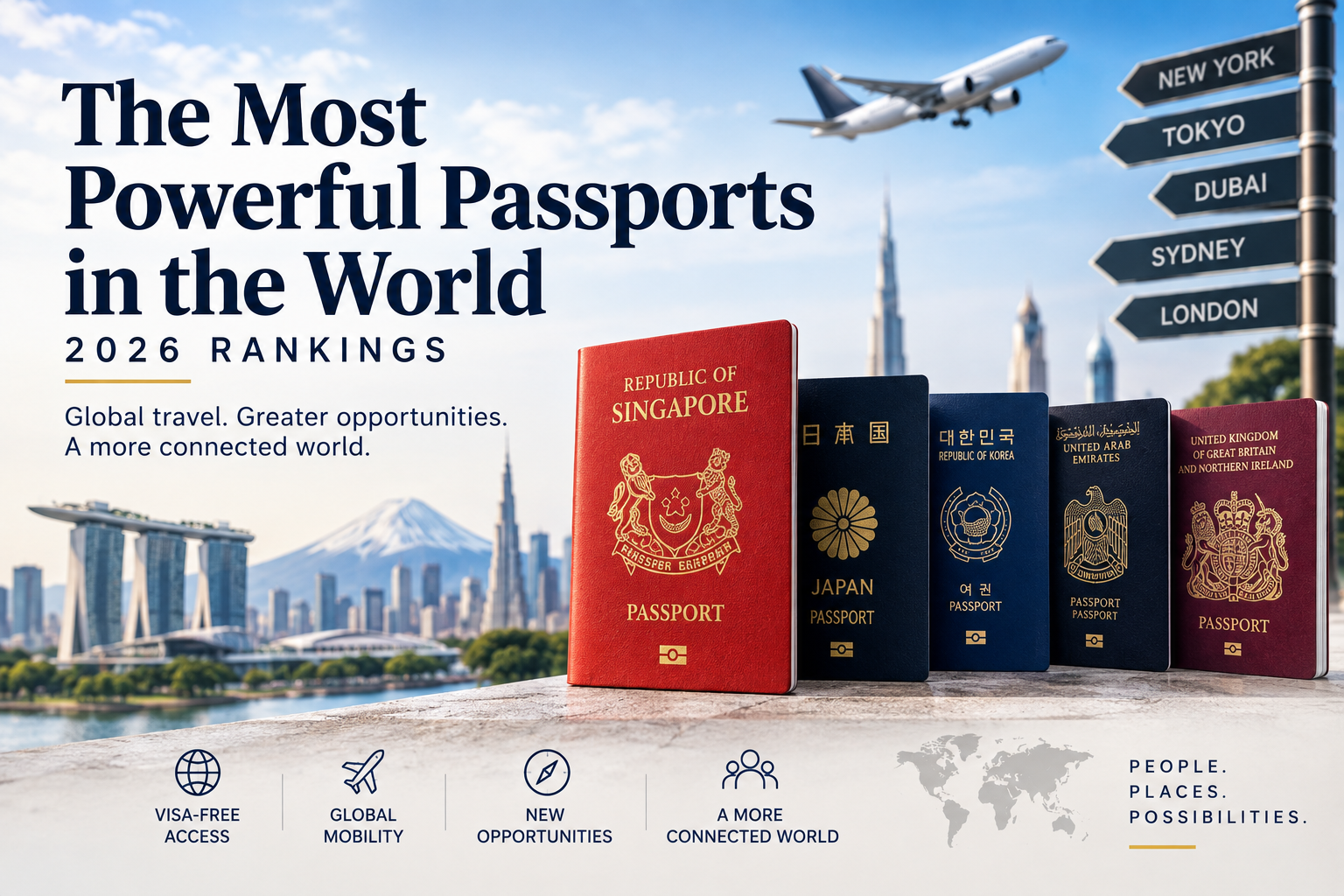
Singapore currently holds the top position in the Henley Passport Index, with its citizens able to access 192 destinations without obtaining a prior visa under the index’s methodology. Japan, South Korea and the United Arab Emirates share second place with access to 188 destinations.
However, describing a passport as “powerful” does not mean its holder can automatically live, work or settle wherever they choose. Passport rankings primarily measure short-term international travel mobility.
The rankings can also differ depending on the index being used. Different organisations count entry arrangements differently and update their data on different schedules.
This guide looks at the leading passports in 2026, explains how passport strength is calculated, shows where the British passport currently ranks and clarifies what these rankings mean in practical immigration terms.
The World’s Leading Passports in 2026
The July 2026 edition of the Henley Passport Index places Singapore alone at the top.
Because many countries have identical access scores, several share the same ranking position.
| Rank | Passport(s) | Destinations accessible without a prior visa* |
|---|---|---|
| 1 | Singapore | 192 |
| 2 | Japan, South Korea, United Arab Emirates | 188 |
| 3 | Sweden | 187 |
| 4 | Belgium, Denmark, Finland, France, Germany, Ireland, Italy, Luxembourg, Netherlands, Norway, Spain | 186 |
| 5 | Austria, Greece, Malta, Portugal, Switzerland | 185 |
| 6 | Hungary, Poland, United Kingdom | 184 |
| 7 | Australia, Canada, Czechia, Latvia, Malaysia, New Zealand, Slovakia, Slovenia | 183 |
| 8 | Croatia, Estonia | 182 |
| 9 | Liechtenstein, Lithuania | 181 |
| 10 | Iceland, United States | 180 |
*Under Henley’s methodology, the score includes qualifying visa-free entry, visa on arrival and certain electronic travel authorisations that do not require prior government approval.
The table illustrates how tightly grouped the upper end of the ranking has become. Only eight destinations separate Singapore in first place from the UK in sixth.
It also shows that the “top 10” contains far more than ten countries because passports with the same mobility score share the same position.
What Does Passport Strength Actually Measure?
Passport strength is generally used to describe how easily a passport holder can travel internationally without arranging a conventional visa before departure.
The Henley Passport Index compares the access available to holders of 199 passports across 227 destinations.
The type of entry permission matters.
Visa-free entry
A traveller can enter the destination for an eligible short stay without obtaining a visa beforehand.
They must still satisfy the destination’s entry requirements.
Visa on arrival
The traveller does not need to secure the visa before departure and can obtain the relevant permission after arriving at the border or airport.
Henley treats qualifying visa-on-arrival access as contributing to the passport’s score.
Electronic travel authorisation
Some countries require visa-exempt visitors to obtain a relatively simple digital authorisation before travelling.
Under Henley’s methodology, an ETA can count towards the mobility score where it does not amount to a conventional pre-approved visa application.
Electronic visas and prior visas
A destination generally does not contribute to the Henley score if the traveller needs a government-approved e-visa or traditional visa before departure.
This is why a passport score should not simply be described as the number of countries someone can enter “with no formalities”. Entry requirements can still apply.
Passport strength measures ease of short-term travel. It does not measure an unrestricted right to immigrate, work or settle abroad.
How Are Passport Rankings Calculated?
For this article, the primary benchmark is the Henley Passport Index.
Henley compares 199 passports against 227 travel destinations using data from the International Air Transport Association’s Timatic system, supplemented by its own research. The ranking is updated monthly.
Under its scoring method:
- qualifying visa-free access scores one point;
- qualifying visa-on-arrival access scores one point;
- qualifying ETA access scores one point;
- a traditional visa required before travel scores zero;
- an e-visa requiring prior government approval generally scores zero.
The final score is the number of destinations accessible under the qualifying conditions. Passports with the same score share the same rank.
Why do passport indexes sometimes disagree?
There is no single legally recognised global definition of the “strongest passport”.
Different rankings can use:
- different destination lists;
- different definitions of visa-free travel;
- different treatment of electronic visas and authorisations;
- different scoring formulas;
- different update dates.
For example, while Henley’s July 2026 ranking places Singapore first, the separate Passport Index 2026 Global Passport Power Rank currently places the United Arab Emirates first and Singapore second under its own system.
The source and methodology therefore matter whenever a ranking is quoted.
Where Does the British Passport Rank?
The British passport is currently joint sixth in the July 2026 Henley Passport Index, with access to 184 destinations without a prior visa under the index methodology. It shares sixth place with Hungary and Poland.
The UK moved up one position from the beginning of 2026 after gaining access to China and Malawi without a prior visa under the relevant arrangements.
A sixth-place position means the British passport remains one of the world’s stronger travel documents, although its relative ranking has declined over the longer term.
In 2006, the UK ranked third. The UK and United States later shared first place in 2014. By July 2026, the UK stood sixth and the United States tenth.
That does not mean British citizens have lost most of their international mobility. Rather, other passports have gained access and moved ahead or into the same highly competitive group.
For people interested in obtaining a British passport, the underlying issue is normally whether they hold or can acquire British citizenship. A passport is evidence of nationality and a travel document; it is not itself an immigration route.
Which Countries Dominate the Top of the Ranking?
The leading group reflects a mixture of Asian, European and Middle Eastern mobility strength.
Asia remains prominent at the very top
Singapore holds first place, while Japan and South Korea share second.
Singapore ranked eighth when the Henley index began in 2006, showing how substantially international travel access can change over time.
Europe has the greatest depth
Although Singapore leads individually, European countries dominate the wider upper tier.
Sweden is third, eleven European passports share fourth place, five share fifth, and Hungary, Poland and the UK sit together in sixth.
Henley reports that 29 of the 38 passports occupying the top 10 ranking positions in July 2026 are European.
The UAE has risen particularly quickly
The United Arab Emirates is now joint second with Japan and South Korea.
Henley describes the UAE as the largest long-term improver in the history of its index, having added 153 destinations over the past 20 years.
This demonstrates an important point: passport rankings are not permanent.
Why Do Passport Rankings Change?
A passport can gain or lose access as governments change their entry policies and international relationships.
Several developments can affect a mobility score.
New visa-waiver arrangements
Two countries may agree that each other’s nationals can make eligible short visits without obtaining a traditional visa.
That can increase the affected passport’s score.
Changes in diplomatic relationships
Travel arrangements are often influenced by wider bilateral relationships, although the reasons for any particular policy change vary.
Reciprocity
Governments sometimes take into account how their own citizens are treated when deciding whether visitors from another country should receive visa-free access.
Security and immigration policy
Entry requirements can be tightened or relaxed in response to security, migration-management or other policy considerations.
Changes to electronic entry systems
Moving from a traditional visa to a simplified ETA, or in the other direction, can affect a passport’s ranking depending on the index methodology.
Because policies change throughout the year, the Henley Passport Index is updated monthly rather than treated as a fixed annual table.
Does a Powerful Passport Give You Immigration Rights?
No.
This is one of the most important distinctions to understand when looking at passport rankings.
A high mobility score mainly concerns entry for qualifying short visits.
It does not automatically give the passport holder permission to:
- take employment;
- establish a business;
- study for an extended period;
- live permanently in another country;
- bring family members to settle;
- access public funds or services;
- acquire permanent residence;
- become a citizen of the destination.
For example, a British passport holder may be able to visit many countries without applying for a traditional visa beforehand, but they may still need an appropriate work, study, family or residence permit if they intend to move there.
The same principle applies to foreign nationals travelling to the UK.
Travel access and immigration permission are separate legal concepts.
A passport ranking therefore tells you a great deal about travel convenience, but considerably less about where someone has a legal right to establish their life.
Can You Legally Obtain Another Passport?
A person normally becomes entitled to another country’s passport by first obtaining or already possessing that country’s citizenship or nationality.
The routes differ considerably between countries, but they may include the following.
Citizenship by birth
Some people acquire citizenship automatically because of where they were born, although the rules vary.
Citizenship by descent
A person may acquire or qualify for citizenship through a parent or, in some countries, another ancestor.
For the UK, the outcome can depend on factors including when and where the person and their British parent were born.
Naturalisation
A foreign national who has lived legally in another country for the required period may eventually become eligible to apply for citizenship.
For people seeking British nationality, this may involve meeting the requirements for British citizenship by naturalisation.
Family connections
Marriage or another family relationship can sometimes affect a person’s route to citizenship, but it does not necessarily grant nationality automatically.
Dual citizenship
Some countries permit their nationals to hold more than one citizenship.
The UK permits dual citizenship, meaning a British citizen can also hold another nationality where the other country’s law allows it. GOV.UK cautions that not every country permits dual nationality.
A second citizenship should therefore be considered as a question of nationality law, not simply as a way of “upgrading” a passport ranking.
What Should You Keep in Mind When Comparing Passport Rankings?
Passport tables are useful, but a ranking number does not tell the whole story.
Before drawing conclusions from one, consider five points.
Check the date. Visa policies can change and rankings can move within the same year.
Check the source. Two indexes using different methodologies may produce different leaders.
Look beyond the rank. Countries separated by several ranking positions may differ by only a handful of destinations.
Distinguish travel from immigration. Visa-free visitor access does not mean unrestricted rights to work or settle.
Check the destination itself before travelling. Even visa-exempt travellers may need an ETA, minimum passport validity, proof of onward travel, sufficient funds or other documentation.
The index itself should therefore be treated as a useful global comparison rather than a substitute for checking the actual entry rules of the country you intend to visit.
Key Takeaways
As of the July 2026 Henley Passport Index:
- Singapore ranks first, with access to 192 destinations without a prior visa under Henley’s methodology.
- Japan, South Korea and the UAE share second place, with 188.
- Sweden ranks third, with 187.
- A large group of European countries dominates the next several positions.
- The United Kingdom is joint sixth, with a score of 184.
- The United States is joint tenth, with 180.
- Passport rankings primarily measure short-term global mobility, not the right to work, live or settle abroad.
Frequently Asked Questions
What is the most powerful passport in the world?
According to the July 2026 Henley Passport Index, Singapore has the highest-ranked passport, providing access to 192 destinations without requiring a prior visa under the index’s methodology.
How is passport strength measured?
The Henley Passport Index measures how many of 227 destinations a holder of each of 199 passports can access without obtaining a prior visa. Qualifying visa-free, visa-on-arrival and ETA access contribute to the score.
Which country has the strongest passport in Europe?
Sweden is currently the highest-ranked European country in the July 2026 Henley Passport Index. It is third globally, with access to 187 destinations under the index methodology.
Where does the British passport rank in 2026?
The UK passport is joint sixth, alongside Hungary and Poland, with access to 184 destinations without a prior visa under Henley’s methodology.
Is the British passport still powerful?
In travel-mobility terms, yes. A joint sixth-place position places the UK among the highest-ranked passports globally. However, passport rankings measure travel access rather than the full set of rights associated with British citizenship.
Why do different passport rankings show different results?
Different indexes can use different destination lists, definitions of visa-free entry and scoring systems. As a result, one index may rank Singapore first while another places the UAE at the top. Always check the methodology as well as the headline ranking.
Does a strong passport let you live in another country?
No. Visa-free entry normally relates to eligible short visits. Working, studying long term, joining family or settling permanently usually requires separate immigration permission unless the person has an independent legal right to reside there.
Can you legally hold two passports?
It can be possible where the nationality laws involved allow dual citizenship. The UK allows dual citizenship, but some countries restrict or prohibit it. A person should therefore check the rules of both countries.
Do passport rankings change every year?
Yes, and they can change more frequently than once a year. Visa-waiver agreements and entry policies can change throughout the year. The Henley Passport Index is currently updated monthly.
Understanding Passport Power in 2026
Singapore currently leads the Henley Passport Index, while Japan, South Korea and the UAE form the next group. The British passport remains highly ranked in sixth place.
But the value of a passport ranking should be understood correctly.
These indexes primarily measure ease of international travel without obtaining a prior visa. They do not measure an unrestricted right to move abroad, take employment or become resident in another country.
For people interested in British nationality rather than travel rankings alone, eligibility for British Citizenship, British Citizenship by Descent, Naturalisation or Dual Citizenship depends on the relevant nationality rules and individual circumstances.
Passport rankings and visa-access arrangements can change. Travellers should check current entry requirements with the relevant government or official authority before making travel arrangements. This article provides general information and does not constitute immigration or nationality advice.