
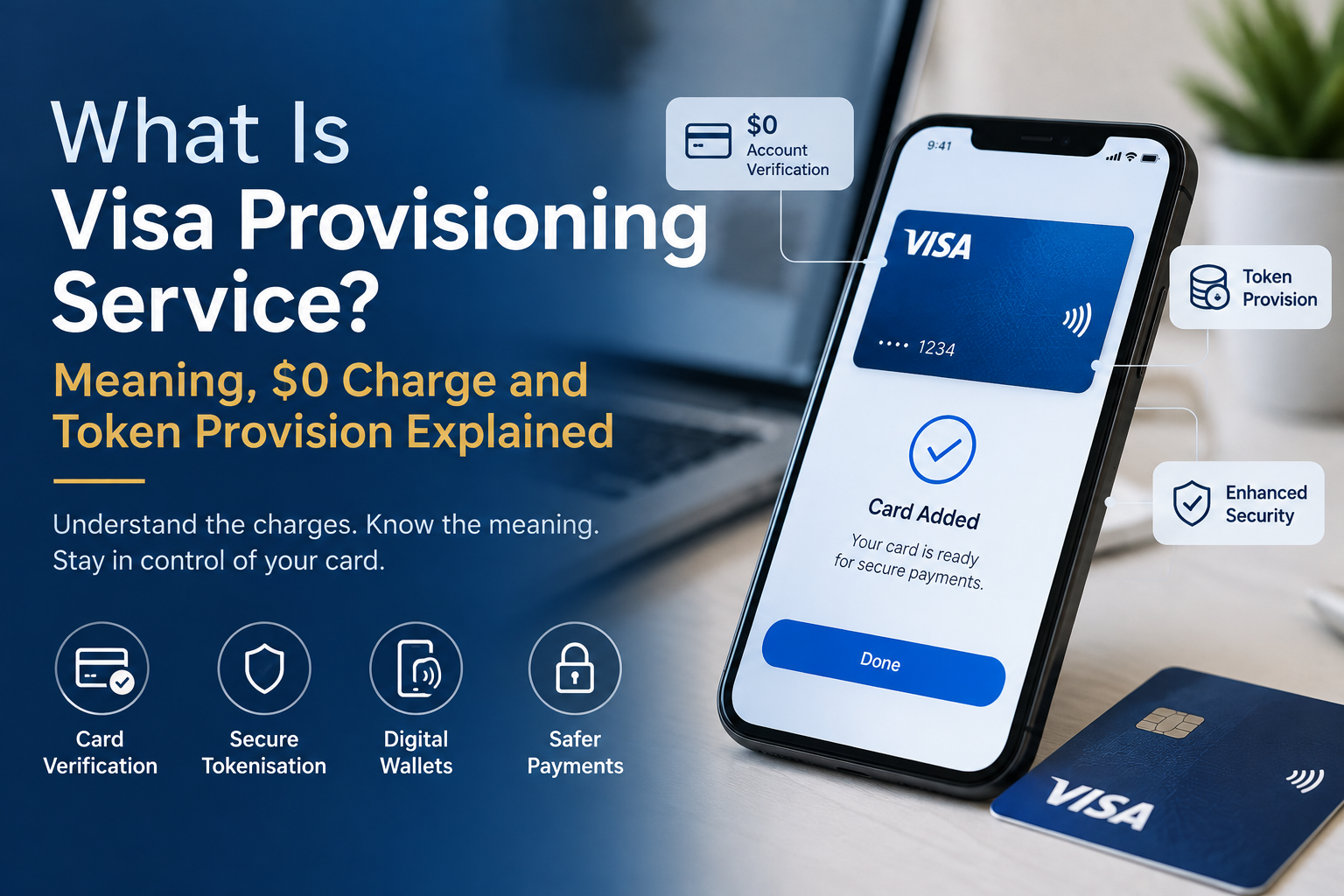
If you have noticed Visa Provisioning Service or a $0 Visa transaction on your bank or card account, it may be connected with the process used to set up or verify your card for digital payments.
In simple terms, Visa provisioning involves preparing a Visa payment credential for use with a digital service, such as a mobile wallet or other token-enabled payment environment. Instead of relying on the card’s underlying account number for every digital payment, Visa’s tokenisation technology can use a separate payment token.
Visa officially describes Visa Token Service as technology that enables tokenised payments across environments including mobile devices, wearables, e-commerce and card-on-file solutions.
A $0 entry does not necessarily mean that money has been taken from your account. Zero-amount authorisations can be used to check whether a card account is valid before a payment credential is used.
However, if you see provisioning activity that you cannot explain, particularly alongside unfamiliar transactions or verification requests, you should check the activity with your card issuer.
What Is Visa Provisioning Service?
The term Visa Provisioning Service generally refers to activity associated with provisioning a Visa payment credential for digital use.
Visa’s official terminology includes Visa Token Service and Visa Token Service Provisioning and Credential Management. Visa describes its provisioning technology as enabling issuers to make Visa cards available securely for use in digital wallets.
Visa Provisioning Service meaning in simple terms
Think of provisioning as setting up your card for a particular type of digital payment.
For example, when an eligible card is added to a supported digital wallet, information about the card may need to be verified and an appropriate digital payment credential established.
Tokenisation can then allow a payment token to be used rather than repeatedly exposing the underlying card number.
This means the phrase does not refer to an immigration visa service. In this context, Visa is the global payments network.
When might you encounter Visa provisioning?
Provisioning technology can be relevant when cards are being enabled for digital-payment environments such as:
- mobile wallets;
- contactless payments through mobile devices or wearables;
- in-app payments;
- e-commerce payments;
- merchant card-on-file services.
Visa states that its Token Service supports contactless and in-app payments as well as remote e-commerce and card-on-file payment use cases.
Exactly what appears on your banking app or statement can vary according to your card issuer, payment provider and the service being used.
What Is Token Provision?
Token provision, or token provisioning, is the process through which a payment token is created or made available for an eligible payment credential.
The purpose is to allow digital payments without requiring the underlying card number to be used in exactly the same way for every transaction.
What is a payment token?
A payment token is a digital credential associated with a payment account.
Rather than a digital wallet or other payment environment relying solely on the original card account number, tokenisation allows another credential to represent the account for approved payment use.
Visa Token Service is based on the EMV Payment Tokenisation framework and supports tokenised payments in several digital environments.
Why are payment tokens used?
Tokenisation can help reduce exposure of sensitive payment credentials.
It is particularly useful in digital environments because a token can be associated with the payment use for which it was created rather than requiring the same underlying credential to be presented everywhere.
Visa describes its Token Service as a technology designed to support digital payments while reducing risks associated with payment credentials.
Tokenisation should not, however, be interpreted as meaning fraud is impossible. Consumers should still investigate unfamiliar payment or wallet activity.
How does token provisioning work?
The precise technical process depends on the payment environment and participating organisations, but a simplified flow can look like this:
- A card is submitted for digital use.
You may add an eligible Visa card to a wallet or another supported service. - A provisioning or token request is made.
The payment service requests the appropriate digital credential. - Card or account information may be verified.
The issuer and payment network can participate in checks before the credential is approved. - A token is provisioned.
If the relevant checks are satisfied, a payment token can be associated with the digital payment environment. - The token can then be used for supported payments.
The payment environment uses the tokenised credential according to the applicable payment process.
For the consumer, much of this may happen automatically while adding or setting up a card.
Why Does Visa Provisioning Service Show a $0 Transaction?
One of the most common questions is “What is Visa Provisioning Service $0?”
A $0 entry can be associated with account verification, where a payment system checks the validity of a card without making a normal purchase.
Visa Acceptance documentation states that a zero-amount authorisation can be used to determine whether a payment-card account is valid and whether the card has been reported lost or stolen.
What does a $0 Visa verification mean?
A zero-amount authorisation is essentially a validation request.
Instead of authorising a purchase for £10, £50 or another amount, the system sends an authorisation with a value of zero.
The aim is to verify the payment credentials rather than charge the cardholder for goods or services.
Visa Acceptance identifies this type of process as Visa Account Verification.
Does a $0 authorisation take money from your account?
A genuine zero-amount authorisation does not contain a purchase amount to capture.
Visa Acceptance’s documentation states specifically that a zero-amount authorisation cannot be captured.
Depending on your bank or card provider, you may still notice the verification in your transaction history, pending activity or notifications.
The important distinction is that seeing a verification entry does not necessarily mean a completed payment has been taken from the account.
Why can this happen when setting up digital payments?
Digital-payment services may need to verify that the card being enrolled is valid before allowing it to be used.
This type of account verification can therefore occur around card setup, storage or other digital-payment activity.
If you recently added your Visa card to a digital wallet or another legitimate payment service, a verification event may be consistent with that activity.
Is Visa Provisioning Service a Real Charge?
A Visa Provisioning Service charge should not automatically be treated as a normal purchase.
First, check what actually appears in your account.
A $0 authorisation and a completed non-zero card transaction are different things.
If the entry is $0
A $0 entry may simply represent account verification.
As explained above, zero-amount authorisations are used to check card validity and cannot themselves be captured as a payment.
If there is an actual amount
If the entry involves money rather than $0, check it more carefully.
Review:
- the exact amount;
- whether it is pending or completed;
- the transaction date;
- whether you recently added or updated the card in a digital service;
- whether there are any other unfamiliar transactions.
Do not assume that every non-zero payment is simply part of token provisioning.
If money has been charged and you cannot identify the transaction, contact your bank or card issuer through an official channel.
Is Visa Provisioning Service a subscription?
Token provisioning itself should not be confused with a consumer subscription simply because an unfamiliar descriptor appears.
A subscription or recurring payment is a separate payment arrangement.
If you see repeated monetary transactions, examine the merchant and transaction information supplied by your bank rather than assuming they are all provisioning events.
Is Visa Provisioning Service Safe?
Visa’s tokenisation and provisioning technologies are legitimate components of its digital-payment infrastructure.
Visa says its Token Service supports secure digital-payment use cases across mobile, wearable, in-app, e-commerce and card-on-file environments.
The more important question for a cardholder is whether you recognise the activity that caused the provisioning or verification.
When the activity may be expected
It may make sense if you have recently:
- added your Visa card to a digital wallet;
- set up mobile or contactless payments;
- enrolled a card with a supported digital service;
- replaced or updated payment credentials;
- saved your card for certain online-payment uses.
Recognised activity around the same time can help explain why verification or provisioning occurred.
When you should investigate
Take a closer look if:
- you have not recently added the card to any digital service;
- an unfamiliar device or wallet appears to be using your card;
- you receive an unexpected verification code or approval request;
- you notice a non-zero transaction you cannot identify;
- other suspicious card activity appears at the same time.
A provisioning entry alone does not prove fraud, but unexplained activity should not simply be ignored.
What Should You Do If You Do Not Recognise Visa Provisioning Activity?
If the activity is unfamiliar, check it systematically rather than assuming either that it is harmless or that your card has definitely been compromised.
1. Think about recent card setup
Check whether you recently added, removed, replaced or updated the card in:
- a digital wallet;
- an app;
- a website;
- another stored-payment service.
That may explain the verification.
2. Review the transaction carefully
Check whether the entry is:
- $0;
- pending;
- completed;
- associated with another monetary transaction.
The distinction matters.
3. Check your digital wallets and devices
Review services where the card may be stored.
If your bank provides controls for connected wallets or digital cards, review them for anything unfamiliar.
4. Do not approve unexpected authentication requests
If you receive a one-time passcode, app approval request or other authentication message for an action you did not initiate, do not approve it.
Never give security codes to somebody who contacts you unexpectedly.
5. Contact your card issuer
If you cannot explain the provisioning event, contact your bank or card issuer using:
- the official banking app;
- the telephone number printed on your card;
- the issuer’s verified website.
Your issuer has access to account-specific transaction information that a general online guide cannot see.
6. Follow the issuer’s security advice
Depending on what the issuer finds, it may recommend steps such as monitoring the account, removing a digital credential, freezing the card or replacing it.
Follow the account-specific guidance provided by your bank.
Visa Provisioning Service vs a Normal Card Payment
Although they may both appear within card activity, provisioning-related verification and ordinary purchases serve different purposes.
| Feature | Provisioning or Verification | Normal Card Purchase |
|---|---|---|
| Main purpose | Set up or verify payment credentials | Pay for goods or services |
| Can involve $0 | Yes | Usually not |
| May be connected with token creation | Yes | Not normally the purpose |
| Does $0 verification take payment? | No | Not applicable |
| Common trigger | Card or digital-payment setup | A purchase |
| What to do if unrecognised | Check wallet activity and contact issuer if needed | Check merchant and contact issuer if needed |
This distinction can help explain why a Visa-related entry appears even though you do not remember making a purchase.
Common Misunderstandings About Visa Provisioning Service
“Visa Provisioning Service is related to immigration visas.”
No.
In this context, Visa refers to the payments company and payment network, not permission to enter or remain in a country.
“A $0 Visa Provisioning Service entry means money was charged.”
Not necessarily.
A genuine zero-amount authorisation has no amount to capture and can be used for account validation.
“Token provision means a merchant receives my normal card number.”
The purpose of payment tokenisation is to enable a tokenised credential to represent the payment account in supported environments rather than relying solely on the underlying card credential.
“Every Visa provisioning notification means fraud.”
No.
Provisioning can be legitimate, particularly if you have recently set up your card for digital payments.
“If it is only $0, I can always ignore it.”
Not necessarily.
If you recognise the card setup that caused it, the verification may be expected. If you did not initiate anything and cannot explain the activity, contacting your card issuer is the safer approach.
Frequently Asked Questions About Visa Provisioning Service
What is Visa Provisioning Service?
Visa Provisioning Service generally refers to activity involved in preparing or verifying a Visa payment credential for digital use. It can be associated with Visa’s tokenisation technology, which supports digital wallets, mobile payments and other token-enabled payment environments. Visa officially refers to products including Visa Token Service and Visa Token Service Provisioning and Credential Management.
What does Visa Provisioning Service mean on a bank statement?
It may indicate that card credentials were being verified or provisioned for a digital-payment service. Check whether you recently added or updated your card in a wallet or payment platform. If the entry is unfamiliar, confirm the details with your card issuer.
What is Visa Provisioning Service $0?
A $0 entry can represent a zero-amount authorisation used to verify a payment-card account without making a normal purchase. Visa Acceptance documentation states that zero-amount authorisation can check whether an account is valid and that the authorisation cannot be captured.
What is token provision?
Token provision is the process of establishing a digital payment token for use with an eligible card or payment account. The token can then be used within an approved digital-payment environment rather than relying solely on the underlying card credential.
Is Visa Provisioning Service a charge?
Not necessarily. A $0 provisioning-related authorisation is an account verification rather than a normal completed purchase. If there is a non-zero amount, inspect the transaction details separately and contact your issuer if you do not recognise it.
Is Visa Provisioning Service legitimate?
Visa’s payment tokenisation and provisioning technology is legitimate. However, legitimate technology can still generate activity that a cardholder did not initiate. If you cannot connect an entry to something you recently did, check it with your card issuer.
Why is my Visa card being tokenised?
Tokenisation enables an eligible Visa card to be used in supported digital-payment environments such as mobile wallets, wearables, in-app payments and e-commerce services.
Does Visa provisioning mean someone added my card to a digital wallet?
Not necessarily. Provisioning can occur in different digital-payment contexts. If you did not initiate any relevant card setup and the activity is unfamiliar, contact your card issuer for account-specific information.
Should I contact my bank if I do not recognise Visa Provisioning Service?
Yes, if you cannot explain the activity after checking recent wallet, app and payment-card setup. Contact your bank or card issuer through an official channel so it can review the account-specific event and advise whether any security action is required.
Understanding Visa Provisioning Service
Visa Provisioning Service is associated with the processes used to establish or verify Visa payment credentials for digital use. Token provisioning can allow a digital token to represent an eligible card in environments such as mobile wallets, in-app payments and online payment services.
If you see a Visa Provisioning Service $0 entry, it may be an account-verification authorisation rather than a purchase. A zero-amount authorisation does not itself contain money to capture.