
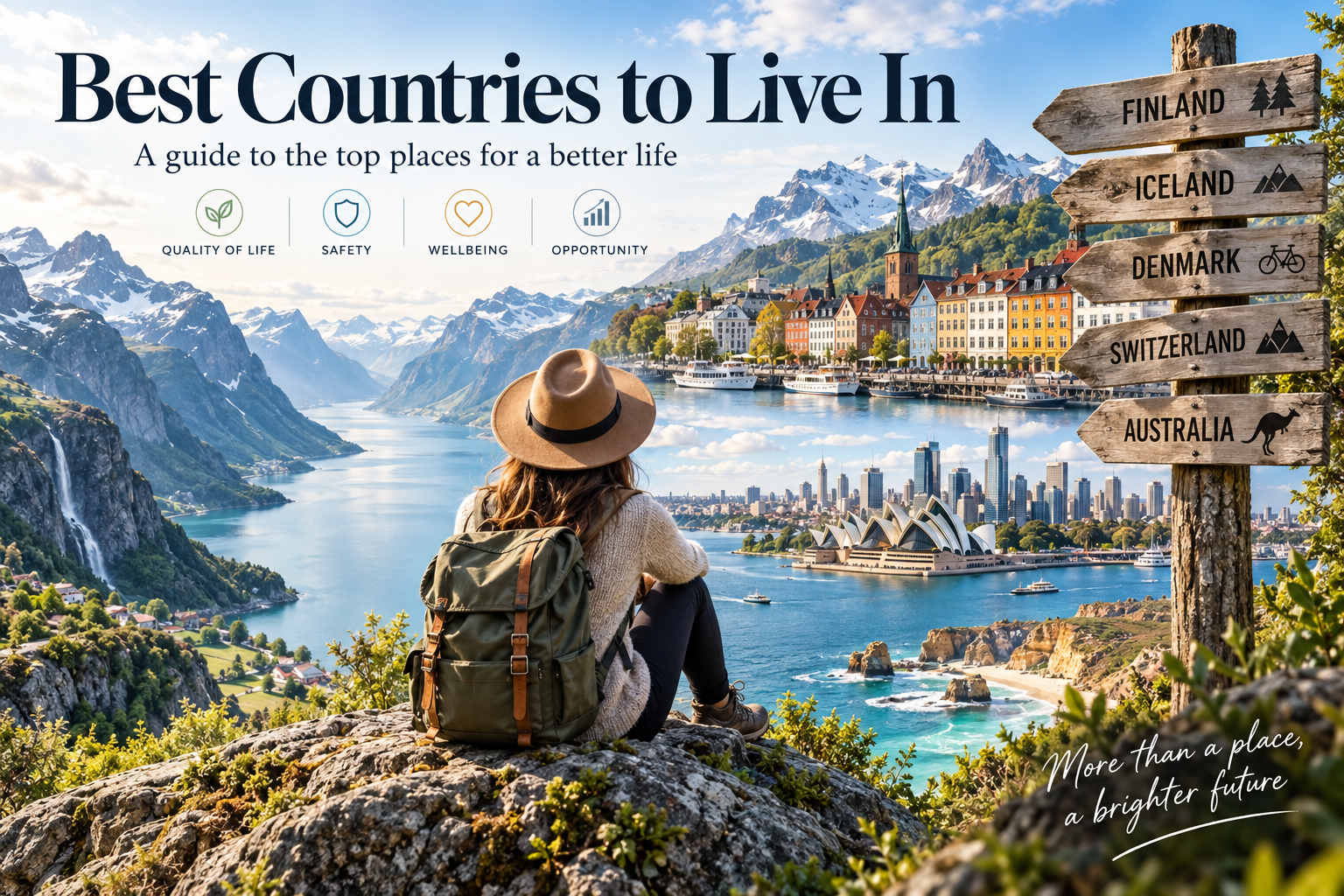
There is no single best country in the world to live in for everyone. The right place depends on what matters most to you: safety, career opportunities, family life, income, healthcare, education, climate, work-life balance or the ability to obtain long-term residence.
However, several countries consistently perform strongly across internationally recognised measures of wellbeing, peacefulness and human development.
In the World Happiness Report 2026, Finland ranks first, followed by Iceland and Denmark. The latest UN Human Development Index places Iceland first, while the 2026 Global Peace Index also ranks Iceland as the world’s most peaceful country.
Countries including Switzerland, Norway, Sweden, the Netherlands, New Zealand, Australia and Ireland also perform strongly across different measures.
The most useful question is therefore not simply “Which country ranks first?” but “Which country best matches the life you want to build?”
How We Compared the Countries
Quality of life cannot be measured by salary or happiness alone.
The OECD’s Better Life Index reflects this by allowing people to assess countries according to different dimensions of wellbeing and to give greater weight to the factors that matter most to them.
For this comparison, we considered several broad factors:
- life satisfaction and general wellbeing;
- safety and social stability;
- health and life expectancy;
- income and employment opportunities;
- education and family life;
- work-life balance;
- environmental quality and lifestyle;
- practical considerations such as housing and living costs;
- the legal ability of a newcomer to live and work in the country.
No artificial overall score has been created. Instead, the countries below have been selected because they perform consistently well across recognised international datasets while offering different strengths for different types of residents.
Countries With the Strongest Overall Living Conditions
| Country | Particularly Strong For | Important Consideration |
|---|---|---|
| Finland | Wellbeing, stability, social support | Climate and language |
| Iceland | Safety, human development, wellbeing | Cost and smaller labour market |
| Denmark | Work-life balance, family life, public services | Taxation and housing costs |
| Switzerland | Income, safety, human development | Very high living costs |
| Norway | Living standards, work-life balance, environment | High everyday costs |
| Sweden | Family life, human development, public infrastructure | Housing availability |
| Netherlands | Work-life balance, connectivity, international careers | Housing pressure |
| New Zealand | Safety, outdoor lifestyle, social stability | Geographic distance |
| Australia | Careers, lifestyle, human development | Housing affordability |
| Ireland | Safety, English-speaking environment, international employers | Housing supply and rent |
These countries are not presented as a rigid ranking from first to tenth. Their advantages vary considerably depending on the priorities of the person considering a move.
What Makes These Countries Stand Out?
Rather than treating every country as though it succeeds for identical reasons, it is more useful to look at the areas in which different destinations perform particularly strongly.
Wellbeing and life satisfaction
The Nordic countries continue to dominate international wellbeing data.
The World Happiness Report 2026 ranks Finland first, Iceland second and Denmark third. Sweden ranks fifth, Norway sixth and the Netherlands seventh, while Switzerland completes the top ten. The rankings are based on how residents evaluate their own lives, using survey data averaged across 2023 to 2025.
Finland has now occupied first place since 2018.
High life satisfaction does not mean these countries are perfect. Climate, taxation, housing and integration can still be significant considerations for someone relocating from abroad.
Safety and stability
Safety can have an enormous influence on everyday quality of life.
The 2026 Global Peace Index ranks Iceland first, followed by New Zealand and Switzerland. Ireland is fifth and Finland ninth. Western and Central Europe remains the world’s most peaceful region overall.
For individuals and families who place a high priority on security and social stability, these countries are therefore particularly relevant to compare.
Human development and living standards
The UN Human Development Index looks beyond economic output alone. It combines measures relating to health, education and living standards.
The latest UNDP data places Iceland first globally with an HDI value of 0.972, while Switzerland ranks second. Denmark ranks fourth, Sweden joint fifth and Australia seventh.
Finland, New Zealand and the United Kingdom also fall within the UN’s “very high human development” category.
Work-life balance and family life
Countries such as Denmark, the Netherlands, Norway, Sweden and Finland attract attention because material prosperity is combined with strong public institutions and a culture that often places significant value on life outside work.
For families, other considerations may include:
- parental leave;
- childcare;
- schools;
- healthcare;
- working hours;
- commuting time;
- access to green space.
The importance of each factor will differ from household to household. This is why the OECD’s wellbeing framework allows people to weight different dimensions according to their own priorities rather than imposing one universal definition of a good life.
Environment and lifestyle
For some people, lifestyle matters as much as salary.
New Zealand is particularly attractive to people who value outdoor space, natural scenery and a less densely populated environment. Norway and Iceland combine dramatic natural environments with high living standards, while Australia offers a combination of major-city employment markets and an outdoor lifestyle.
The trade-off may be location. New Zealand and Australia are geographically distant from Europe, while Iceland has a much smaller employment market than larger economies.
Which Country May Suit Your Priorities?
A useful relocation decision starts with your priorities rather than a league table.
| If You Prioritise… | Countries Worth Comparing |
|---|---|
| Overall wellbeing | Finland, Iceland, Denmark |
| Safety and stability | Iceland, New Zealand, Switzerland |
| High earning potential | Switzerland, Norway, Australia |
| Family life | Denmark, Sweden, Finland |
| Work-life balance | Denmark, Netherlands, Norway |
| English-speaking environment | Australia, New Zealand, Ireland |
| Outdoor lifestyle | New Zealand, Australia, Norway |
| European connectivity | Netherlands, Switzerland, Ireland |
This does not mean that one country is objectively superior within each category.
A software engineer, a family with school-age children and a retiree may each reach a completely different conclusion even when reviewing the same countries.
Quality of Life vs Cost of Living
One of the biggest mistakes in international comparisons is to look at quality of life without considering what it costs to maintain that lifestyle.
Several countries with exceptionally strong living standards are also expensive.
Switzerland offers very high levels of human development and income, but housing, food and services can be costly. Norway and Iceland can also involve high day-to-day expenditure.
The more useful comparison is therefore not simply:
“Where are salaries highest?”
Instead, consider:
Income − tax − housing − essential expenses = realistic disposable income
Other costs can also change the picture.
A country with higher taxation may provide more publicly funded healthcare, education or family support. A country with lower tax may require households to pay more directly for services.
When comparing destinations, look at the complete household budget rather than salary alone.
Is the Happiest Country Always the Best Place to Live?
No.
Finland ranks first in the World Happiness Report 2026, but that does not mean every prospective migrant should automatically choose Finland.
The happiness ranking measures how people already living in each country evaluate their lives. It is not a ranking of immigration accessibility or how easy it will be for a newcomer to build a career there.
A person considering relocation also needs to assess:
- whether they qualify for a visa or residence permit;
- employment opportunities in their profession;
- salary relative to living costs;
- housing availability;
- language requirements;
- taxation;
- climate;
- family circumstances;
- whether temporary residence can lead to permanent status.
International indexes are useful evidence, but they should be treated as a starting point rather than a substitute for personal planning.
What Should You Check Before Moving to Another Country?
A country can look excellent on a quality-of-life table and still be impractical for your circumstances.
Before making a serious relocation decision, ask the following questions.
1. Can you legally live and work there?
Immigration eligibility should be checked before planning around salary, housing or lifestyle.
Some countries have relatively accessible routes for certain skilled workers, while others impose much tighter requirements.
2. Is there genuine demand for your skills?
A strong national economy does not mean every profession has equally good opportunities.
Research your own sector, qualifications and expected salary.
3. What will housing cost?
Housing can fundamentally alter the attractiveness of a destination.
Compare rent or purchase costs with realistic earnings rather than national salary averages alone.
4. What will you keep after tax and essential expenses?
Gross salary is only part of the picture.
Consider taxation, housing, food, transport, childcare and insurance.
5. How does healthcare work?
Understand whether you will be covered through the state, employment, compulsory insurance or private arrangements.
6. What are the education options?
Families should consider schools, language of instruction, university costs and access to childcare.
7. Will language affect your career or integration?
It may be possible to work in English in some international industries while still needing the local language for professional advancement or everyday life.
8. Can you obtain permanent residence?
Temporary work permission and long-term residence are different.
If your goal is to build a permanent life abroad, examine the route to settlement from the beginning.
9. Can your family move with you?
Check the rules for partners and children as well as any financial or accommodation requirements.
10. Could you eventually obtain citizenship?
If nationality is part of your long-term plan, investigate residence periods, language requirements, naturalisation rules and whether dual citizenship is permitted.
Where Does the UK Fit?
The UK may not lead the World Happiness Report or Global Peace Index, but it remains attractive for different reasons.
The latest UN Human Development Index places the United Kingdom joint 13th, within the “very high human development” category.
For international residents, potential advantages include:
- a large and diverse employment market;
- English as the principal working language;
- major financial, technology, research and professional-services sectors;
- globally recognised universities;
- multicultural cities and communities;
- established immigration routes for workers, families, founders and recognised talent;
- potential pathways towards settlement on qualifying routes.
The practical challenges should also be considered.
Housing can be particularly expensive in London and parts of southern England. Immigration applications can involve significant fees, and the cost of living varies considerably between regions.
The UK should therefore be evaluated in the same way as any other destination: according to your career, finances, family situation and eligibility rather than its reputation alone.
Moving to the UK: Main Routes to Consider
If the UK is among the countries you are considering, your ability to relocate will depend on whether you qualify under an appropriate immigration route.
Skilled Worker Visa
The Skilled Worker route is designed for eligible applicants with qualifying sponsored employment in the UK.
It should be considered in the context of your occupation, employer, salary and the current Immigration Rules rather than simply whether you would like to work in Britain.
Global Talent Visa
The Global Talent route is available to eligible leaders and potential leaders in academia or research, arts and culture, and digital technology. Depending on the applicant, endorsement or an eligible prestigious prize may be relevant.
Family routes
People with qualifying partners or close family relationships in the UK may have options under the family immigration rules.
The appropriate route depends on the relationship and immigration circumstances involved.
Innovator Founder Visa
The Innovator Founder route is designed for people seeking to establish and develop an innovative, viable and scalable business in the UK. A qualifying applicant requires endorsement and must play a key role in developing the business.
It is a founder route rather than passive investment-based residence.
Anyone considering relocation should check the current eligibility requirements for the relevant visa before making significant financial or personal commitments.
Key Takeaways
There is no universal answer to the question of which country is the best place to live.
Current international evidence shows that:
- Finland leads the 2026 World Happiness Report.
- Iceland ranks first in both the latest UN Human Development Index and the 2026 Global Peace Index.
- Nordic and Western European countries consistently perform strongly across wellbeing and human-development measures.
- New Zealand performs particularly strongly on peacefulness, while Switzerland combines very high human development with a high position in the peace index.
- Rankings alone cannot tell you where you should live.
For a real relocation decision, immigration eligibility, employment, housing, family needs, language and long-term residence options are just as important as international quality-of-life rankings.
Frequently Asked Questions
What is the best country in the world to live in?
There is no objectively best country for every person. Finland currently ranks first in the World Happiness Report 2026, while Iceland ranks first in both the latest Human Development Index and the 2026 Global Peace Index. The right country for an individual depends on priorities such as work, safety, family life, cost, language and immigration eligibility.
Which countries offer a high quality of life?
Finland, Iceland, Denmark, Switzerland, Norway, Sweden, the Netherlands, New Zealand and Australia consistently perform strongly across different international measures of wellbeing, safety and human development. Because the indexes measure different things, they should be considered together rather than treated as one definitive ranking.
What is the happiest country in the world in 2026?
Finland ranks first in the World Happiness Report 2026, with an average life-evaluation score of 7.764 based on survey data covering 2023 to 2025. It has held first place since 2018.
What is the safest country to live in?
Iceland ranks first in the 2026 Global Peace Index, followed by New Zealand and Switzerland. The index assesses 163 countries and territories across measures of peacefulness.
Which countries are good to consider for families?
Finland, Denmark, Sweden, Norway and the Netherlands are worth comparing because of their wider wellbeing, public-service and work-life characteristics. The right choice still depends on schooling, childcare, housing, employment and immigration eligibility.
Which English-speaking countries offer a high quality of life?
Australia, New Zealand and Ireland are notable options. New Zealand ranks second in the 2026 Global Peace Index, Australia ranks seventh in the latest Human Development Index, and Ireland ranks fifth for peacefulness.
Should I choose a country based only on quality-of-life rankings?
No. Rankings can help you create a shortlist, but they do not tell you whether you can obtain a visa, find suitable employment, afford housing or achieve permanent residence. Personal circumstances should be considered alongside international data.
Is the UK a good country to move to?
The UK offers advantages including a large labour market, globally recognised universities, English-language professional opportunities and established immigration routes. It also has high housing costs in some areas and relatively expensive immigration processes. Whether it is suitable depends on your career, finances, family circumstances and visa eligibility.
Choosing the Right Country for You
The top countries to live in are not necessarily the same for every person.
Finland, Iceland, Denmark, Switzerland, Norway, Sweden, the Netherlands, New Zealand, Australia and Ireland all offer compelling advantages, but they do so in different ways.
International rankings can help identify countries with strong living conditions. The final decision should also reflect what life would realistically look like for you: your income, work, housing, family, language, immigration status and long-term goals.