
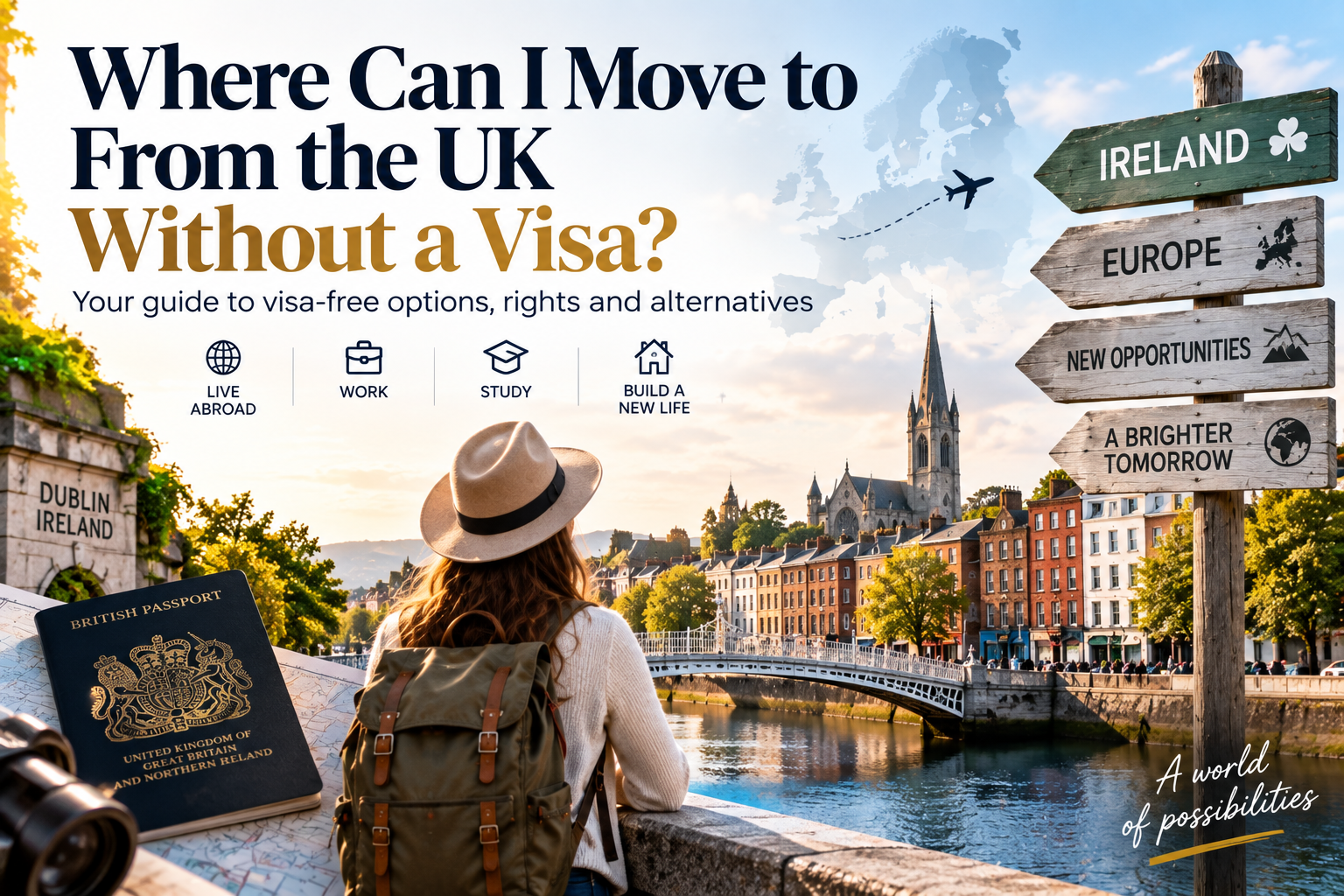
If you are a British citizen, Ireland is the clearest place you can move to without first applying for a visa or standard residence permit. Under the Common Travel Area, British citizens can move to Ireland, live there, work and study without needing normal immigration permission.
The position is different for most other countries.
A British passport gives visa-free access to many destinations for short visits, but visa-free travel does not usually give you the right to relocate permanently, take a job or establish long-term residence.
For example, British citizens can normally visit countries in the Schengen area for up to 90 days in any 180-day period without a visa for permitted purposes. Staying longer or working may require a visa or residence permit.
This guide assumes you are a British citizen. If you live in the UK but hold another nationality, your residence rights abroad may be very different.
Where Can British Citizens Live Without a Visa?
For someone looking to leave the UK permanently rather than simply take a holiday, the list is much shorter than a typical visa-free travel list suggests.
| Destination | Can a British Citizen Relocate Without a Standard Visa? | Important Point |
|---|---|---|
| Ireland | Yes | British citizens can live, work and study under Common Travel Area rights |
| Jersey | Generally no immigration visa required for British citizens | Local housing and employment controls can still apply |
| Guernsey | Part of the Common Travel Area | Check local residence, housing and employment rules |
| Isle of Man | British citizens are not subject to the ordinary immigration permission system | Separate work-permit rules may still apply |
| EU/Schengen countries | Generally not for permanent relocation | Visa-free access is normally for short stays only |
The most straightforward answer is therefore Ireland.
The Crown Dependencies also form part of the Common Travel Area, but they are not independent foreign countries and operate their own local systems. The UK Government describes Jersey, Guernsey and the Isle of Man as self-governing Crown Dependencies rather than parts of the United Kingdom.
Why Is Ireland Different?
Ireland has a special relationship with the UK through the Common Travel Area (CTA).
The CTA predates both countries’ membership of the European Union and continues independently of Brexit. It covers the UK, Ireland, Jersey, Guernsey and the Isle of Man.
Under these arrangements, British and Irish citizens can move freely and reside in either the UK or Ireland. Associated rights include the ability to work and study, as well as access to certain social-security, healthcare and voting rights where the applicable conditions are met.
Can British citizens work in Ireland without a visa?
Yes.
British citizens do not need an Irish visa or standard residence permit to live, work or study in Ireland. GOV.UK confirms that British nationals can remain indefinitely in Ireland under Common Travel Area arrangements.
You may still need to deal with ordinary practical matters such as tax, employment registration, healthcare arrangements and proof of identity.
Can a British citizen live permanently in Ireland?
A British citizen can live in Ireland without being limited by the Schengen 90-day visitor rule.
Ireland is not part of the Schengen area, and British-Irish movement is governed by the Common Travel Area rather than the ordinary post-Brexit visitor arrangements applying across much of continental Europe.
That makes Ireland fundamentally different from countries such as France, Spain, Italy or Germany.
What About Jersey, Guernsey and the Isle of Man?
Jersey, Guernsey and the Isle of Man are also within the Common Travel Area.
They are Crown Dependencies, which means they are self-governing and maintain their own legal, administrative and employment systems.
For British citizens, immigration permission is generally not the main obstacle. Local rules can still affect whether and how you can work, rent or purchase accommodation.
For example, Jersey states that British and Irish nationals do not require immigration permission, but residents and workers can still be subject to its separate Control of Housing and Work system.
The Isle of Man also separates immigration status from its local work-permit regime. A British citizen may not require an immigration visa, yet someone who is not classed as an Isle of Man worker may still need a work permit unless an exemption applies.
So, while moving to a Crown Dependency can be considerably simpler from an immigration perspective, you should check the specific island’s employment and housing rules before relocating.
Can You Move to Europe Without a Visa After Brexit?
For most EU and European destinations, not for permanent residence simply because you hold a British passport.
British citizens can normally make short visa-free trips to countries in the Schengen area for up to 90 days in any rolling 180-day period for permitted purposes such as tourism, visiting family, certain business activity or short courses.
The Schengen area includes countries such as:
Austria, Belgium, France, Germany, Greece, Italy, the Netherlands, Portugal, Spain, Sweden and Switzerland, among others.
The 90-day allowance applies across the Schengen area as a whole rather than separately to each member country.
If you want to:
- live there beyond the visitor allowance;
- take local employment;
- study long term;
- establish a business;
- retire there permanently;
you will generally need to meet that country’s immigration or residence requirements.
Work rules can also be different even during a visa-free visit. GOV.UK specifically advises British travellers to check the rules of the destination country if they intend to work.
When Can a British Citizen Have More Residence Options?
Your British passport may not be the only factor that determines where you can live.
Some people have additional rights through nationality, ancestry, family or previous residence.
Dual citizenship
If you hold another citizenship, that nationality may provide residence rights that your British citizenship does not.
For example, a British citizen who is also a citizen of an EU country may have EU free-movement rights through their EU nationality.
The relevant rights come from that second citizenship rather than from the British passport.
Citizenship by descent
Some British citizens may qualify for another nationality through a parent, grandparent or other family connection, depending on the nationality laws of the country concerned.
If another citizenship is acquired, it can substantially change where the person has a right to live.
If ancestry may apply to you, verify the country’s current nationality law rather than assuming that having an ancestor from that country automatically gives you citizenship.
Family relationships
Marriage, civil partnership or another qualifying family relationship may provide access to a residence route abroad.
These are immigration routes rather than automatic visa-free residence in most cases, but they can make relocation possible where visitor status would not.
Existing residence rights
If you already hold permanent residence, settled status or another valid residence status in another country, you may have rights that a British citizen starting from scratch does not.
Always check whether long periods outside that country can cause an existing status to lapse.
If You Cannot Move Visa-Free, What Routes Could Let You Relocate?
Needing immigration permission does not mean you cannot move abroad.
For most countries, the practical question is not “Can I move without a visa?” but “Which residence route can I qualify for?”
Work-based routes
Many countries provide residence permission to people who have qualifying employment, professional skills or occupations that are in demand.
Requirements can include:
- a job offer;
- employer sponsorship;
- minimum salary;
- professional qualifications;
- language ability.
Family residence
You may be able to relocate to join a spouse, partner or qualifying relative who is a citizen or legal resident of the destination country.
Digital-nomad and remote-work routes
Some countries have introduced residence categories aimed at people who work remotely for employers or clients outside the destination country.
These are still immigration permissions. Being able to work online does not automatically make it lawful to live indefinitely in a country as a visitor.
Retirement or financially independent residence
Some jurisdictions allow people with sufficient pensions, savings or independent income to apply for residence without taking local employment.
The required income, insurance and residence conditions vary considerably.
Founder and entrepreneur routes
Countries may also have immigration categories for entrepreneurs, founders or investors.
These should be checked carefully because investing money or forming a company does not automatically give a person immigration status.
What Should You Check Before Moving Abroad?
Before choosing a destination, look beyond whether you can enter without a visa.
A proper relocation assessment should consider:
- Your right to reside – Can you legally stay beyond the visitor period?
- Your right to work – Does your status allow employment or self-employment?
- Length of stay – Is there a maximum period before you need residence permission?
- Family rights – Can your spouse, partner or children accompany you?
- Healthcare – Will you need private insurance or local registration?
- Tax residence – Could moving change where you pay tax?
- Financial requirements – Is there a minimum income, savings or accommodation requirement?
- Permanent residence – Can temporary status eventually become permanent?
- Language requirements – Are they relevant to residence, employment or citizenship?
- Citizenship options – Could lawful residence eventually lead to naturalisation if that is part of your long-term plan?
These questions often matter far more than the number of countries a British passport can enter without a visitor visa.
Key Takeaways
For a British citizen, Ireland is the clearest answer to the question of where you can genuinely relocate without first obtaining a visa or normal residence permit. British citizens can live, work and study there under Common Travel Area arrangements.
Jersey, Guernsey and the Isle of Man are also within the Common Travel Area, although local housing and employment controls can apply.
For most European countries, British citizens retain substantial visa-free visitor access, but this does not normally include an automatic right to move there permanently. In the Schengen area, short stays are generally limited to 90 days in any 180-day period.
Dual nationality, ancestry, family relationships and existing residence rights can significantly broaden someone’s options.
Frequently Asked Questions
Which country can a British citizen move to without a visa?
Ireland is the clearest example. British citizens can live, work and study in Ireland without obtaining an Irish visa or ordinary residence permit because of the Common Travel Area.
Can a British citizen live permanently in Ireland?
British citizens can remain indefinitely in Ireland under Common Travel Area arrangements. They are not subject to the Schengen 90-day visitor limit when living in Ireland.
Can British citizens work in Ireland without a visa?
Yes. British citizens have the right to work in Ireland under the Common Travel Area and do not need ordinary Irish immigration permission simply to take employment.
Can UK citizens still move freely to the EU?
British citizens generally no longer have EU free-movement rights simply because they are British. Short visa-free travel remains possible across much of Europe, but permanent residence and employment usually require permission under the destination country’s rules.
How long can British citizens stay in Europe without a visa?
In the Schengen area, British citizens can normally stay for up to 90 days in any 180-day period for qualifying short visits. The limit applies across the Schengen area as a whole.
Can dual citizenship give me more countries to live in?
Yes. Another nationality may give you residence rights unavailable through a British passport alone. Your rights depend on the laws attached to the second citizenship.
Can I move abroad without a visa if I work remotely?
Not automatically. Being employed remotely does not by itself create a legal right to live in another country. You still need to comply with that country’s immigration and residence rules unless you already have a right to live there.
Choosing Where to Move From the UK
If you want to move abroad without navigating a conventional visa process, Ireland is the most straightforward option for a British citizen.
Elsewhere, a British passport often makes travel easier, but short-term visitor access should not be mistaken for a right to settle.
If Ireland is not suitable, the next step is to identify whether you qualify through work, family, ancestry, dual citizenship, remote work, retirement or another residence category.
For people who may have another nationality claim, our guidance on Dual Citizenship, British Citizenship and British Citizenship by Descent can help explain how nationality and residence rights differ.