
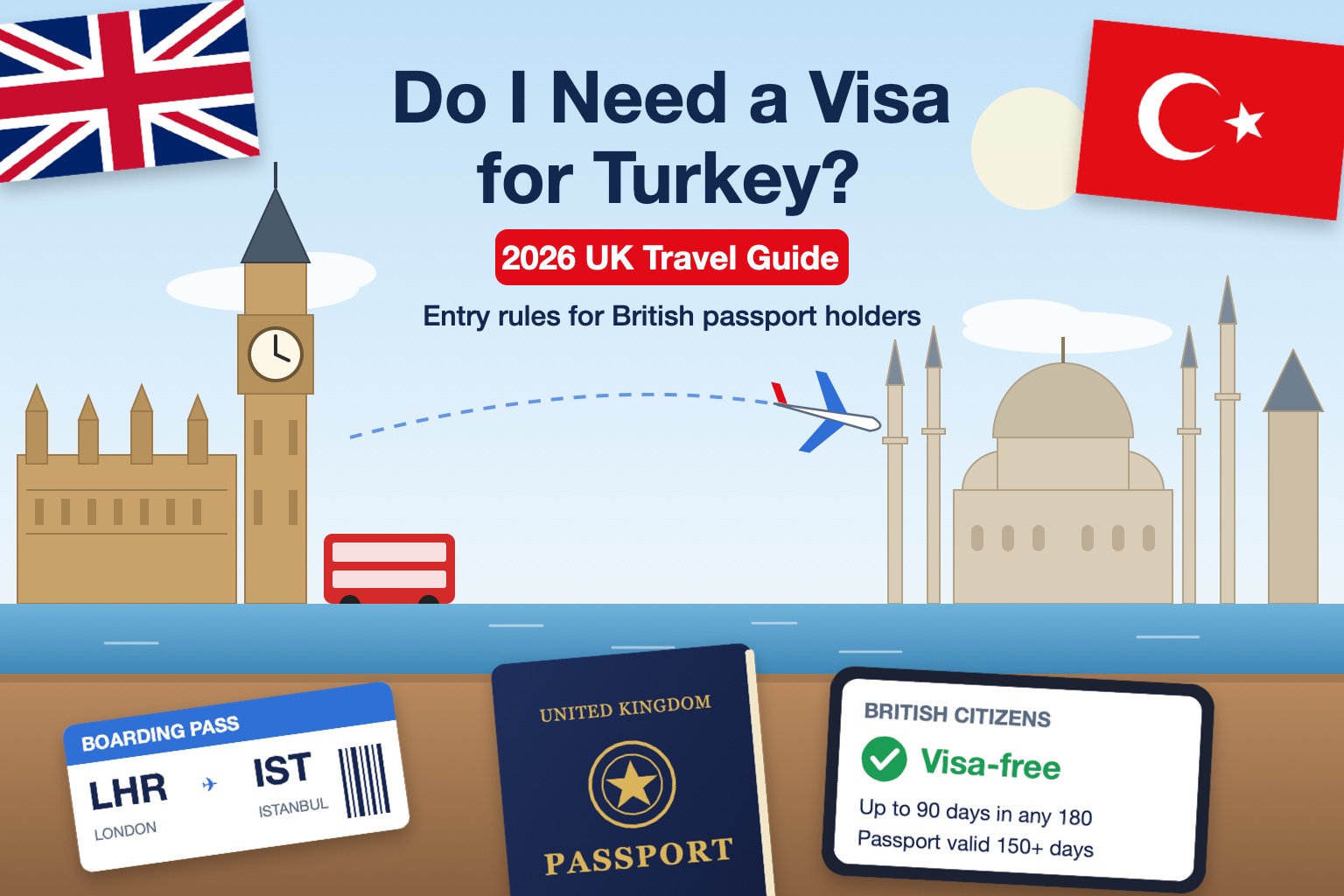
No. If you hold a British citizen passport, you don’t need a visa for Turkey for a holiday or business trip of up to 90 days in any 180-day period. You don’t need an e-Visa either, and there’s nothing to pay before you fly.
There are conditions, though. Your passport must have enough validity left, the visit must be for tourism or business, and the visa-free rule doesn’t cover every type of British passport. This guide explains each rule, shows who still needs a visa or e-Visa, and covers the mistakes that most often cause problems at the airport.
- British citizens: visa-free for up to 90 days in any 180 days, for tourism or business.
- Passport: must expire at least 150 days after the date you arrive, with at least one blank page.
- Cost: £0. You don’t need to apply for anything online.
- Need a visa: work, study, stays over 90 days, other types of British nationality, and many non-British passport holders who live in the UK.
Do I Need a Visa for Turkey From UK?
It depends on your passport, not on where you fly from. British citizens can visit Turkey (officially Türkiye) without a visa for up to 90 days in any 180-day period, for business or tourism. That’s the current FCDO travel advice for Turkey.
This visa exemption has applied since 2 March 2020, when Turkey dropped the visa requirement for UK citizens on tourist trips (Turkish Consulate General in London). Before then, British holidaymakers had to buy an e-Visa, which is why many people still assume they need one.
If you live in the UK but travel on another country’s passport, the UK exemption doesn’t apply to you. Turkey looks at your nationality. See the section on living in the UK on a non-British passport below.
Do I need a visa for Turkey with a UK passport?
That depends on what kind of UK passport you hold. The visa-free rule is for British citizens. The FCDO says that if you hold a different type of British nationality, you should check visa requirements with the Turkish Embassy or Consulate General before you travel.
| Passport type (shown on your passport’s photo page) | Visa needed for a holiday in Turkey? |
|---|---|
| British citizen | No, up to 90 days in any 180 days |
| British National (Overseas), BN(O) | Check with the Turkish Consulate General |
| British overseas territories citizen (BOTC) | Check with the Turkish Consulate General |
| British overseas citizen (BOC) | Check with the Turkish Consulate General |
| British protected person or British subject | Check with the Turkish Consulate General |
To see which one you have, look at the nationality line on your passport’s photo page. Most UK passport holders will see “British Citizen”.
So do British passport holders need a visa for Turkey? Not if they are British citizens and the trip is a holiday or business visit within the 90-day limit.
What counts as tourism or business?
The exemption covers holidays, visiting family and friends, and short business visits such as meetings or conferences. Turkey’s visa-free rule doesn’t cover education, employment or medical purposes. For those, the FCDO says to check the official information on applying for a visa.
If you’re travelling to Turkey for treatment, such as dental work or a hair transplant, contact the Turkish Consulate General before you book.
How the 90-Day Rule Works
You can spend up to 90 days in Turkey in any rolling 180-day period. It isn’t 90 days per trip, and it doesn’t reset each calendar year.
On any day you’re in Turkey, count back 180 days. Add up every day you spent in Turkey in that window, including the day you arrive and the day you leave. The total must be 90 or fewer.
Worked example: You spend 60 days in Turkey from 1 March. If you return in June, you can stay at most 30 more days until some of the March days fall outside the 180-day window. If you want a third long trip, plan it for after late August, when the March days start to drop out.
If you plan to spend more than 90 days in Turkey, you’ll need a visa or a residence permit. See the section on when you do need a visa for Turkey below.
Visa Requirements for Turkey: What You Need at the Border
For most British holidaymakers, Turkey’s entry requirements come down to your passport. Border officers can also ask about the purpose of your trip.
Passport validity: the 150-day rule
The FCDO says your passport must:
- have an expiry date at least 150 days after the date you arrive in Turkey
- have at least one blank page
If you’re a resident of Turkey, your passport must instead be valid for 6 months from the date you arrive.
Some holiday companies and older guides still quote “six months” for all visitors. The official rule for British visitors is 150 days. Still, check the rules of your airline or tour operator, as they can refuse boarding if they believe you don’t meet the requirements. Renewing a passport that’s close to the limit is cheaper than a missed holiday.
If you cross into Turkey by land, the FCDO advises making sure the border officials stamp and date your passport.
Other documents worth carrying
British citizens aren’t asked to show a visa, but it helps to have:
- your return or onward booking
- your accommodation details
- travel insurance documents
Travelling with children
Children with British citizen passports follow the same visa-free rule and the same passport rules as adults.
If you’re leaving Turkey with a dual British-Turkish child aged 18 or under, you may need to show permission to travel from the Turkish parent (FCDO).
Do I need a Turkey e-Visa from the UK?
No, not as a British citizen. British citizens are visa-exempt, so there’s no Turkey e-Visa for them to apply for.
The e-Visa is Turkey’s online visa for nationalities that aren’t visa-exempt. Eligible applicants get it through the official Republic of Türkiye e-Visa website.
Living in the UK on a non-British passport
If you live in the UK on another country’s passport, your nationality decides whether you need a visa. Many EU and Schengen-area nationals, along with Irish and US citizens, are visa-exempt for short visits. Others need an e-Visa or a visa from a Turkish consulate.
Some nationalities qualify for a conditional e-Visa if they hold a valid visa or residence permit from a Schengen country, the USA, the UK or Ireland. Turkey’s consular guidance sets these conditions (Turkish Consulate General, Los Angeles):
- you have a return ticket, a hotel reservation and at least US$50 for each day of your stay
- you’re travelling for tourism or business
- you enter Turkey through an airport, not a land border
One detail catches UK residents out. Turkey has said that a visa from these countries must be a sticker-type visa, and electronic visas from those countries aren’t accepted. The UK has replaced biometric residence permits (BRPs) with digital eVisas. If your only proof of UK status is a digital eVisa, don’t assume you qualify for the conditional e-Visa. Check your eligibility on evisa.gov.tr or with the Turkish Consulate General in London before you book.
How to avoid fake e-Visa websites
Many websites sell Turkish “visas” or “travel authorisations” to British travellers who don’t need one. Some are fake, and others charge a large markup for an application you could make yourself. ABTA, the Foreign Office and Get Safe Online have warned UK travellers to apply only through the official site (ABTA).
- If you’re a British citizen on holiday, you don’t need anything, so don’t pay.
- If you do need an e-Visa, use evisa.gov.tr only.
- Watch for “fast track”, “checking” or “processing” fees. They’re signs of a third-party site.
Turkey visa fee: how much does it cost from the UK?
For British citizens visiting for tourism or business, the cost is £0. You don’t need a visa, so you don’t pay a visa fee.
If you do need a visa, the price depends on your nationality and the type of visa:
| Who | What they need | Cost |
|---|---|---|
| British citizen, holiday or business, up to 90 days | Nothing | Free |
| Irish citizen, holiday or business, up to 90 days | Nothing | Free |
| Other nationalities eligible for an e-Visa | e-Visa from evisa.gov.tr | Set by nationality and shown on evisa.gov.tr when you apply |
| Anyone travelling to work, study or stay longer | Visa from a Turkish consulate | Set by the consulate, depending on visa type |
Avoid paying a website that charges you for a “Turkey visa” if you’re a British citizen. Your money buys nothing you need.
Do I need a transit visa for Turkey?
British citizens don’t need a transit visa for Turkey. You’re visa-exempt anyway, so you can connect through Istanbul Airport or leave the airport during a layover without applying for anything.
For other nationalities, the rules differ. Passengers who stay airside on a through ticket generally don’t need a visa. Leaving the airport means entering Turkey under the normal visa rules for your nationality. Turkey has also brought in an airport transit visa for a small number of nationalities. If you don’t hold a British citizen passport, check with your airline and the Turkish Consulate General before you travel.
When you do need a visa for Turkey
You’ll need to apply before you travel if you plan to:
- work in Turkey, including paid jobs, internships and seasonal work
- study, including language courses
- stay longer than 90 days in any 180-day period
- travel for medical purposes or another special reason
In the UK, you apply through the Turkish Consulate General in London. For stays beyond 90 days, foreign nationals usually need a Turkish residence permit, which is handled by Turkey’s migration authorities.
Don’t overstay. If you stay past your 90 days, you risk a fine, deportation and a ban on returning to Turkey. If you think you might overstay, speak to the Turkish authorities before your 90 days run out.
Before you travel: a quick checklist
- Your passport says “British Citizen” and expires at least 150 days after you arrive
- Your passport has at least one blank page
- Your trip is for tourism or business and fits within the 90-day limit
- You have travel insurance. The GHIC and EHIC are not valid in Turkey (FCDO health advice)
- You’ve read the latest FCDO travel advice for Turkey
- Travelling with a non-British passport? You’ve checked your nationality’s rules on evisa.gov.tr
Frequently asked questions
Do I need a visa for Istanbul?
No, not if you’re a British citizen. Istanbul is in Turkey, so the same rule applies: visa-free for up to 90 days in any 180 days for tourism or business. The rules are the same for Antalya, Dalaman, Bodrum and the rest of the country.
Do I need a visa for Turkey with an Irish passport?
No. Since 2 March 2020, Irish ordinary passport holders can visit Turkey visa-free for tourism or business for up to 90 days within 180 days (Turkish Embassy in Dublin). Work, study and other purposes still need a visa.
Do I need a Schengen visa for Turkey?
No. Turkey isn’t in the Schengen area, and a Schengen visa doesn’t give you entry to Turkey. British citizens don’t need one. Some non-visa-exempt nationalities who hold a valid Schengen sticker visa or residence permit may qualify for Turkey’s conditional e-Visa.
Can I extend my stay in Turkey beyond 90 days?
Not on the visa exemption. To stay longer, you’d need a residence permit from the Turkish authorities, and you should apply before your 90 days run out. Rules and documents vary by situation, so check official guidance or get professional advice.
Do the 90 days reset when I leave Turkey?
No. The 90 days are counted across a rolling 180-day period, so leaving and coming back doesn’t restart the count.
Do I need a visa for Northern Cyprus?
Northern Cyprus is governed separately from Turkey, and the rules above don’t automatically apply. Read the FCDO’s Cyprus entry requirements before you travel. They warn that entering the Republic of Cyprus via the north, such as through Ercan Airport, is treated as illegal entry by the Republic of Cyprus authorities.
Is the visa exemption the same if I arrive by land or sea?
Yes, the visa-free rule for British citizens applies at airports, land borders and ports. At land crossings, check that officials stamp and date your passport.