
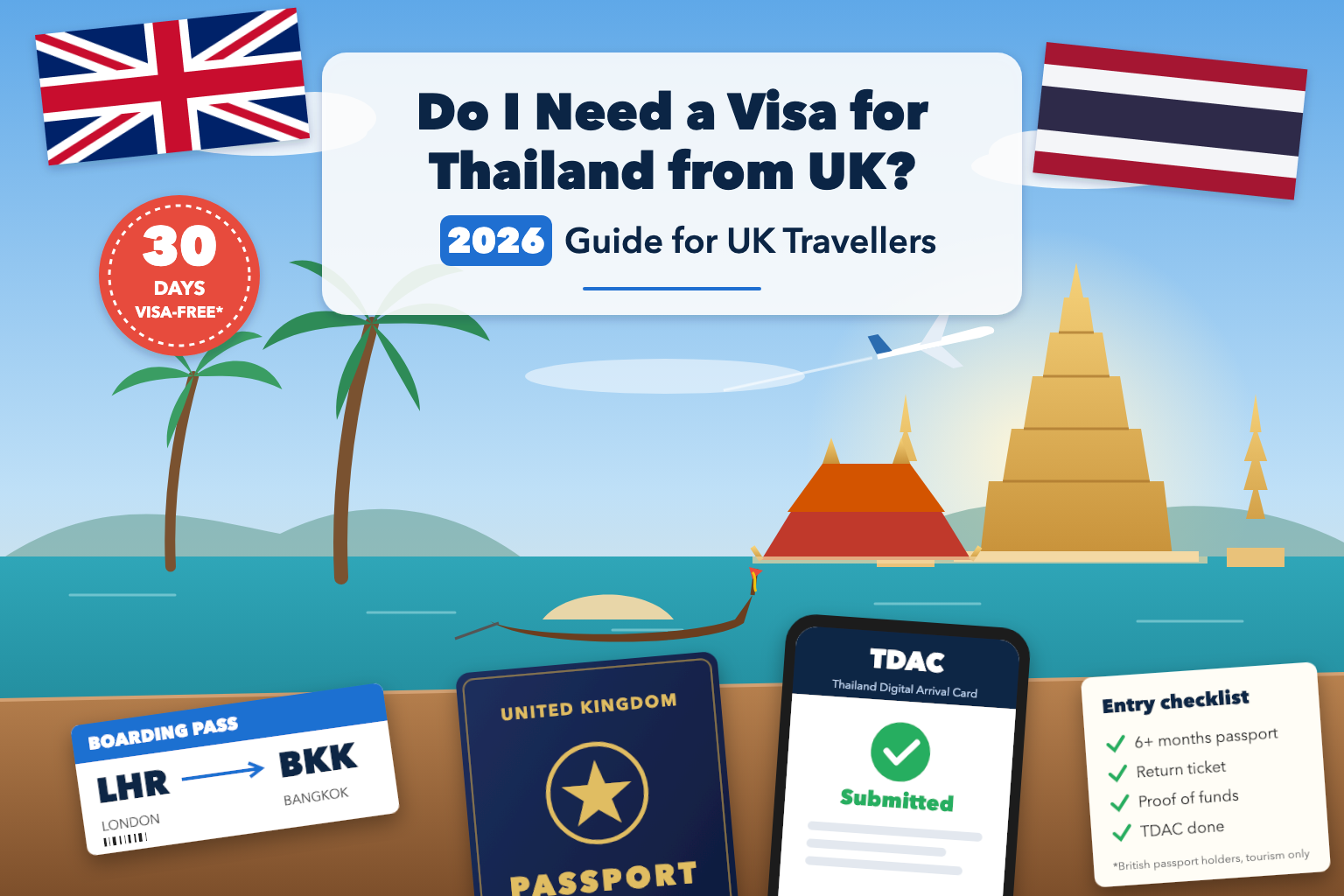
Do I need a visa for Thailand from UK? For most British holidaymakers, the answer is no. It depends on your passport, how long you stay and why you are going.
If you are a British citizen travelling on a valid British passport, you do not need a visa for a holiday in Thailand of up to 30 days. You can enter under Thailand’s visa exemption scheme. You still need to complete the free Thailand Digital Arrival Card (TDAC) before you arrive.
What changed in 2026: Thailand cut its visa-free stay from 60 days to 30 days on 15 September 2026. The 30-day exemption is for tourism only, and the Royal Thai Embassy in London says it can be used only twice in a calendar year. If you want to stay longer than 30 days, you can apply for a tourist visa before you travel or ask Thai immigration for a 30-day extension once you are there.
Who this does not apply to: Visa rules depend on your passport, not on where you live or which country you fly from. If you live in the UK but hold a Pakistani, Indian, Nigerian or other passport, Thailand’s rules for that nationality apply to you. If you travel on a UK-issued travel document rather than a British passport, you must get a Thai visa before you travel.
In one sentence: British passport holders can visit Thailand visa-free for up to 30 days for tourism. Everyone else should check the rules for their own nationality.
Travelling from the UK vs being a UK citizen
People often search “do i need a visa for thailand from the uk” when the real question is “does my passport need a visa?”. Thai immigration does not care that your flight left from Heathrow or Manchester. It looks at the passport you hand over.
- British citizen with a British passport: visa exemption, up to 30 days, tourism only.
- UK resident with another passport: follow the rules for your nationality. If you need a visa, you can usually apply as a UK resident through the Thai e-Visa system.
- UK travel document holder (for example a refugee or stateless travel document): a Thai visa is required before travel.
A small wording point: some people search “do i need a uk visa for thailand from uk” or “do i need a visa for uk from thailand”. You do not need a UK visa to visit Thailand. If you are a Thai national coming to the UK, that is a separate question about UK immigration rules, which this guide does not cover. See our UK visitor visa guide.
Do UK Citizens Need a Visa for Thailand?
No, not for a short holiday. Since 15 September 2026, British passport holders can enter Thailand without a visa and stay for up to 30 days for tourism. This is called the visa exemption scheme (Royal Thai Embassy, London).
The exemption comes with conditions:
- Tourism only. GOV.UK says visa-exempt entry does not cover business activities such as conferences or meetings. Working, studying, retiring or living in Thailand needs the correct visa before you travel (GOV.UK).
- Twice a calendar year. The Royal Thai Embassy in London says the exemption can be used only twice in a calendar year. If you plan to visit more often, apply for a visa.
- Proof may be checked. Immigration officers can ask to see accommodation details, an onward or return ticket within 30 days, and evidence of funds. See How much money do I need to enter Thailand? below.
- Passport rules. Your passport must be valid for at least 6 months from your arrival date and have at least 1 blank page.
So, does a UK passport need a visa for Thailand? For a tourist trip of 30 days or less, no. For a longer stay, for work, or for frequent trips, yes.
Do I Need a Visa for a 2 Week Holiday in Thailand?
No. If you have a British passport, a 2-week holiday sits comfortably within the 30-day visa exemption. That is the most common reason people ask “do I need a visa for Thailand from UK”, and for a fortnight’s holiday the answer is no. You do not need to apply for anything in advance except the TDAC.
For a typical 14-night trip, have these ready:
- A British passport valid for at least 6 months after the date you arrive, with a blank page.
- A completed Thailand Digital Arrival Card (submitted within 3 days before arrival).
- Your return flight booking, or a ticket to another country.
- Your hotel or accommodation address for at least the first night.
- Access to money for your trip. A bank card and recent statement are sensible to have on your phone.
If you hold a non-British passport, the answer depends on your nationality, even for 2 weeks. See UK residents with other passports.
How Long Can I Stay in Thailand Without a Visa (UK)?
Up to 30 days per entry, for tourism, if you travel on a British passport. Day one is the day you arrive. Check the date stamped in your passport before you leave the immigration desk: that is your last permitted day.
If you want to stay longer, you have two options:
- Extend once you are in Thailand. You can apply at a Thai immigration office for an extension of up to 30 more days. Approval is at the officer’s discretion. Officially reported fees for this extension are 1,900 baht, but check with the immigration office as fees and documents can vary.
- Get a tourist visa before you go. A Thai tourist visa (TR) gives up to 60 days from arrival and can usually be extended by 30 days in Thailand. See 60-day tourist visa.
Do not overstay. GOV.UK warns that overstaying carries a fine of 500 baht per day, up to 20,000 baht. You could also be detained, deported at your own cost, and banned from returning for up to 10 years.
Entered before 15 September 2026? You keep the stay you were given on arrival. Thailand’s Ministry of Foreign Affairs confirmed that people already in the country may stay until the date on their stamp.
Thailand 60-Day Visa Exemption: Has It Ended?
Yes. The Thailand 60-day visa exemption ended on 15 September 2026. It was replaced by a 30-day tourism exemption for British and many other passport holders.
The 60-day scheme ran from July 2024. Thailand revoked it in orders published in the Royal Gazette on 31 August 2026 (Thai Ministry of Foreign Affairs). Many blogs and older articles still say UK travellers get 60 days visa-free. That is now out of date.
Visa exemption vs 60-day tourist visa:
| 30-day visa exemption | 60-day tourist visa (TR) | |
|---|---|---|
| Do you apply before travel? | No | Yes, online |
| Cost | Free | Fee payable (see fees) |
| Stay on arrival | Up to 30 days | Up to 60 days |
| Extension in Thailand | Up to 30 days, at the officer’s discretion | Usually up to 30 days, at the officer’s discretion |
| Purpose | Tourism only | Tourism |
| Best for | Holidays up to a month | Trips of 1–3 months |
If you want roughly 60 days in Thailand, you can either enter visa-free and extend, or get a tourist visa. The tourist visa is the safer route: you know your stay before you fly, and you can still extend it.
60-Day Tourist Visa Thailand UK
A Thai tourist visa (TR) lets you stay for up to 60 days from the day you arrive. It is a Thailand entry visa that you apply for online before you travel. Since the visa exemption is now only 30 days, this is the main option for UK travellers who want a longer trip.
When a tourist visa makes sense:
- You plan to spend more than 30 days in Thailand.
- You have already used the visa exemption twice this calendar year.
- Your passport is from a country that is not on Thailand’s visa exemption list.
- You want your full stay settled before you fly, rather than relying on an extension.
How the tourist visa works:
| Detail | Single-entry tourist visa |
|---|---|
| Stay per entry | Up to 60 days from arrival |
| Validity | 3 months from issue. You must enter within this period. |
| Extension | Usually up to 30 more days at a Thai immigration office, at the officer’s discretion |
| Where to apply | thaievisa.go.th (official Thai e-Visa site) |
| When to apply | No earlier than 3 months before travel |
A multiple-entry tourist visa also exists, valid for 6 months with up to 60 days per entry. It needs extra evidence, including bank statements. The Royal Thai Embassy in London has listed a balance of at least £5,000 and an employer letter.
90-Day Visa for Thailand from UK
There is no standard “90-day tourist visa” for UK travellers. When people search for a 90-day visa for Thailand from the UK, they usually mean one of these:
- Tourist visa plus extension. A 60-day tourist visa plus a 30-day extension in Thailand gives around 90 days. This is the most common route for a long holiday.
- Visa exemption plus extension. 30 days visa-free plus a 30-day extension gives up to 60 days, not 90.
- A non-immigrant visa. A single-entry non-immigrant visa allows stays of up to 90 days. It is for specific purposes such as business, family visits, study or retirement, not for tourism.
If you want 3 months or more in Thailand, the tourist visa plus extension is usually the simplest option. For work, family or retirement plans, apply for the right non-immigrant visa. Thinking of retiring abroad? See our guide to the best countries to retire in.
E Visa for Thailand from UK
The Thai e-Visa is the official online system for applying for a Thai visa. If you live in the UK or Ireland and need a Thai visa, you apply through thaievisa.go.th. The Royal Thai Embassy in London no longer accepts paper applications from walk-in applicants.
Who needs it:
- British citizens who want to stay longer than 30 days, or who travel for anything other than tourism.
- UK residents whose passport is not on Thailand’s visa exemption list.
- Holders of UK-issued travel documents.
Do not confuse the e-Visa with these:
- The TDAC is a free arrival card. It is not a visa.
- Third-party “Thailand e-visa” websites charge extra service fees. The only official application site is thaievisa.go.th.
How to Apply for a Thai Visa from the UK
The Royal Thai Embassy in London sets out the process (how to apply):
- Create an account on thaievisa.go.th. You can apply yourself or use a travel agency.
- Choose the right visa type and select the Royal Thai Embassy in London as your applying office.
- Fill in the form. Enter your name exactly as it appears in your passport. The embassy cannot correct names, email addresses or passport numbers after payment.
- Upload your documents (list below).
- Pay the fee online in pounds. Fees are non-refundable, including if your application is refused.
- Wait for the decision by email. If approved, print the e-Visa confirmation. Show it to the airline at check-in and to Thai immigration on arrival.
Documents usually required for a tourist visa:
- Passport: valid for at least 6 months on the date you apply (1 year for multiple-entry), with at least 2 blank pages.
- Passport photo: recent, meeting the size rules on the application site.
- Flight booking: the embassy says tickets must start from the UK or Ireland. Applications without them are rejected.
- Accommodation evidence: a hotel booking or address in Thailand.
- Proof of UK residence: if you are not a British citizen. For example, evidence of your UK immigration status.
- Financial evidence: recent bank statements. Required amounts vary by visa type.
- Translations: documents not in English must be translated, and the translation certified.
Officers can ask for more documents. Use only genuine bookings and statements. Fake documents can lead to refusal and future bans.
Thailand Visa Fees from the UK
The Royal Thai Embassy in London publishes these fees, payable online in pounds (visa fees):
| Visa | Validity | Stay | Fee |
|---|---|---|---|
| Visa exemption | n/a | Up to 30 days | Free |
| Tourist, single entry | 3 months | Up to 60 days | £30 |
| Tourist, multiple entry | 6 months | Up to 60 days per entry | £150 |
| Non-immigrant, single entry | 3 months | Up to 90 days | £60 |
| Non-immigrant, multiple entry | 1 year | Up to 90 days per entry | £150 |
The embassy’s fee page was last updated in 2022, so confirm the fee shown on thaievisa.go.th when you apply. An extension of stay inside Thailand is paid separately to Thai immigration.
How Long Does a Thailand Visa Take from the UK?
The Royal Thai Embassy in London gives a processing time of between 3 and 15 working days. Its page quotes both 3–5 and 5–15 working days, and it will take longer if officers ask for more documents.
In practice:
- Apply at least 3–4 weeks before you fly.
- Do not apply more than 3 months before your travel date.
- Avoid booking non-refundable travel until your visa is approved, if you need one.
Thailand Visa on Arrival UK
British passport holders do not use visa on arrival. They enter under the visa exemption, which is free and needs no application.
A visa on arrival is a different thing: a paid visa issued at the airport to nationals of a few specific countries. Since 15 September 2026, it is available only to nationals of Azerbaijan, Belarus and Serbia. It allows up to 15 days for tourism, costs 2,000 baht in cash, and normally cannot be extended.
People mix the two up because both happen at the border without a visa applied for in advance. The difference:
- Visa exemption: no visa at all. You get a free entry stamp. This applies to British citizens.
- Visa on arrival: a visa you apply and pay for at the airport. This does not apply to British citizens.
If you are a UK resident from a country that previously had visa on arrival, such as India, check the current rules carefully. India moved to the 30-day exemption on 15 September 2026. Other former visa-on-arrival nationalities may now need an e-Visa.
Thailand Digital Arrival Card (TDAC) for UK Travellers
The TDAC is a free online arrival form that every foreign national must complete before entering Thailand. It replaced the paper TM6 arrival card and has been mandatory since 1 May 2025.
The TDAC is not a visa. Completing it does not give you permission to enter Thailand. You still need a visa exemption, a visa or another valid basis for entry.
Key facts:
- Who: all foreign nationals, including British citizens, arriving by air, land or sea.
- When: within the 3 days before you arrive. Submit a new TDAC for each trip.
- Where: the official site, tdac.immigration.go.th. It is free.
- What you need: passport details, flight number and arrival date, the address where you will stay, your contact details, and a short health declaration including countries visited recently.
- Groups and families: one person can add other travellers on the same submission.
Save the confirmation on your phone or print it. If you need to change your details, submit a new TDAC: the latest one replaces the earlier one.
Watch out for fake TDAC sites. Some websites charge a fee to “process” the TDAC. The official TDAC is free.
Visa exemption vs tourist visa vs visa on arrival vs e-visa vs TDAC
| What it is | Is it a visa? | Applies to British citizens? | Apply before travel? | Cost | Stay | |
|---|---|---|---|---|---|---|
| Visa exemption | Permission to enter without a visa | No | Yes | No | Free | Up to 30 days, tourism only |
| Tourist visa (TR) | A visa for tourism | Yes | Optional, for longer stays | Yes | £30 single entry (check current fee) | Up to 60 days |
| Visa on arrival | A paid visa issued at the border | Yes | No | No | 2,000 baht | Up to 15 days |
| E-visa | The online system for applying for a Thai visa | It is how you get one | Only if you need a visa | Yes | Depends on visa type | Depends on visa type |
| TDAC | Digital arrival card | No | Yes, required for everyone | Yes, within 3 days of arrival | Free | n/a |
Thailand Visa for UK BRP Holders
Holding UK residence permission does not give you the same Thai visa-free entry as a British citizen. Thailand decides based on your passport. A biometric residence permit (BRP) or a UK eVisa shows your right to live in the UK. It is not a travel document for Thailand.
If you are a UK resident with a non-British passport:
- Check whether your nationality is on Thailand’s visa exemption list. The Royal Thai Embassy in London publishes the list on its visa exemption page. For example, Indian passport holders are now eligible for the 30-day exemption.
- If your nationality is not on the list, apply for an e-Visa through thaievisa.go.th, selecting the London embassy as a UK resident.
- Show evidence of your UK status with your application. Note that the UK replaced physical BRPs with digital eVisas, so use the evidence your current status gives you.
- Make sure you can return to the UK. Your UK permission should remain valid for your return. If you have settled status, check how long you can stay outside the UK with ILR.
Pakistani, Bangladeshi, Nigerian and other UK residents
Can Pakistani citizens apply for a Thailand e-visa? Yes. Pakistan is not on Thailand’s visa exemption or visa on arrival lists, so Pakistani passport holders need a visa before travelling. Pakistani nationals living in the UK can apply online through thaievisa.go.th as UK residents. Apply well ahead and upload genuine flight and hotel bookings.
The same applies to any UK resident whose nationality is not on the exemption list. Check the list first rather than assuming. Rules for individual countries can change, so confirm on the embassy page or thaievisa.go.th before booking.
Do I Need a Visa for Thailand with a UK Travel Document?
Yes. The Royal Thai Embassy in London says holders of travel documents issued by the British government must apply for a Thai visa before entering Thailand. The 30-day visa exemption does not apply to them.
This covers documents such as the UK refugee travel document, stateless person’s document and certificate of travel. Apply through thaievisa.go.th and allow extra time. The exact type of document can affect what Thai officials ask for, so check with the embassy if you are unsure.
Other British nationality passports, such as British National (Overseas), are not full British citizen passports. Check the Thai embassy’s exemption list for your exact passport type before relying on visa-free entry.
Do I Need a Visa to Enter Thailand from the UK if I Have a Different Passport?
It depends on your passport, not on where you live. Use this table:
| Traveller | Visa requirement | Typical permitted stay | Important notes |
|---|---|---|---|
| British citizen, British passport | No visa for tourism | Up to 30 days, extendable by up to 30 days | Tourism only. Twice per calendar year. TDAC required. |
| UK resident with another nationality | Depends on nationality | Depends on nationality | Check the exemption list. If not listed, apply for an e-Visa. |
| UK BRP or eVisa holder | Depends on passport | Depends on passport | UK status does not give visa-free entry to Thailand. |
| UK travel document holder | Visa required before travel | Depends on visa granted | Apply through thaievisa.go.th. |
| Dual British national | Use your British passport for exemption | Up to 30 days | Enter and leave Thailand on the same passport. |
| Traveller needing a tourist visa | Tourist visa (TR) | Up to 60 days, extendable by up to 30 days | Apply online before travel. |
GOV.UK advises dual nationals to enter and leave Thailand on the same passport.
Thailand Entry Requirements for UK Travellers
Entry requirements are different from visa requirements. Even once you have answered “do I need a visa for Thailand from UK”, you still have to meet these conditions to be let in. The final decision rests with the Thai immigration officer.
| Requirement | What it means for British passport holders | Source |
|---|---|---|
| Passport validity | At least 6 months from your arrival date | GOV.UK |
| Blank pages | At least 1 blank page (2 for visa on arrival) | GOV.UK, Thai embassy |
| Onward or return ticket | Officers may ask for travel out of Thailand within 30 days if you are visa-exempt | Thai embassy, GOV.UK |
| Accommodation | Hotel booking or address in Thailand | Thai embassy |
| Proof of funds | Officers may ask to see money for your stay | GOV.UK, Thai embassy |
| TDAC | Required for every foreign national, within 3 days before arrival | GOV.UK |
| Lost or stolen passport | You will be refused entry if you use a passport you have reported lost or stolen | GOV.UK |
Airline checks: your airline may check your passport validity and return ticket before you board in the UK. If you are visa-exempt and have only a one-way ticket, the airline may refuse to carry you.
Health: there are no COVID-19 entry requirements. If you are arriving from a country with a risk of yellow fever, you may need a vaccination certificate. Check TravelHealthPro for vaccine advice.
Customs: Thailand has strict rules on what you can bring in. E-cigarettes and vapes are illegal in Thailand. Large amounts of cash must be declared. Check GOV.UK before packing.
Reasons you could be refused entry:
- Passport with less than 6 months’ validity or no blank pages.
- No return or onward ticket, or no proof of accommodation.
- Not enough money for your stay, if asked.
- Signs you plan to work or stay longer than allowed on a visa-exempt entry.
- Frequent visa-exempt trips, or using the exemption more than twice in a year.
- A previous overstay or criminal record.
How Much Money Do I Need to Enter Thailand?
Thailand can ask you to show that you have enough money for your stay. Officers do not check everyone, and the rule does not say you must carry Thai baht in cash.
The official figures:
- GOV.UK says you may be asked to show at least 10,000 baht per person or 20,000 baht per family.
- The Royal Thai Embassy in London’s visa exemption page says officers may ask for proof of 20,000 baht per person.
Because these official sources differ, the safest plan is to be able to show at least 20,000 baht per person (roughly £450, depending on exchange rates).
Is it mandatory to carry 10,000 baht to Thailand?
No. You do not have to carry 10,000 baht in cash. The requirement is to have enough money for your stay and to show it if asked. GOV.UK describes it as funds, not cash. In practice, a mix of debit or credit cards, a recent bank statement on your phone and some cash covers most situations.
Do I really need 20,000 baht to enter Thailand?
Possibly, if an officer asks. Most British holidaymakers are not asked to show money. However, the London embassy’s page refers to 20,000 baht per person, and British travellers have been refused entry for not having proof of funds or onward travel. Having evidence of 20,000 baht per person means you are covered under either figure.
Tip: do not change all your money at the airport in the UK just to meet this rule. A bank card and statement are usually enough evidence.
Common Mistakes UK Travellers Make When Travelling to Thailand
- Relying on outdated information. Many websites still say British citizens get 60 days visa-free. Since 15 September 2026, it is 30 days.
- Confusing visa exemption with visa on arrival. British citizens do not need to queue for or pay for a visa on arrival.
- Assuming UK residency means visa-free entry. Your passport decides your Thai visa rules, not your UK address or BRP.
- Not checking passport validity. Six months from your arrival date, not from your departure from the UK.
- Forgetting the TDAC, or paying a fake website for it.
- Booking a one-way ticket. Without a return or onward ticket, you may be refused at check-in or at immigration.
- Using the exemption for work. Remote work, business meetings and conferences are not covered by the tourism exemption.
- Overstaying, even by one day. Fines are 500 baht per day, and longer overstays can lead to detention and bans.
- Booking before confirming eligibility. If you need a visa, wait for approval before paying for non-refundable travel.
- Using the exemption too often. The embassy says it can be used only twice per calendar year.
Thailand Visa Checklist for UK Travellers
Before you book:
- Check which passport you will travel on. This decides the answer to “do I need a visa for Thailand from UK”.
- British passport and staying 30 days or less for tourism? No visa needed.
- Staying longer, working, or using a different passport? Apply for the right visa on thaievisa.go.th.
- Check you have not already used the visa exemption twice this calendar year.
Before you fly:
- Passport valid for 6 months from arrival, with a blank page.
- Return or onward flight booked (within 30 days if visa-exempt).
- Accommodation booked for at least the first night.
- Evidence of funds: cards, recent bank statement, some cash.
- TDAC submitted within 3 days of arrival, confirmation saved.
- e-Visa confirmation printed, if you needed a visa.
- Travel insurance arranged.
On arrival:
- Check the date stamped in your passport before leaving the immigration desk.
- Note your last permitted day and plan any extension before it.
Frequently Asked Questions
Do I need a visa for Thailand from UK?
No, if you are a British citizen on a holiday of up to 30 days. You need a visa if you stay longer without an extension, travel for work or business, hold a non-British passport that is not on Thailand’s exemption list, or use a UK travel document.
Do I need a visa for Thailand UK?
Not if you are a British citizen visiting for tourism for 30 days or less. You enter visa-free under Thailand’s visa exemption scheme. You must still complete the TDAC.
Do I need a visa to visit Thailand from UK?
It depends on your passport. British passport holders can visit for up to 30 days without a visa. UK residents with other passports should check Thailand’s rules for their nationality.
Do you need a visa for Thailand from UK?
For a holiday of up to 30 days on a British passport, no. For longer stays, work or study, you need a visa, which you apply for online at thaievisa.go.th.
Do I need a visa from UK to Thailand for longer than a month?
Yes, unless you extend in Thailand. You can either get a 60-day tourist visa before you travel or enter visa-free and apply for a 30-day extension at a Thai immigration office.
Do I need a visa to enter Thailand from UK on a one-way ticket?
A British passport holder does not need a visa for a short stay, but you may be asked for proof of onward or return travel within 30 days. Without it, the airline or Thai immigration can refuse you.
Do you need a visa to visit Thailand from UK for business?
Yes, in most cases. The 30-day visa exemption is for tourism only. GOV.UK says it does not cover business activities such as conferences or meetings.
Does a UK passport need a visa for Thailand?
No, for tourist visits of up to 30 days. A UK passport needs a visa for stays longer than that (without an extension), for non-tourism purposes, or if you have already used the exemption twice that calendar year.
Do I need a UK visa for Thailand from UK?
No. A UK visa has nothing to do with entering Thailand. If you are not a British citizen, you need valid UK permission to return to the UK, but Thai entry depends on your passport.
Do I need a visa for UK from Thailand?
That depends on your nationality and is a UK immigration question. British citizens returning home do not need one. Thai nationals and others should check GOV.UK’s visa checker. See our guide to types of UK visas.
Do I need a visa for Thailand with a UK travel document?
Yes. The Royal Thai Embassy in London says holders of travel documents issued by the British government must get a Thai visa before travelling.
Is there a visa on arrival in Thailand for UK citizens?
No. British citizens use the visa exemption instead, which is free. Visa on arrival is now available only to nationals of Azerbaijan, Belarus and Serbia.
Can I still get 60 days visa-free in Thailand?
No. The 60-day visa exemption ended on 15 September 2026. British passport holders now get 30 days, which can be extended by up to 30 days in Thailand.
How long can I stay in Thailand without a visa (UK)?
Up to 30 days per entry for tourism. You can apply once in Thailand for an extension of up to 30 days, which immigration may or may not approve.
Do I need a visa for a 2 week holiday in Thailand?
No, if you travel on a British passport. Two weeks is within the 30-day visa exemption.
Is it mandatory to carry 10,000 baht to Thailand?
No, not in cash. You may be asked to prove you have enough money for your stay. Cards, bank statements and some cash are usually acceptable evidence.
Do I really need 20,000 baht to enter Thailand?
Only if an immigration officer asks to see proof of funds. The Royal Thai Embassy in London refers to 20,000 baht per person, so have evidence of that amount to be safe.
Can Pakistani citizens apply for a Thailand e-visa?
Yes. Pakistani passport holders need a visa for Thailand and can apply through the official e-Visa site, thaievisa.go.th. Pakistani nationals living in the UK apply as UK residents through the London embassy.
Is the TDAC a visa?
No. The Thailand Digital Arrival Card is a free online arrival form. It does not give you permission to enter Thailand.
Final Answer: Do I Need a Visa for Thailand from UK?
So, do I need a visa for Thailand from UK? If you are a British citizen on a British passport, you do not need a visa for a holiday of up to 30 days. Complete the free TDAC within 3 days of arrival, carry a return ticket and evidence of funds, and check your passport validity.
If you want to stay longer than 30 days, travel for a reason other than tourism, or hold a different passport or travel document, apply for the right visa on thaievisa.go.th before you go.
Thai entry rules changed in September 2026 and could change again. Check GOV.UK and the Royal Thai Embassy in London shortly before you travel.
Planning another trip? Read our guides on whether you need a visa for Turkey, whether you need a visa for Egypt and where you can move from the UK without a visa. If you have questions about your UK immigration status before you travel, contact our immigration solicitors.