
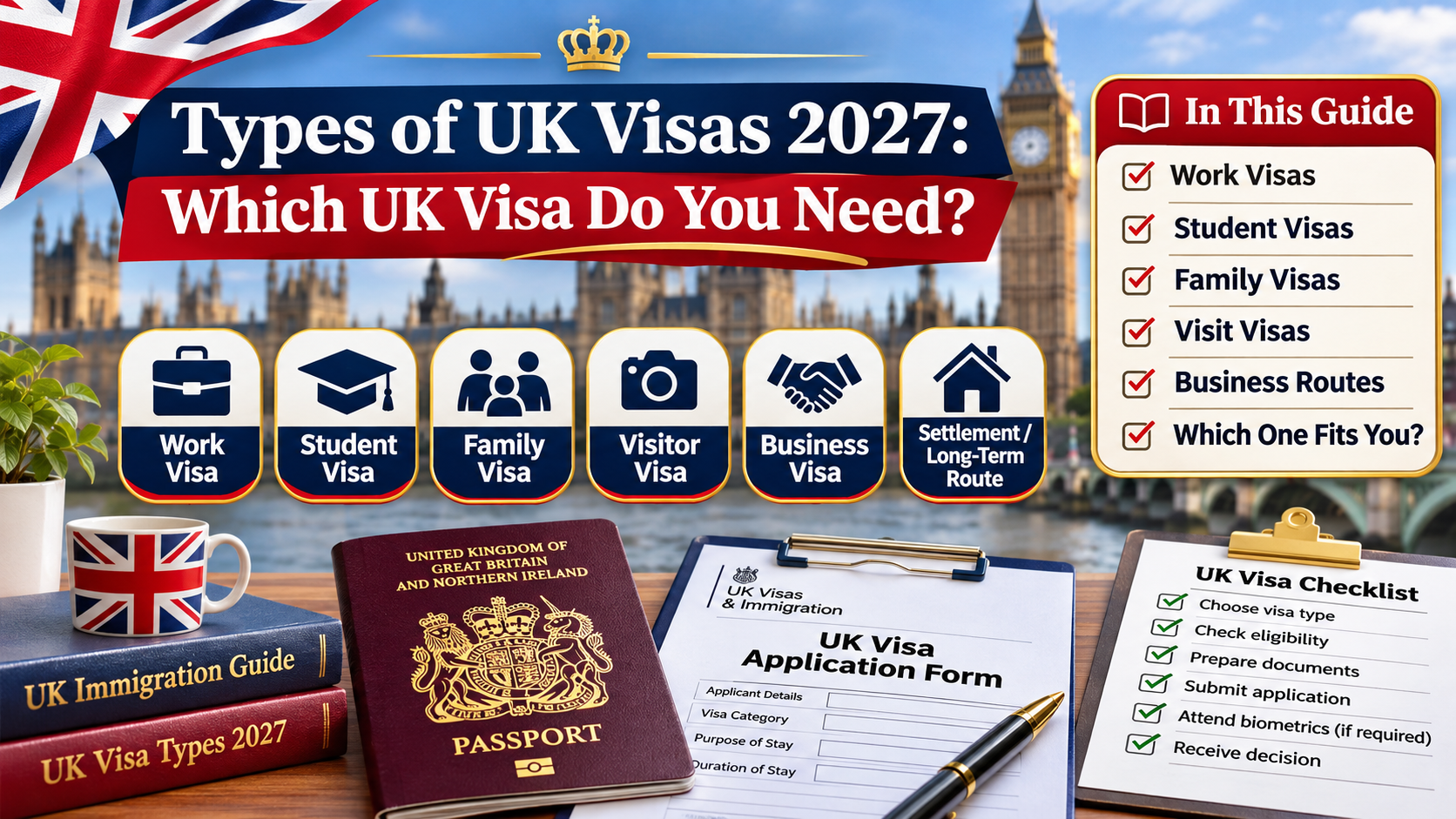
Choosing the right UK visa can be confusing because there is no single visa for everyone who wants to visit, work, study, join family or build a life in the United Kingdom. The UK immigration system contains different visa categories, each designed for a particular purpose and subject to its own eligibility rules.
The main types of UK visas include visitor visas, work visas, student visas, family visas and business routes. Some immigration routes can eventually lead to Indefinite Leave to Remain (ILR), while others are strictly temporary and do not provide a direct path to settlement.
The right route therefore depends on much more than how long you want to stay. Your nationality, reason for coming to the UK, family circumstances, qualifications, finances, sponsorship arrangements and long-term plans can all affect which visa is appropriate.
This guide explains the main UK visa types for 2027, their purposes, important requirements and how to identify the route that best matches your circumstances.
What Are the Main Types of UK Visas?
UK visas can broadly be grouped according to why a person wants to enter or remain in the country.
| UK Visa Category | Main Purpose | Examples | Can It Lead to Settlement? |
|---|---|---|---|
| Visitor visas | Tourism, family visits and permitted short-term activities | Standard Visitor, Marriage Visitor | No |
| Work visas | Employment and professional activities | Health and Care Worker, Global Talent, HPI, Scale-up | Some routes can |
| Student visas | Education in the UK | Student, Child Student | Not directly |
| Family visas | Living with qualifying family members | Spouse, Partner, Fiancé, Parent, Child | Some routes can |
| Business routes | Establishing or developing qualifying businesses | Innovator Founder | Some routes can |
| Ancestry route | Living and working based on qualifying UK ancestry | UK Ancestry | Yes, if requirements are met |
| Settlement | Permanent residence after qualifying residence | Indefinite Leave to Remain | Permanent status |
This distinction matters because the United Kingdom visa types have very different conditions. A route suitable for a six-month holiday, for example, would not normally be suitable for someone whose actual intention is to establish permanent family life in the UK.
UK Visitor Visas
Visitor routes are designed primarily for temporary stays.
The Standard Visitor route can cover tourism, visiting friends or family, certain permitted business activities, short periods of study and other approved activities. A Standard Visitor can usually remain in the UK for up to six months, although limited exceptions allow longer stays.
Standard Visitor Visa
The Standard Visitor route may be appropriate if you want to come to the UK for purposes such as:
- Tourism or a holiday
- Visiting family or friends
- Certain business activities, such as attending meetings or interviews
- Short-term study
- Medical treatment
- Certain academic activities
- Permitted paid engagements
- Transit in appropriate circumstances
A visitor generally cannot use this route to take ordinary paid or unpaid employment for a UK company, make the UK their main home through repeated visits, or access public funds.
Not every traveller needs a Standard Visitor Visa before travelling. Depending on nationality and circumstances, a person may instead need an Electronic Travel Authorisation (ETA), or may have different entry arrangements.
What Are the British Tourist Visa Requirements?
People searching for British tourist visa requirements or British travel visa requirements are generally looking for the rules governing a visit to the UK.
Where a Standard Visitor Visa is required, the applicant must satisfy the visitor requirements. Among other matters, they should be able to demonstrate that they are a genuine visitor, intend to leave at the end of their visit and can support themselves during the trip.
Evidence may include information relating to:
- The purpose and planned duration of the visit
- Personal financial circumstances
- Accommodation
- Funding for the trip
- Return or onward travel
- Employment, studies, business or other circumstances in the country of residence
- Any person funding the visit
The exact documents needed depend on the individual circumstances rather than a universal checklist that applies identically to every visitor.
Is There a Minimum Bank Balance Required for a UK Visitor Visa?
There is no single fixed minimum bank balance that every UK visitor must hold.
Instead, the applicant’s available funds should be credible in the context of the planned trip. UKVI may consider the expected cost of the visit, the applicant’s income and commitments, the length of the stay and whether another person is legitimately funding some or all of the trip.
Simply depositing a large sum of money shortly before applying does not automatically establish that the financial requirement is satisfied. The source and credibility of funds can also matter.
Marriage Visitor Visa
A Marriage Visitor Visa is intended for someone coming to the UK to marry, form a civil partnership or give notice of a marriage or civil partnership, without intending to settle in the UK through that visit.
It is fundamentally different from a family route intended for a person who plans to remain in the UK with their partner.
A Marriage Visitor will normally need to show that the relationship and proposed marriage or civil partnership are genuine, that the permitted activity will take place during the visit and that they intend to leave the UK afterwards.
Someone planning to marry in the UK and then make the UK their home should therefore check the appropriate family immigration route rather than assuming a Marriage Visitor Visa will achieve that objective.
UK Work Visas
The UK has several work-related immigration routes for people with different professional backgrounds and circumstances. Some require sponsorship or endorsement, while others are available without a conventional job offer.
The correct route depends on factors such as the applicant’s profession, qualifications, employer, proposed activities and long-term plans.
Health and Care Worker Visa
The Health and Care Worker route is available to eligible medical and health or adult social care professionals undertaking qualifying employment.
Applicants must meet the requirements applicable to the route, including having qualifying employment and the required sponsorship. English-language and other eligibility requirements also apply.
Where the relevant conditions continue to be met, the route can provide a pathway towards settlement.
Global Talent Visa
The Global Talent Visa is aimed at leaders and potential leaders in qualifying fields, including:
- Academia or research
- Arts and culture
- Digital technology
Depending on the applicant’s circumstances, an endorsement may be required. Certain holders of eligible prestigious prizes can apply without first obtaining an endorsement.
One significant advantage of this route is its flexibility. Successful applicants can work in the UK without being tied to a conventional sponsored position, and qualifying applicants may eventually become eligible for ILR.
High Potential Individual Visa
The High Potential Individual Visa, commonly called the HPI Visa, is designed for recent graduates of eligible leading universities outside the UK.
To qualify, the applicant must generally have received an eligible overseas degree-level qualification from a university appearing on the relevant Global Universities List for the year in which the qualification was awarded.
The qualification must normally have been awarded within the five years before the application. Applicants must also satisfy the English-language and financial requirements.
Importantly, a job offer is not required.
The HPI Visa normally provides permission for two years, or three years where the qualifying degree is a PhD or other doctoral-level qualification.
However, it is not itself a route to settlement. Someone who wants to remain in the UK longer would need to qualify for and switch to another appropriate immigration category before their HPI permission expires.
Scale-up Visa
The Scale-up route is designed for eligible workers recruited by qualifying high-growth UK businesses.
It differs from many traditional sponsored arrangements because, after the initial sponsored period and subject to the immigration conditions, the holder can have greater employment flexibility.
The route has its own requirements concerning employment, sponsorship, salary and English-language ability. Qualifying residence on the route can potentially lead to settlement.
Global Business Mobility Visas
Global Business Mobility covers several routes intended primarily for overseas businesses sending workers to the UK for qualifying commercial purposes.
These include:
- Senior or Specialist Worker
- Graduate Trainee
- UK Expansion Worker
- Service Supplier
- Secondment Worker
These routes serve different business situations and should not be treated as interchangeable. They also differ in areas such as sponsorship, eligibility, permitted length of stay and settlement prospects.
Temporary Work Visas
The UK’s temporary work categories include routes for specific types of short-term activity, including:
- Seasonal Worker
- Creative Worker
- Charity Worker
- Religious Worker
- Government Authorised Exchange
- International Agreement
These are purpose-specific routes and are generally unsuitable for someone whose circumstances do not fit the particular temporary work category.
Youth Mobility Scheme Visa
The Youth Mobility Scheme provides eligible young people from participating countries and territories with an opportunity to live and work in the UK for a limited period.
Eligibility depends on factors including nationality and age. Unlike many employer-based work routes, applicants do not normally need a UK employer to sponsor their application.
International Sportsperson Visa
The International Sportsperson route is intended for elite sportspeople and qualified sports coaches who meet the relevant requirements.
The applicant normally requires endorsement from the appropriate sports governing body as well as sponsorship for the role.
UK Student Visas
People coming to the UK primarily for education may need a Student Visa or another study-related route depending on their age, course and length of study.
Student Visa
A Student Visa may be available to a person aged 16 or over who has been offered a place on an eligible course by a licensed student sponsor.
Applicants generally need to satisfy requirements relating to:
- An eligible course and education provider
- A valid Confirmation of Acceptance for Studies where required
- Financial resources
- English-language ability
- Parental consent where relevant for applicants aged 16 or 17
The conditions attached to a Student Visa depend on the applicant and course. Permission to work is restricted and should be checked carefully rather than assuming all international students have the same work rights.
Child Student Visa
The Child Student Visa is available to children aged between 4 and 17 who want to study at an independent school in the UK and meet the relevant requirements.
The applicant needs an unconditional offer from a licensed Child Student sponsor, suitable living arrangements, sufficient funds and parental or legal guardian consent.
What Can You Do After a UK Student Visa?
Completing a course does not automatically give an international student permanent residence.
Eligible graduates may be able to apply for the Graduate route after successfully completing an eligible UK course. The Graduate route permits eligible graduates to remain in the UK temporarily to work or look for work.
However, the Graduate route itself is not a settlement route. Anyone planning long-term residence should consider whether they can later qualify for another immigration category that supports their longer-term objectives.
UK Family Visas
Family visas allow eligible people to live in the UK with certain qualifying family members for more than six months.
Depending on the circumstances, an application may be made on the basis of a relationship with a spouse or partner, fiancé or proposed civil partner, child, parent or qualifying relative requiring long-term care.
UK Spouse Visa
A Spouse Visa may be appropriate where an applicant is married to or in a recognised civil partnership with a qualifying partner in the UK.
Applicants generally need to establish a genuine qualifying relationship and satisfy the applicable financial, English-language and other requirements.
For many applicants, this is a long-term family route capable of leading to ILR after the relevant qualifying residence requirements have been met.
Unmarried Partner Visa
Marriage is not always required to qualify under the partner route.
An applicant may potentially qualify as an unmarried partner where the relationship satisfies the Immigration Rules. Evidence of the genuine and subsisting nature of the relationship is important.
The requirements should be assessed against the applicant’s actual circumstances rather than assuming that a marriage certificate is the only way to qualify as a partner.
UK Fiancé Visa
A fiancé, fiancée or proposed civil partner may be able to apply to come to the UK where they intend to marry or enter into a civil partnership within six months of arrival.
This permission is different from being granted leave as a spouse or partner. A person granted permission as a fiancé or proposed civil partner cannot normally work or study during that initial period.
After the marriage or civil partnership, a further application is normally required to remain under the partner route.
Parent Visa
A family application may also be possible on the basis of a qualifying relationship with a child in the UK.
The rules can involve the child’s immigration or citizenship status, age, where the child lives, parental responsibility and the applicant’s involvement in the child’s upbringing.
Parent applications can become legally complex, particularly where there are unusual family arrangements or human-rights considerations.
Child Visa
Children may be eligible to join or remain with qualifying parents in the UK.
The relevant requirements depend on matters including the child’s age, dependency, where the parents live and the immigration status of the parents.
Adult Dependent Relative Visa
The Adult Dependent Relative route applies in limited circumstances where an adult needs long-term personal care because of age, illness or disability and seeks to join a qualifying relative in the UK.
Among other requirements, the applicant normally needs to establish that the required level of care is unavailable or unaffordable in the country where they live and that the UK relative can provide the necessary maintenance, accommodation and care.
This is a demanding immigration category and should not be confused with an ordinary family visit.
UK Business Visas
The UK’s business immigration system has changed significantly over time. Some routes frequently mentioned in older articles are no longer open to new applicants.
Innovator Founder Visa
The Innovator Founder Visa is designed for eligible entrepreneurs who want to establish and operate an innovative business in the UK.
The business proposal must meet the required standards and receive endorsement from an approved endorsing body.
A qualifying business idea must be:
- New
- Innovative
- Viable
- Scalable
Applicants must also satisfy other requirements, including the relevant English-language and financial requirements.
Permission is normally granted for three years. An Innovator Founder may potentially qualify for settlement after three years if the settlement requirements are satisfied.
Are the Investor and Entrepreneur Visas Still Available?
The old Tier 1 Investor and Tier 1 Entrepreneur routes are closed to new applicants.
The Start-up route is also closed to new applications.
This is important because older immigration websites and search results can still refer to these categories. Applicants should not assume that a route remains open simply because an old article describes it.
UK Ancestry Visa
The UK Ancestry Visa is available to certain Commonwealth citizens and specified categories of British nationality, as well as citizens of Zimbabwe, who meet the ancestry and other eligibility requirements.
A key requirement is generally proving that at least one grandparent was born in the UK, the Channel Islands or the Isle of Man.
The route permits work and study and normally provides five years of permission.
After five years, an eligible holder may be able to extend their visa or apply for Indefinite Leave to Remain.
Other UK Visa and Immigration Routes
Not everyone fits neatly into the main visitor, work, student, family or business categories.
Other immigration routes and statuses include, depending on eligibility:
- British National (Overseas) route
- EU Settlement Scheme family permits
- Overseas Domestic Worker route
- Minister of Religion route
- Specialist temporary work routes
- Immigration routes based on protection or other particular circumstances
It is important to distinguish between a visa, permission to stay, settlement and other forms of UK immigration status. They are not interchangeable terms.
UK Settlement and Indefinite Leave to Remain
Indefinite Leave to Remain, commonly known as ILR, is a form of permanent immigration status.
A person with ILR is no longer subject to the same time limit on their stay as someone holding temporary immigration permission.
However, there is no universal rule that every UK visa leads to ILR after the same period.
Which UK Visa Types Can Lead to Settlement?
| Immigration Route | Direct Settlement Potential? |
|---|---|
| Spouse/Partner route | Yes, subject to the qualifying route and requirements |
| Global Talent | Yes |
| Innovator Founder | Yes |
| UK Ancestry | Yes |
| Health and Care Worker | Can lead to settlement |
| Scale-up | Can lead to settlement |
| High Potential Individual | No direct settlement route |
| Student | No direct settlement route |
| Graduate | No direct settlement route |
| Visitor | No |
The qualifying period and conditions differ between routes. Applicants planning to make the UK their permanent home should therefore consider settlement prospects before choosing an immigration route rather than waiting until their temporary permission is close to expiring.
Which UK Visa Is Right for You?
There is no single “best UK visa”. The appropriate option depends on what you actually intend to do.
If you want to visit the UK:
A Standard Visitor Visa or another visitor route may be appropriate, depending on your nationality and purpose.
If you want to marry in the UK and then leave:
Consider whether the Marriage Visitor route matches your circumstances.
If you want to marry and build family life in the UK:
A family route may be more appropriate than a Marriage Visitor Visa.
If you want to work in health or adult social care:
Check whether you qualify under the Health and Care Worker route.
If you are an eligible recent graduate from a leading overseas university:
The High Potential Individual Visa may allow you to work or look for work without first obtaining a job offer.
If you are a leader or potential leader in an eligible professional field:
The Global Talent route may be relevant.
If you want to study in the UK:
A Student or Child Student Visa may apply depending on your age and course.
If you want to live with your spouse, partner, child or parent:
Check the relevant family immigration rules.
If you want to establish an innovative UK business:
Consider whether your business and personal circumstances meet the Innovator Founder requirements.
If you have a qualifying UK-born grandparent:
The UK Ancestry route may be worth considering.
The correct question is therefore not simply “Which visa is best for the UK?” It is “Which visa legally matches my purpose, circumstances and long-term plans?”
What Are the UK Visa Requirements?
There is no universal set of UK visa requirements that applies identically to every applicant.
Each route has its own Immigration Rules. However, applications commonly involve one or more of the following areas.
Passport and Identity Requirements
Applicants normally need to establish their identity and nationality using an appropriate passport or other accepted travel document.
The way identity is verified can depend on the application route and individual circumstances.
Financial Requirements
Some immigration routes require applicants to demonstrate specified funds, income or financial support.
The amount and method of proving finances vary significantly. A financial rule applying to one visa should not automatically be applied to another.
English Language Requirements
English language requirements apply to several UK immigration categories, but not every visa has the same requirement.
Where English is required, the necessary level and permitted methods of proving ability depend on the particular route and application stage. Some applicants may also qualify for exemptions.
Sponsorship Requirements
Certain immigration categories require sponsorship by an approved employer, educational institution or another qualifying organisation.
Other routes, including the HPI route, do not require a conventional job offer or employer sponsor.
Relationship Requirements
Family applications may require extensive evidence of the relevant family relationship and, depending on the route, evidence that a relationship is genuine and subsisting.
Accommodation and Maintenance
Applicants under certain routes may need to demonstrate appropriate accommodation or sufficient financial resources to support themselves and eligible dependants.
Tuberculosis Testing
Applicants coming to the UK for more than six months from certain countries may need a tuberculosis test from an approved clinic, subject to the applicable rules and exemptions.
Suitability and Immigration History
Previous immigration breaches, criminality, deception and other suitability issues can affect an application.
The significance of a previous problem depends on the facts and the Immigration Rules applying to the particular application.
How to Apply for a UK Visa
The exact visa application for a UK visa varies by category, but most applications follow a broadly similar process.
1. Identify the Correct UK Visa
Start with your actual purpose for coming to or remaining in the UK.
Choosing an inappropriate route can create problems even if the supporting documents are otherwise strong.
2. Check the Eligibility Requirements
Read the current requirements for that specific immigration route rather than relying on a generic visa checklist.
3. Prepare Your Supporting Documents
Depending on the route, documents may relate to finances, employment, sponsorship, studies, relationships, accommodation, English-language ability or other eligibility criteria.
4. Complete the Online Application
Most UK visa applications are submitted online through the relevant GOV.UK application process.
5. Pay the Relevant Fees
Applicants normally pay the applicable visa application fee. Depending on the route, the Immigration Health Surcharge and other costs may also apply.
6. Verify Your Identity
The applicant may need to provide biometrics or verify their identity through the method specified during the application process.
7. Provide Supporting Evidence
Documents should support the requirements of the route and be consistent with the information provided in the application.
8. Wait for the UKVI Decision
Processing time depends on the visa category, whether the application was submitted inside or outside the UK, and whether additional checks are required.
How Much Are UK Visa Application Fees?
UK visa application fees vary substantially between immigration routes and can change.
The overall cost of an application can potentially include:
- Visa application fee
- Immigration Health Surcharge
- Fees for eligible dependants
- Priority or Super Priority service, where available
- English-language testing
- TB testing where required
- Document translation
- Endorsement or other route-specific costs
For example, the fee for a Standard Visitor Visa for up to six months is currently £135. Family visa fees are substantially higher, and some long-term immigration routes can also attract the Immigration Health Surcharge.
Because Home Office fees are periodically changed, applicants should check the current fee for their exact route immediately before applying rather than relying on an old article or screenshot.
How Long Does a UK Visa Application Take?
UK visa processing times depend on the application type and circumstances.
Factors can include:
- The immigration route
- Whether you apply inside or outside the UK
- When your identity and biometrics are completed
- Whether UKVI requests additional evidence
- Document verification
- Additional eligibility or suitability checks
- Availability of a faster decision service
Some applications made outside the UK have a published standard of around three weeks, while family and other routes can take considerably longer.
Applicants should check the current processing time for their exact visa category before making travel plans.
What Are the New UK Visa Rules for 2027?
There is no single set of “2027 UK visa rules” that replaces the entire immigration system on 1 January.
The Immigration Rules are amended throughout the year. Applicants planning to apply during 2027 should therefore check the rules that are actually in force on the relevant application date.
Changes may affect areas such as:
- Eligibility criteria
- Salary or financial requirements
- English-language requirements
- Application fees
- Sponsorship
- Dependants
- Digital immigration status
- Settlement requirements
Be cautious with articles claiming that a future immigration change is already law when it has only been proposed or announced. The legal position should be checked against current Home Office rules and guidance before an application is submitted.
Which UK Visas Can Lead to British Citizenship?
A UK visa and British citizenship are not the same thing.
For many migrants, the journey may broadly look like:
Qualifying immigration route → qualifying residence → Indefinite Leave to Remain → British citizenship
However, the exact path and qualifying period depend on the person’s immigration history and circumstances.
Temporary routes such as Visitor, Student, Graduate and HPI do not themselves provide a direct route to settlement.
What Is the Fastest Way to Become a British Citizen?
There is no universally “fastest UK visa” that guarantees British citizenship.
Different immigration routes have different settlement periods, and becoming eligible for ILR does not automatically make a person a British citizen.
Nationality law has separate requirements. The applicant’s residence history, immigration status, absences and other circumstances can all matter.
Selecting an immigration route solely because it appears to offer a shorter theoretical path can be a serious mistake if the applicant does not genuinely meet its requirements.
How Much Money Do You Need to Become a UK Citizen?
British citizenship cannot simply be obtained by maintaining a particular bank balance.
Applicants need to meet the relevant legal requirements and pay the applicable application costs. Someone progressing from a temporary visa to settlement and then citizenship may also have paid substantial immigration fees during earlier stages.
Those costs should not be confused with a supposed minimum wealth requirement for citizenship.
What Is the Current Waiting Time for UK Citizenship?
Citizenship applications have their own decision process and should not be confused with UK visa processing times.
Applicants should check the current Home Office nationality guidance and service standards when they are ready to apply because processing periods and procedures can change.
How Can Our Immigration Solicitors Help You Choose the Right UK Visa?
Choosing the wrong immigration route can result in unnecessary costs, delays and, in some circumstances, refusal.
At UK Immigration Solicitors, we can assess your circumstances and help determine which immigration option is appropriate for your objectives.
Our immigration solicitors can assist with:
- Identifying an appropriate UK immigration route
- Assessing eligibility before an application is submitted
- Reviewing visa requirements
- Preparing supporting evidence
- Family and relationship applications
- Financial and English-language requirements
- Extensions and switching applications
- Long-term settlement planning
- Applications involving previous immigration problems
- Responding to visa refusals and complex cases
The best immigration route is not necessarily the one that sounds easiest. It is the route whose legal requirements match your circumstances and objectives.
Book a Free Online Assessment to discuss your circumstances with our immigration team.
Types of UK Visas FAQs
What’s the Easiest UK Visa to Get?
There is no universally easiest UK visa. A visa may be straightforward for someone who clearly meets all of its requirements but completely unsuitable for another applicant. Your purpose for coming to the UK and your individual eligibility should determine the route you choose.
Which Visa Is Best for the UK?
There is no single best UK visa. A visitor, international student, entrepreneur, professional and person joining a spouse all have different immigration needs. The best route is the one that legally matches your circumstances and longer-term plans.
How Many Types of UK Visas Are There?
The UK immigration system contains several broad categories and numerous individual routes within them. Rather than relying on a fixed number, it is more useful to divide the system into visitor, work, study, family, business and other specialist immigration routes.
Do All UK Visas Require an English Language Test?
No. English-language requirements depend on the visa category. Even where an English requirement applies, an applicant may be able to demonstrate their ability in different approved ways or may qualify for an exemption.
Do All UK Visas Require Sponsorship?
No. Some routes require sponsorship, while others do not. For example, the High Potential Individual route does not require a job offer, although it has its own strict eligibility requirements.
Can I Switch From One UK Visa to Another?
Some people can switch immigration categories from within the UK, but switching is not permitted from every route into every other route. The rules of the intended visa and the applicant’s current immigration status must be checked before applying.
Which UK Visas Allow Dependants?
Several long-term routes allow eligible partners and children to apply as dependants, but the rules differ by category and exceptions apply. Never assume that dependant rights under one route automatically apply to another.
Which UK Visas Lead to Permanent Residence?
Several family, work, talent, business and ancestry routes can potentially lead to Indefinite Leave to Remain once the relevant qualifying requirements are met. Visitor, Student, Graduate and High Potential Individual permission do not provide a direct settlement route.
Can You Work in the UK on a Visitor Visa?
A Standard Visitor cannot normally take ordinary paid or unpaid employment for a UK company or work as a self-employed person. Specific permitted activities and limited permitted paid engagements exist, but a visitor should not use the route as a substitute for appropriate work permission.
Is There a Minimum Bank Balance for a UK Visa?
There is no single minimum bank balance covering every type of UK visa. Financial requirements depend on the immigration route. Some routes specify an amount that must be held in accordance with particular rules, while others assess whether the applicant has sufficient funds for the circumstances.