
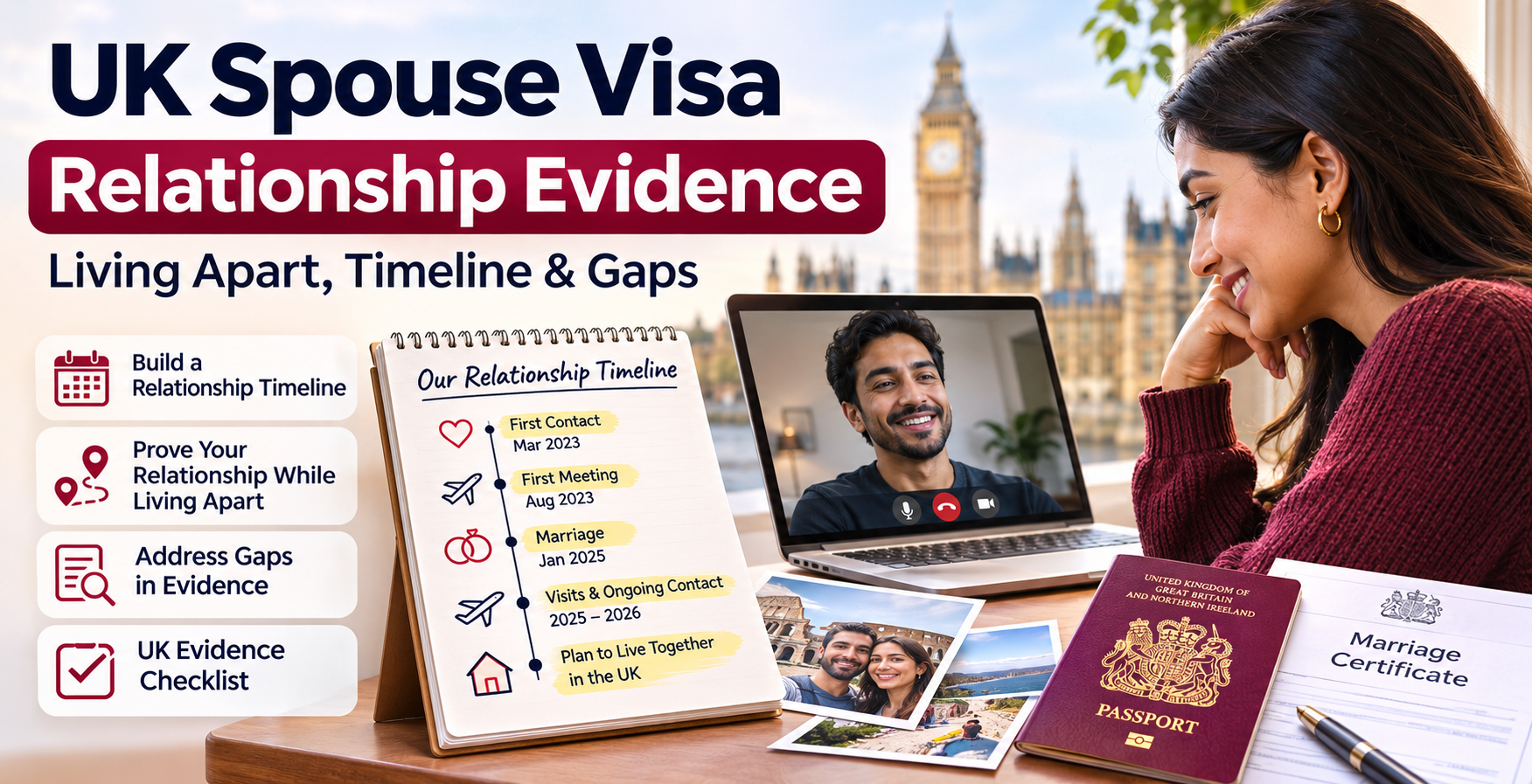
Living apart does not automatically prevent a UK spouse visa application. The evidence needs to explain your circumstances and demonstrate your continuing commitment to each other. GOV.UK recognises that couples may be unable to live together and provides examples of evidence they can submit.
The challenge is deciding what to include. You may have no joint bills, missing messages or long periods between visits. Rather than uploading everything available, build a clear account of your relationship and connect it with relevant documents.
This guide explains how to prepare spouse visa relationship evidence, create a worked timeline and address gaps honestly before applying.
What must your spouse visa relationship evidence show?
Under Appendix FM, the relevant relationship requirements include having met in person, being in a genuine and continuing relationship, and intending to live together permanently in the UK. A marriage or civil partnership relied upon must be valid, and relevant previous relationships must have ended permanently, subject to the rules’ provisions.
“Genuine and subsisting” means that the relationship is real and continues. Your account should therefore explain both how it began and what your life together looks like now.
A marriage certificate establishes the marriage relied upon. It does not explain everything that has happened since the ceremony.
Start with the facts you need to communicate: when you met, when you married, where each person lives, why you are apart and how you intend to establish your shared home.
This guide addresses relationship evidence. For the wider application, read our UK spouse visa requirements guide.
Does the evidence differ for first applications and extensions?
Use your application stage to decide which period and circumstances need the most attention.
First spouse application from overseas
Build a chronology covering the relationship’s development, marriage, visits and contact during separation. Explain the proposed UK living arrangements without suggesting that you already share a home when you do not.
Avoid concentrating the entire file on the wedding. Include relevant information about what happened before and afterwards.
Spouse visa extension
For relevant partner extensions, the rules require evidence of living together since the specified partner grant, or a good reason for periods apart that remains consistent with the intention to live together permanently in the UK.
Prepare an address history covering the relevant period. Identify moves, temporary absences and changes in your household.
Our spouse visa extension guidance explains the wider application and assistance available.
Unmarried partner application
Unmarried partners must establish a relationship similar to marriage or civil partnership lasting at least two years before applying. That does not invariably require two years of cohabitation. Do not confuse this with a requirement for spouses to have been married for two years.
UK spouse visa relationship evidence checklist
Use this as a starting point, not a compulsory shopping list. Select evidence that reflects your circumstances and follow the instructions for your application.
| Evidence area | Documents to consider | Question to address |
|---|---|---|
| Marriage or civil partnership | Relevant certificate and translation | What legal relationship is relied upon? |
| Previous marriage or partnership | Applicable divorce, dissolution or death records | How did the previous relationship end? |
| Shared address | Tenancy, Council Tax, bank or medical records | Where and when did you live together? |
| Continuing commitment | Relevant communication, support and parenting records | How has your relationship continued? |
| Time spent together | Travel records and selected photographs | Which meetings or visits support the chronology? |
| Shared-home plans | Relevant accommodation records and explanations | Where do you intend to live together? |
GOV.UK identifies official household records and evidence of ongoing commitment as useful examples. Separate rules address the evidence of marriage, civil partnership, divorce and dissolution.
Which evidence carries more weight?
Home Office guidance generally gives greater weight to official records such as tenancy agreements and bank statements than to photographs or message transcripts. This is an assessment framework, not a points system or guarantee of approval.
For each document, ask: What does this establish, which period does it cover, and does it agree with the application?
How can you prove your relationship when living apart?
Explain the reason for separate homes
State where each partner lives, when the separation began and why it continues.
Be specific. Instead of writing “we cannot live together”, explain the actual circumstances: your current immigration arrangements, work or study commitments, caring responsibilities, or other relevant factors.
Where a document supports the explanation, identify it. For example, a temporary work assignment letter may help explain dates, but it should not be presented as proving the whole relationship.
Show how you maintain your relationship
Describe your actual routine and connect it with available records.
You might explain how you communicate, make decisions together, arrange visits or share responsibilities. Where one partner provides financial support, identify what the payments relate to rather than submitting unexplained transfers.
Do not create transactions or commitments simply to make the evidence appear more conventional.
Keep visits and cohabitation distinct
Describe a visit as a visit. Staying together during a holiday is not the same account as establishing a permanent shared household.
Likewise, distinguish your proposed UK home from your present address. Use the same explanation in the form, relationship timeline and sponsor’s statement.
Recent or arranged marriages
Explain how the relationship developed in its cultural and family context. Home Office guidance recognises cultural differences and does not make premarital cohabitation a prerequisite.
There is no need to invent a longer dating history. Present the real chronology and explain the relationship as it stands today.
Worked relationship timeline for a couple living apart
This is a fictional example, not a client case, complete checklist or prediction of approval.
Maya is a British sponsor living in the UK. Her husband, Karim, lives overseas. They are preparing an initial spouse visa application and have lived apart between visits.
They begin with a timeline, then allocate references to the documents supporting it.
| Date or period | What happened | Evidence reference and checking point |
|---|---|---|
| 15 March 2023 | They first communicated online. | R1: Available early messages. This is first contact, not the first meeting in person. |
| 8–22 August 2023 | Maya visited Karim’s country. They first met on 10 August. | R2–R3: Travel records and dated photographs. The meeting falls within the visit. |
| 14–28 January 2025 | Maya visited again. They married on 18 January. | R4–R5: Marriage certificate, translation and visit records. Names and dates agree with the form. |
| From 29 January 2025 | They resumed living in separate countries. | R6: Selected communication records and their explanation of the living arrangements. |
| April–June 2025 | Some saved chats became unavailable after Maya replaced her phone. | R7: Available emails, retained records and an explanation of the missing material. |
| 6–20 July 2026 | Maya made another visit. | R8: Travel records and relevant photographs. This visit is distinguished from permanent cohabitation. |
| Application preparation | They confirmed their proposed UK living arrangements. | R9: Relevant accommodation records. The address matches the application. |
Check the dates without forcing them to be identical
Maya arrived on 8 August 2023, but the couple first met on 10 August. Both dates can be correct.
Similarly, their marriage certificate may have an issue date different from the wedding date. Their explanation should identify what each date represents.
The aim is consistency of meaning, not making every document display the same date.
Identify the limits of each document
A flight booking records a booking. Check what other retained records show about the journey actually taken.
A photograph illustrates a particular moment. Add an accurate caption, but do not use it to claim continuous cohabitation throughout a much longer period.
Check the current position
Before submitting, Maya and Karim review what has happened since the July visit. They add relevant current information rather than leaving the chronology several months behind the application.
They also check that every reference in the timeline leads to an included document.
Use this method to organise your own circumstancesm, not to copy another couple’s dates, visits or explanations.
What should you do about gaps in relationship evidence?
A gap in saved documents is not necessarily a gap in the relationship. An actual relationship break is a different issue and should not be described as lost paperwork.
First identify exactly what is missing.
| Type of gap | What to investigate |
|---|---|
| Deleted or unavailable messages | The affected dates, why the records are missing and whether either partner retained alternatives. |
| No shared-address documents | Whether you lived apart, lived with relatives or held household accounts separately. |
| A long interval between visits | The reason and what records explain the relationship during that period. |
| An actual separation or reconciliation | The true chronology and whether the current application needs a legal reassessment. |
Look for genuine alternatives
Check existing email accounts, saved attachments, the other partner’s records and relevant archives.
Only use an alternative where it helps establish the point in question. An unrelated purchase made during the missing period does not become relationship evidence merely because its date is convenient.
Do not recreate conversations or backdate statements. Explain what is unavailable and what can still be verified.
Explain the gap precisely
In the fictional example, Maya might write:
Some WhatsApp conversations from April to June 2025 are unavailable after I replaced my phone. Karim and I remained in contact during that period. At R7, we have included the relevant emails and other records we still hold. We have not recreated the missing chats.
This is an illustration of how to structure an explanation, not wording to copy unless it accurately describes your circumstances.
The explanation identifies the missing material, the period and the supporting reference. It does not claim that the alternative records are identical to the lost messages.
Do not assume missing evidence will be requested later
Home Office guidance allows case-specific consideration where evidence cannot be supplied, but that is not a promise that every omission will be excused or followed by a request for more documents.
Where the missing information affects a central part of your account, obtain advice before submitting.
Unsure whether a gap needs an explanation or more evidence? Ask UK Immigration Solicitors about reviewing the relationship evidence as part of your application preparation.
How can you show a shared address without joint bills?
Documents do not always need to be jointly addressed. GOV.UK includes bank statements and medical correspondence confirming the same address among its examples.
Create a simple address schedule showing where each partner lived and the dates covered by the available records.
For example, one partner’s bank statement and the other’s medical letter may provide information about the same address. Check the dates carefully rather than assuming that matching addresses establish the entire period.
Living with parents or relatives
Explain who owns or rents the home, who lives there and which accounts are in someone else’s name.
Ask the relevant person to describe the actual arrangement, then identify any independent records supporting your residence. A statement that you lived at an address serves a different purpose from someone saying they believe your relationship is genuine.
Do not describe a household as shared if only one partner actually lived there. Equally, do not open a new joint account and present it as evidence of years of earlier cohabitation.
How should you present photographs, messages and call records?
Choose material with a clear purpose
Select records that illustrate relevant events and periods. Avoid repeating dozens of nearly identical screenshots while leaving a significant period unexplained.
For photographs, use brief, factual captions stating who is pictured, where and when. Mark an approximate date as approximate rather than inventing precision.
Make communication records understandable
Identify the participants and retain enough context to explain the exchange. A saved contact name such as “My Love” may need a separate explanation connecting it with the person concerned.
Keep dates visible. Distinguish the date of the conversation from the date you exported or printed it.
Protect privacy without changing the meaning
Avoid unnecessary intimate material. Select relevant content, retain the originals and do not edit a conversation to create a misleading impression.
Discuss any necessary redactions with your adviser, particularly where removing information could make the evidence harder to understand.
Treat screenshots as supporting material, not as a substitute for explaining your circumstances.
How much relationship evidence should you provide?
Aim for relevant coverage, not the largest possible file.
Follow the instructions for your application. GOV.UK explains that additional documents depend on individual circumstances and that applicants are told how to provide them during the process.
Review the file against your timeline. Does it address the important events, periods apart, changes of address and current position?
Use older records for the historical events they establish, then consider what shows the relationship continues. Do not rely entirely on wedding photographs from several years ago while leaving your present circumstances unexplained.
There is no useful reason to add a document merely to increase the page count. Equally, do not remove necessary evidence to fit an arbitrary page target found online.
Should you include a relationship statement or sponsor letter?
Consider a concise statement where it helps connect the documents, explain periods apart or address a discrepancy.
Organise it around the points requiring context. State what happened, identify the relevant dates and refer to the supporting evidence.
Avoid copying a romantic narrative that does not describe your relationship. A statement should make the file easier to understand, not introduce a second version of the facts.
Our spouse visa sponsor letter sample includes a worked example and checks connecting the letter with the application evidence.
Before signing, both partners should review their own accounts against the same chronology. Correct mistakes rather than leaving different dates unexplained.
How should you organise and check the documents?
Create a clear evidence index
Group records by purpose and use descriptive filenames. Identify the period each document covers.
Keep an outstanding-items list showing what is missing, who may hold it and what action you are taking.
Check names, dates and addresses
Compare the form, timeline, statements and documents side by side.
Explain name changes or different spellings where relevant. Distinguish event dates from document-issue dates and tenancy commencement from the actual moving-in date.
If an official record contains an error, seek correction through the appropriate source rather than editing the document yourself.
Prepare readable files and translations
GOV.UK requires certified translations of documents that are not in English or Welsh. Keep each translation connected with its original.
For specified documents, the rules set requirements concerning the translation’s accuracy confirmation, date, translator’s identity and contact details, with additional certification provisions for in-country applications.
Check legibility, complete pages and the upload instructions. Retain a copy of the final application and everything submitted.
Spouse visa relationship evidence FAQs
Can we apply if we have never lived together?
Potentially. Premarital cohabitation is not a prerequisite for a spouse application, but the relationship requirements still need to be met. Unmarried-partner applications require a separate assessment of the qualifying relationship history.
Explain your actual living arrangements rather than trying to make them resemble another couple’s application.
Is a marriage certificate enough?
Do not assume it answers every relationship question. The certificate records the marriage; the application also concerns whether the relationship is genuine and continuing.
Check what needs explaining about your circumstances since the wedding.
Do we need a joint bank account?
Do not open one solely to make your paperwork look conventional. Review the records that reflect how you actually live and manage responsibilities. Explain separate finances clearly and check the application-specific evidence requirements.
How many photographs or messages should we include?
Do not use a number from a generic checklist as an approval target. Select material that helps explain the timeline, avoid unnecessary duplication and follow any specific instructions you receive.
What if WhatsApp messages have been deleted?
Identify the affected period, explain the loss and check whether either partner holds genuine alternatives. Do not reconstruct conversations. The explanation should distinguish missing saved records from a period when contact actually stopped.
What if we have not visited recently?
Explain the circumstances and review what demonstrates your continuing relationship during that period. Do not conceal the interval or describe cancelled travel as a completed visit. Seek advice where the explanation or evidence is uncertain.
Can friends or relatives write supporting letters?
Focus on facts they can personally establish. Home Office guidance says a third party’s opinion that a relationship is genuine should not itself be given weight. A factual account of accommodation arrangements is a different matter.
Can we reuse evidence from an earlier application?
Review each item for relevance. Keep useful historical records, but check what needs updating. Compare the previous application with the current chronology and investigate discrepancies before submitting a new account.
Get help with relationship evidence and periods living apart
You do not need to finish the evidence file before asking for help.
UK Immigration Solicitors can examine relationship and supporting evidence, identify issues requiring attention and help prepare your spouse visa application. The assessment should connect your documents with your actual circumstances—not simply count photographs or messages.
Tell us whether you are preparing a first application or extension, where you and your partner live, and what concerns you most. Mention any missing records, previous refusal or approaching deadline.
Ask whether the proposed service covers a relationship-evidence assessment, wider eligibility advice, application preparation or a combination of these, and confirm the scope and fees before instructing us.
Call 020 3384 4389 or request a free initial assessment to discuss the support you need. The initial assessment is with our assessments team. A solicitor consultation and substantive legal advice are separate, chargeable services.
This article provides general information, not legal advice. Immigration requirements can change, and the appropriate evidence depends on your circumstances.